
Next President Should Be a Democratic Governor Says Kentucky’s Andy Beshear - Newsweek
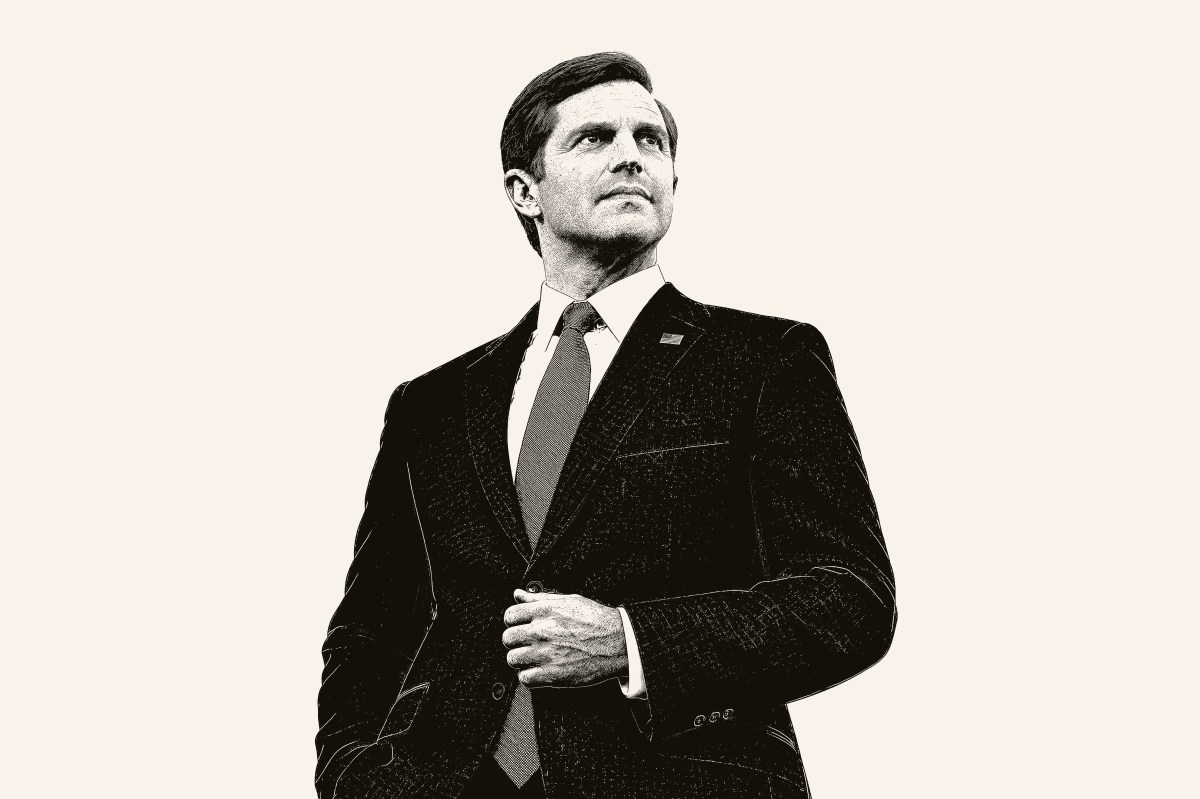
Considerable ink has been spilled this midterm cycle covering the Democratic Party’s civil war between progressives and centrists. But what’s been less covered, and may perhaps prove even more crucial in shaping the party’s future, is the divide between state lawmakers and federal ones.
Not since 1992 have Democrats nominated a president whose core political experiences took place in a governor’s mansion. That man was Arkansas Governor Bill Clinton, who leveraged his experience chairing the Democratic Governors Association to win in states previously deemed uncompetitive.
Since 2000 onward, the party has nominated U.S. senators. To many folks, a politician is a politician. But in the wake of Donald Trump overhauling Washington via the levers of executive power, some Democrats believe the moment requires a leader who can also act like a CEO. This person must do so in a way that heals rather divides the country, in which case, the thinking goes, red state merits would help. One of the leaders behind that line of thinking happens to be a red state governor himself. He also happens to chair the DGA.
His name is Andy Beshear, and he hails from the Commonwealth of Kentucky.
“I think our next nominee and the next president should be a Democratic governor,” Beshear told Newsweek during a 30-minute interview in Louisville on September 11. “I think Democratic governors should be the face of the Democratic Party because, with all due respect to senators and congressmen and women, they’re voting on the rule of the amendment of the something else [instead of practical governance].
“We need someone that can heal these divisions but, just as importantly, get stuff done, and get stuff done despite Donald Trump burning the federal government to the ground.”
It’s no secret that Beshear’s name is in the 2028 mix. His newly released memoir, Go and Do Likewise: How We Heal a Broken Country, is about how faith informs his worldview and can heal politics. But even before he announced his book and before he was shortlisted as Kamala Harris’ potential vice presidential running mate in 2024, Beshear was deemed a rising star. After all, it’s not every day a Kentucky Democrat carries a 65 percent approval rating.
Beshear did not confirm his intention to run when asked, but said he’d decide when his term as chair of the DGA ends, in December. Newsweek noted that Beshear’s ideal candidate resembled someone with his resume and asked how Beshear would lead if he were the party’s standard bearer.
To this, Beshear spoke about not seeing individuals in Kentucky as Democrat or Republican before going on to state: “I think it’s going to be really important for the next president and the next Democratic nominee to run a campaign that, yes, turns people out, but you’ve got to go where people haven’t otherwise gone. Because that’s not just so that you’re a good candidate; it’s so that you would be a good president.”
Therein lies the question for Beshear. While he did face a relatively competitive primary for governor in 2019, most of his electoral experiences have played out in the general, and much of his politicking has played out in a ruby red atmosphere. Political observers agree that he would be a very formidable threat to Vice President JD Vance in a general election, but the major question is whether he can get there.
Race after race this primary cycle, Democrats have shown they want a fighter, from Illinois Lieutenant Governor Juliana Stratton to former Health and Human Services Secretary Xavier Becerra. Beshear, however, brands himself a unifier, an affable one at that. He hosts a friendly namesake podcast and receives rave reviews for his warmth and authenticity in a retail setting. However, going toe-to-toe on the debate stage with a Gavin Newsom, Jon Ossoff or Alexandria Ocasio-Cortez might be a different matter.
While Americans may want an affable unifier whose main focus is getting stuff done, it remains an open question whether Democrats want the same thing. In speaking with Beshear and those around him, Newsweek sought to determine whether a nice governor can become the standard bearer of today’s Democratic Party.
To understand Beshear requires an understanding of the environment from which he’s sprung. His father, Steve Beshear, is a household name in the state. Multiple people described the elder Beshear as a highly skilled politician who was both a notable executive and leader of the state party. He also posted a 61 percent approval rate upon leaving office. But before that, after serving as attorney general and lieutenant governor, he lost a 1987 primary for the governorship, then ultimately made a comeback in 2007, securing the role till 2015.
Andy Beshear, a graduate of the University of Virginia School of Law and a civil litigator, worked on his father’s 2007 campaign in his late 20s.
“I never thought about following in his footsteps, but what I did get to see is that government done right can really improve the lives of people,” Beshear said. “I’ll never forget, we’re in Lexington, we’re on an elevator in what we call the Big Blue Building, and a woman walks onto the elevator and bursts into tears, and she looks at my dad and she says, ‘I’m only alive today because of you.’”
Beshear explained that the woman had cancer and was kicked off her insurance, but later received treatments on account of Kentucky’s Affordable Care Act marketplace, which his father helped implement. “I got to see not just on the macro, but for that individual, what government done right really means.”
Beshear, a deacon in the Christian Church (Disciples of Christ), said his faith guides him to pursue a better world. Remembering the incident in the elevator and how public service can help achieve just that, Beshear ran unopposed in the 2015 race for Kentucky attorney general and ultimately went on to beat his Republican opponent 50.1 percent to 49.9 percent.
That same year, his father was term limited, and Tea Party conservative Matt Bevin—a businessman who’d previously lost a primary challenge to Senate Leader Mitch McConnell—won the race for governor. Bevin, who was arrested on September 3 after being held in contempt of court in an ongoing child support case, faced a low approval rating during his term. His clashes with state teachers and his combative rhetoric were liabilities.
In 2019, Bevin lost his reelection campaign, getting 48.8 percent of the vote to the younger Beshear’s 49.2 percent.
Eric Hyers, a Democratic strategist who hasn’t lost a general election since he began managing congressional and gubernatorial races in 2010, served as campaign manager for Beshear’s 2019 gubernatorial bid and his 2023 reelection campaign. As part of their strategy, Hyers said Beshear traveled across the state, going to deep red communities where Democrats are few and far between. The campaign implemented a strategy of deploying digital ads localized to each area that featured real community newspaper headlines touting Beshear’s accomplishments. It’s in that intimate, personal setting where Beshear thrives.
“His ability to communicate and distill Democratic values to folks who don’t normally vote for Democrats is the best I’ve ever seen,” Hyers told Newsweek. “He is himself, and he is very comfortable in his own skin and comfortable with who he is, and I think that comes across when he’s meeting with people.”
Though Beshear carries himself with the grace and professionalism of a natural politician, in his interview with Newsweek, he displayed a willingness to dive deep and bounce between topics in a way that highly scripted politicians don’t tend to possess. Hyers suggested it’s that authenticity and confidence in his understanding of right and wrong that has allowed Beshear to maintain his high approval rating, despite suing the Trump administration dozens of times and vetoing the Republican-controlled state legislature’s bills that sought to ban access to gender-affirming health care for transgender minors, restrict their bathroom use and bar trans girls from playing in female sports. Ultimately, the veto was overridden by the GOP legislature and passed into law.
The latter is a topic that Beshear allies note separates him from the governor who could perhaps prove his most challenging competitor in a Democratic primary, Newsom. On an episode of his podcast, Newsom told Charlie Kirk, six months before the conservative activist’s killing, that it is “deeply unfair” for trans girls to compete in female sports. Newsom has emerged as one of Trump’s chief provocateurs, often mimicking the president’s trademark trolling on social media. This is an area where Beshear drew contrast when asked how he feels about Newsom’s style.
“Trump is not attacking me every day, and so I don’t want to criticize [Newsom] for doing what he thinks helps California,” Beshear said. “I just think that by the time next year and the year after comes around, the American people are going to want to move past a lot of what we’ve seen from Donald Trump and hopefully move back to something more stable with adults in the room.” He added, “If people are looking for a Democratic version of Trump, I’m not their guy.”
While people may not want to see a continuation of Trump, his antics and style continue to draw attention. As for name recognition, there’s no doubt Newsom leads Beshear. To overcome that reality and sell his message of good-natured, pragmatic politics to Democratic primary voters, politicos believe Beshear’s campaign methods may prove more important than his campaign message.
When it comes to earning goodwill in the formal Democratic Party, there’s no position for an elected politician perhaps better poised to capitalize than that of DGA chair. While control of Congress may be the flashiest story of the midterm cycle, Democrats are within striking distance of controlling the majority of state governorships for the first time since the end of 2010.
More often than not, these governors are deeply tied to the state’s Democratic Party and the organizing apparatuses that interact with voters on the ground and turn them out for elections. Following Clinton’s tenure heading the DGA in 1988, the Arkansas governor emerged with an elevated national profile and expanded donor network. In turn, when he ran for president in 1992, Clinton received support from then DGA Chair, Hawaii Governor John D. Waihe’e III, with his “winning the West” campaign tour through California, Colorado, Montana, Nevada, Oregon, Washington and Wyoming. Clinton won each state in 1992, minus Wyoming.
“I just think governors have a natural advantage because they, frankly, just spend more time with the people of their state than with other politicians in Washington,” former Rhode Island Governor Gina Raimondo, who chaired the DGA when Beshear was running in 2019, told Newsweek. “[Democrats are] overly focused on Congress and president, but I think where most people interact with government is at the state level.”
As chair, Raimondo said Beshear was her “top priority.” The two built a genuine friendship, she said, that continues to this day. When Raimondo later became commerce secretary under President Joe Biden, Beshear had an open line to Raimondo as the two worked to resolve a tariff that the European Union had placed on whiskey and bourbon, a key product of the Kentucky economy.
The Democratic Party’s 2028 early primary window includes South Carolina, Nevada, New Hampshire, New Mexico, Michigan and Virginia in that order. All of these states host governors races this year, save Virginia, which had a race last year when Beshear was DGA vice chair. Nevada, along with Georgia, Iowa and Ohio, are key flip opportunities for the DGA this year, with Michigan being a top defensive priority. These are all places where Beshear has visited and campaigned alongside Democratic leaders, making his philosophy of winning known. If Democrats are able to flip these seats, Beshear and the DGA will deserve some credit.
“He’s one of the most engaged and enthusiastic chairs we’ve ever had,” Meghan Meehan-Draper, executive director of the DGA, who’s been with the organization since 2015, told Newsweek. “He’s totally locked into our financial success. He knows all about our races. He’s connected with all of our candidates. He’s spent an enormous amount of time on the road campaigning for our candidates around the country and spends a lot of time on the road with me fundraising, to make sure the DGA is breaking fundraising records all the time.”
To that point, Melissa Ceriale—a national Democratic fundraiser who serves as finance chair for the DGA’s Women Governors Fund—believes Beshear has been adept national funder because “he is the everyman,” who’s comfortable in all spaces, and “has a high moral standard that comes that comes through in every conversation.” But that fundraising prowess isn’t just confined to the national level. Colmon Eldridge serves as chair of the Kentucky Democratic Party and met Andy Beshear while the two were working on Steve Beshear’s campaign. While the party was not depleted under the elder, Eldridge told Newsweek that under his son “we have never had a deficit of staff,” maintaining an executive director, a communications director, a data director and folks dedicated to county outreach. The same cannot be said for other red states.
The Democratic National Committee under President Barack Obama backed away from a 50-state investment strategy which left many red states chronically underfunded, yielding historic down-ballot losses. Current DNC Chair Ken Martin has sought to course correct by sending $1 million a month to state parties. While Beshear said the dollar figure should be dependent on fundraising, he stated he supports the overall strategy and believes “strongly” in the importance of coordinated campaigns between candidates and the state party, emphasizing that winning requires pooling resources together.
“Ken believes in state parties, and I think that’s one of his strengths, and so I think it’s a positive that he’s funding,” Beshear said. “To have some stable funding means that you can have some professional staff, which means you should get better results over time, so I think that’s one of Ken’s strengths.” One of Beshear’s former chief Democratic opponents, Adam Edelen, believes working the state party system may be essential to a Beshear presidential bid.
Edelen, the former auditor of Kentucky, now runs the clean energy firm Edelen Renewables, which backs solar energy projects across the country, including in Kentucky. In that capacity, Edelen has seen the commitment and depth with which Beshear works to support Kentucky communities and the projects dear to them. Edelen also ran to Beshear’s left in the 2019 Democratic primary for governor and got a front row seat to Beshear’s political acumen.
The two have known each other since they were children overlapping in youth government programs during their high school years. They reconnected later in life during Steve Beshear’s campaign, with Edelen supporting the older Beshear’s bid for governor and ultimately serving as his chief of staff. Edelen said the younger Beshear was studious, detailed and “relentless in his execution,” but described him “as a unique politician in that he doesn’t rely on charisma.”
Ultimately, Edelen said Beshear is earnest and a man of true faith, but not one with a “strong ideological bent.” Thus, Edelen said Beshear positioned himself in the primary as a problem-solver with a “Mr. Rogers persona” who split the difference between Edelen’s progressive campaign and Kentucky House Minority Leader Rocky Adkins’ conservative one.
While Beshear is not one to make “pulses quicken” from the debate stage, Edelen said, his affable demeanor and genuine commitment translated. “Andy doesn’t have his father’s easy charm, but his father also doesn’t have Andy’s relentless discipline,” Edelen said, and the younger Beshear was incredibly disciplined in his campaigning. Steve Beshear was a “pioneer in the politics of making sure you’re omnipresent,” which his son observed and built off.
Replicating that at the national level may prove a challenge, but it’s one that could work. “He is self-assured enough to be comfortable with his strengths, and he is aware of his weaknesses, and so they will design a campaign that seeks to build on his strength, which is, I think, retail connection,” Edelen told Newsweek. “In the Hunger Games that is the Democratic primary for president, being everybody’s second or third may be a path.”
Ultimately, no matter who takes the debate stage in 2028, no Democrat will hold the red state bona fides of Beshear. To many Democratic fundraisers across the country, like Ceriale, that resume, combined with Beshear's work as an executive, matters deeply. It matters to elected Democratic leaders as well.
“I would argue that Andy’s experience in Kentucky is resonant around the country because, at the end of the day, people want government to work,” Michigan Governor Gretchen Whitmer, who serves as vice chair of the DGA, told Newsweek. “There are a lot of great people in Congress who I am sure aspire to be a chief executive, but they’re very different skills.”
And just because Beshear’s resume mirrors that of the influential politician of the ’90s, it doesn’t mean he needs to be a replica. “The Bill Clinton comparison isn’t fair to Andy because that’s fundamentally not who he is,” Edelen said. “He is much more, a Jimmy Carter, a fundamentally decent guy who plans his work and works his plan.” This makes Beshear, in Edelen’s view, an “anti-Trump,” and after four years of MAGA, a sizable share of the electorate may very well be craving an affable problem-solver.
In a 2024 poll by YouGov, the top five traits that Americans said they valued in a president were “their leadership skills, their decision-making abilities, their honesty, their mental health and their vision for the country’s future.” If one were to strip the partisan labels and take a blind sampling of all Americans, Beshear could very well be the person who emerges on top.
But today’s politics are made for the screen, made for viral short video, made for fiery moments. If Beshear can upend that, perhaps he’ll be sitting in the White House in 2029. But no matter who the nominee is, when they’re filling out their cabinet, Beshear believes that leader must prioritize the nation’s most savvy executives.
“I also think we need a lot of Democratic governors and Democratic mayors and Democratic executives, that would be willing to leave [their] companies, throughout the Cabinet, because they’re also leaders that bring on leaders,” Beshear said. “People who believe the American dream is no longer possible need to see that Democratic governors, representing a Democratic Party, are making it possible again.”


