'No Crisis Remains Confined To One Region': PM Modi Warns BRICS Nations Against Tech, Mineral Weaponisation - Republic World
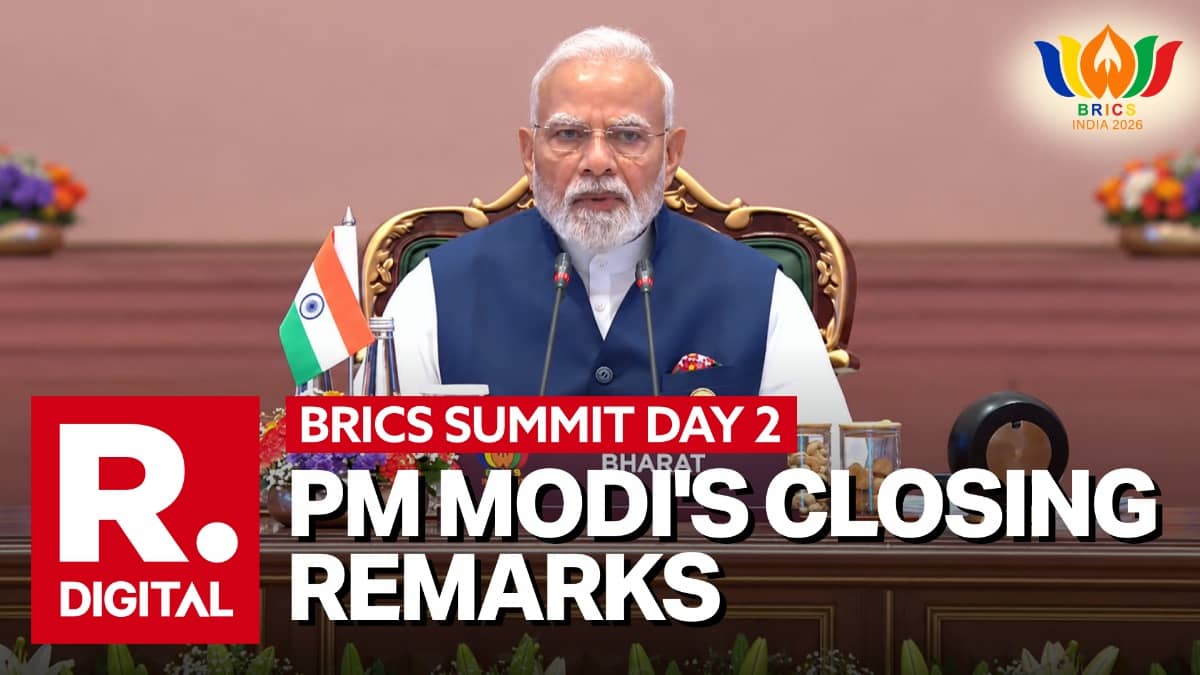
New Delhi: Prime Minister Narendra Modi on Sunday called for greater resilience and preparedness among BRICS nations amid rising global tensions, warning that the weaponisation of technology and critical minerals could hinder shared progress. He also stressed that in an interconnected world, no crisis can remain confined to a single region.
Addressing the open session on “Resilience, Innovation, Cooperation and Sustainability: Shaping the Future for Inclusive Global Growth” on the second day of the 18th BRICS Summit in New Delhi, PM Modi said rising tensions were having a widespread impact on ordinary people.
“Pandemics, climate disasters, and supply chain disruptions have demonstrated that in today's interconnected world, no crisis remains confined to a single region,” Modi said.
He stressed the need for BRICS countries to identify challenges in a timely manner, remain prepared and take immediate action. He said India had placed special emphasis on enhancing resilience within the grouping.
Modi said BRICS countries had reached a consensus on an Integrated Early Warning System for the prevention of and response to infectious diseases. He also highlighted the formulation of Early Warning Data Integration Guidelines for disaster management.
Turning to innovation and technology, the Prime Minister warned that the weaponisation of technology and critical minerals could obstruct the shared development of BRICS nations.
“Under the umbrella of innovation, the BRICS Incubator Network will connect our startups and incubators. We have proposed the BRICS Startup Innovation Fund to promote innovative and scalable solutions,” Modi said.
He also highlighted the BRICS Network on Digital Agriculture, which aims to create new opportunities for farmers by aligning artificial intelligence, geospatial technology and digital public infrastructure with their actual needs.
“The weaponization of technology and critical minerals could hinder our shared progress; therefore, we have emphasized inclusivity in the adoption of technology,” Modi said.
The Prime Minister also highlighted the BRICS Logistic Supply Chain Cooperation Framework, saying it would help make supply chains more reliable and resilient.
Critical minerals have emerged as an important part of the grouping's economic and energy agenda. The New Delhi Declaration, adopted unanimously by BRICS leaders on Saturday, stressed the need for reliable, responsible, diversified, resilient, fair, sustainable and just supply chains for critical minerals.
The declaration called for benefit sharing, value addition and economic diversification in resource-rich countries. It also emphasised the sovereign rights of such countries over their mineral resources, including their ability to adopt measures to pursue legitimate public policy objectives.
The BRICS declaration recognised the key role of critical minerals in the development of zero- and low-emission energy technologies, energy security and resilient energy supply chains.
Modi said the trust of Global South nations in BRICS had grown because their voices were being heard, their experiences respected and solutions developed with them.
“The strength of BRICS lies in our diversity and cooperation,” he said.
The Prime Minister said BRICS nations may be rooted in different realities but could rise together through cooperation and ensure that their progress benefits humanity.
Earlier on Saturday, BRICS leaders unanimously adopted the New Delhi Declaration, with Modi describing the outcome as a reflection of a BRICS that is “wider in reach and stronger in purpose”.
The declaration expressed deep concern over the continued escalation of tensions in West Asia and called for maximum restraint and avoidance of actions that could further aggravate the situation.
It reaffirmed BRICS' support for a lasting two-state solution to the Israeli-Palestinian conflict, while calling for deeper international institutional support for Palestine and reaffirming Israel's legal obligation to ensure the provision of humanitarian aid in Gaza.
The grouping also called for an immediate end to unilateral economic sanctions and expressed concern over rising protectionist policies, warning that arbitrary tariff hikes and green-labelled trade barriers were disrupting global supply chains and affecting the developing world.
The second day of the summit is focused on the core pillars of India's 2026 BRICS chairship - resilience, innovation, cooperation and sustainability.
India is hosting the two-day 18th BRICS Summit on September 12-13 under the theme “Building for Resilience, Innovation, Cooperation and Sustainability”.
Earlier on Sunday, Modi and BRICS leaders posed for a family photograph at Bharat Mandapam, with Russian President Vladimir Putin and Chinese President Xi Jinping standing beside the Indian Prime Minister.
India's BRICS presidency began on January 1, 2026, with a human-centric approach focused on strengthening institutional resilience, promoting innovation, deepening cooperation and supporting sustainable growth.
Get Current Updates on India News, Entertainment News, Cricket News along with Latest News and Web Stories from India and around the world.