Not just treasures: Peranakan Museum’s new show finds meaning in everyday objects - The Straits Times
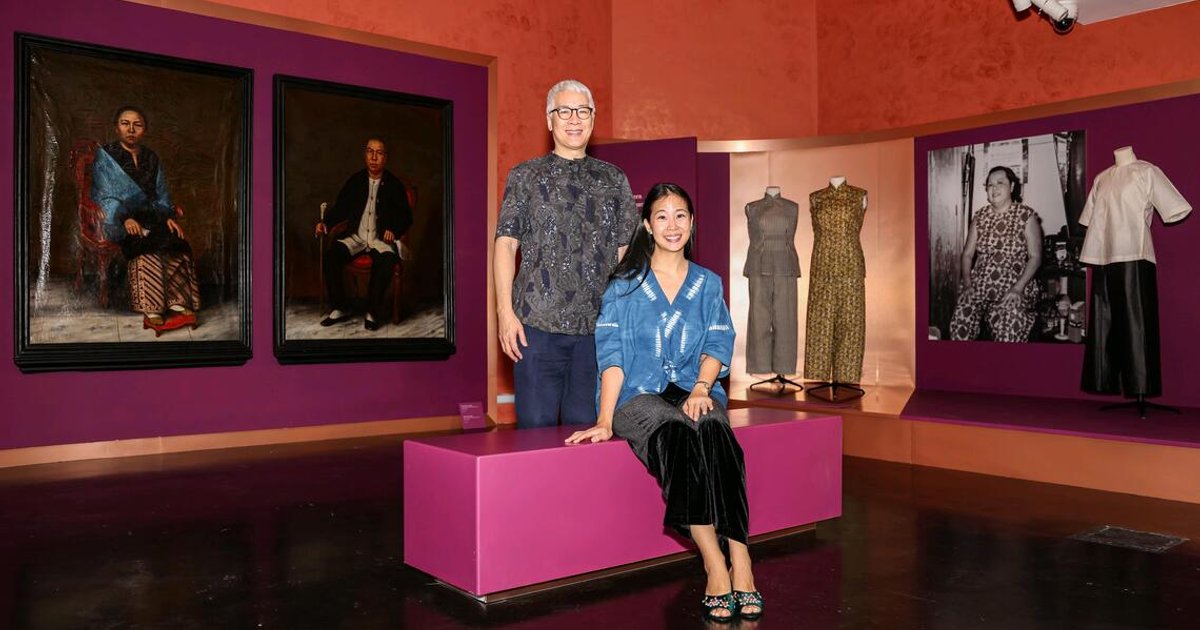
(From left) Curators Peter Lee and Naomi Wang during the preview of the Exceptional/Everyday: New Acquisitions, New Perspectives exhibition at the Peranakan Museum on Oct 27.
SINGAPORE – Among a display of colourful enamelled tiffin carriers sits a plain, weathered one on a plinth of its own, towering over the rest.
It may not be the flashiest object at the Peranakan Museum, but it carries a story crossing seas and generations.
A Chinese Peranakan family, Lim Yeok Quan and her husband Ong Peng Hock, bought the tiffin carrier in Bangalore while sheltering there during World War II. They later took it home to Singapore, where their granddaughter Felicity Ong used it to carry food to their ancestors’ graves at Bukit Brown Cemetery.
It is one of 159 objects in the museum’s new show, Exceptional/Everyday: New Acquisitions, New Perspectives.
Opening on Oct 30 and running until Aug 29, 2027, the exhibition is curated by Naomi Wang, the museum’s Tun Tan Cheng Lock Curator of Peranakan Art, and curatorial consultant Peter Lee.
It tells 14 stories through objects, many acquired from donors over the past five years. Jewellery, furniture and beadwork sit alongside ordinary household items like checked sarong and samfoo. A 14-essay book accompanies the show.
At the media preview on Oct 27, museum director Clement Onn thanked the families who had contributed to the growing collection. “They did not just entrust beautiful objects to the museum, but also their family stories and memories that we are proud to be the custodian of.”
A close-up of tiffin carriers at the preview of Exceptional/Everyday: New Acquisitions, New Perspectives exhibition at the Peranakan Museum on Oct 27.
The show’s message is that an object becomes Peranakan not through its origin or aesthetics, but through its use and legacy. Many of these objects travelled across seas and generations, and were adapted and reinterpreted in Peranakan homes.
“Art history often focuses on the creator and how objects were made,” Lee says. “What is often neglected is the significance of the object after creation. Often, an object is used in a completely different way that has no relevance to how it was made. Historically, that function is important.”
The exhibition opens with portraits of Javanese Peranakans wearing unconventional clothing.
Under Dutch colonial rules that barred non-European men from wearing European suits, Peranakan men in Java wore hybridised jackets designed with Western lapels and Chinese frock buttons. “This response resulted in a completely invented way of dressing that had no precedent,” Wang, a senior curator, says.
Blue-and-white porcelain ware from China, typically used as crockery, served as containers for ancestor altars in some Peranakan homes. “There are many families who wouldn’t use it for dining,” Lee says, “because they associated it with offerings.”
The bridal handkerchief known as bin poh in Hokkien began as a folded cloth, but became a purely ornamental accessory hung from a ring worn by Peranakan brides during weddings.
Ornamental handkerchiefs on display at Exceptional/Everyday: New Acquisitions, New Perspectives exhibition at the Peranakan Museum on Oct 27.
The show also pushes the Peranakan story beyond Singapore, as well as Malaysia’s Penang and Melaka, where the museum has long focused.
Wang says many acquisitions came from communities the museum had never worked with.
One of the donors is Kadjin Low, whose family hails from Aceh, Indonesia. He e-mailed the museum about his grandmother’s jewellery used for mourning, and the donation shed light on a Peranakan community the curators knew nothing about.
Traditional Chinese rites called for modest, unbleached clothing, but Straits Peranakan women leant towards Victorian customs instead, wearing dark clothes and memorial jewellery in silver.
From Kedah, Malaysia, a set of phoenix hairpins worn by a Peranakan bride bore traces of kingfisher feathers, which Wang says could be an older style of bridal headdress than the one Penang brides were known to wear.
The museum had no prior record of Peranakan wedding customs in Kedah.
Curator Naomi Wang introducing the samfoo attire on display during the preview of Exceptional/Everyday: New Acquisitions, New Perspectives exhibition at the Peranakan Museum on Oct 27.
Wang says: “It’s just mind-boggling, the amount of material Peranakan families still have, and still want to donate.”
In fact, donors continue reaching out to the museum through its e-mail address and phone lines.
“More importantly, they come with provenance,” she adds. “They provide important information about the life of ordinary objects across the region. Scholarship doesn’t really privilege looking at things like everyday menswear or the samfoo.”
Lee credits the reputation the museum has built over almost two decades.
One of the donors, who lives in Brisbane, Australia, e-mailed and called for years before the museum took up her gift of an ornamental bridal handkerchief worn at her mother’s 1949 wedding, set with over 100 jewels.
Curator Naomi Wang (centre) giving guests a tour of the Exceptional/Everyday: New Acquisitions, New Perspectives exhibition during the preview at the Peranakan Museum on Oct 27.
The stories and collective memories behind the objects push back against the typical perception of Peranakan culture as showy and extravagant. “Families go through cycles of wealth and loss, but they still hang on to these objects, whether a grandmother’s kitchenware or a single jewel,” Lee says.
“To me, it’s jaw-dropping that nobody ever threw out the rusty tiffin carrier. So I think it’s not just about ostentation. It’s about memory.”
Where: Peranakan Musem, 39 Armenian Street When: Oct 30 to Aug 29, 10am to 7pm (Thursdays to Wednesdays), 10am to 9pm (Fridays) Admission: $6 for Singaporeans and permanent residents; $18 for foreign residents/touristsInfo: str.sg/J8AaU