Ntshavheni rejects US pressure to scrap B-BBEE - IOL
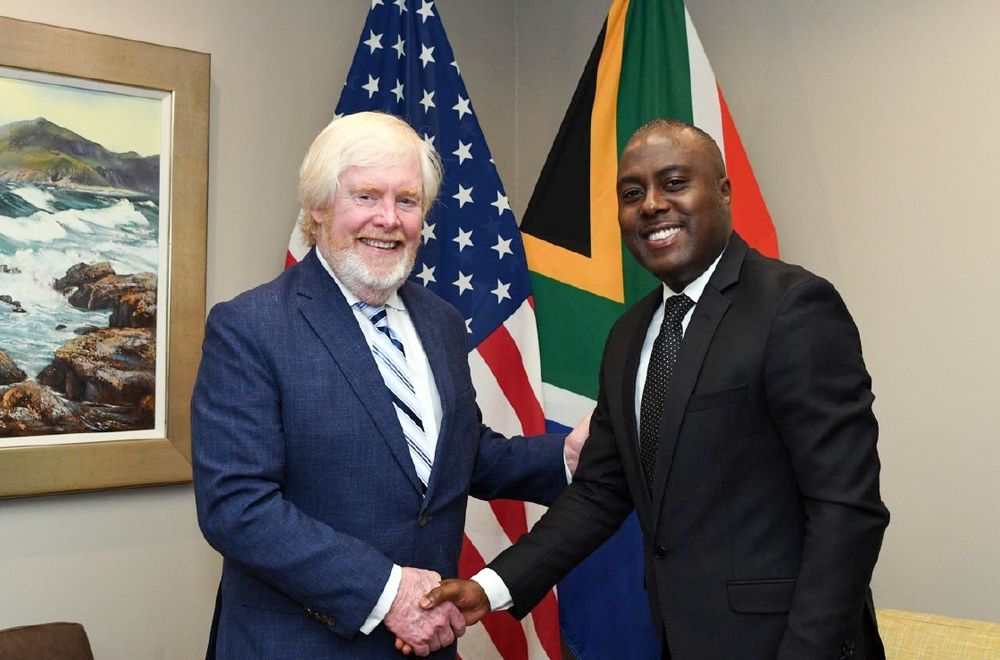
Department of International Relations and Cooperation (Dirco) Deputy Director-General (DDG) Clayson Monyela (right) received Letters of Credence from L Brent Bozell III, United States Ambassador to South Africa, earlier in 2026 in Pretoria.
South Africa has stood its ground and said it will not compromise on Broad-Based Black Economic Empowerment (B-BBEE) policies despite external pressure and demands from the United States of America (US).
Pretoria has been warned that its continued political stance may jeopardise South Africa's African Growth and Opportunity Act (AGOA) agreement, which is up for review in November.
Speaking exclusively to Sunday Independent, Minister in the Presidency Khumbudzo Ntshavheni stated that the US demand to scrap B-BBEE policies is a demand to maintain apartheid's outcomes, which South Africa will not accept.
These remarks come after the US reaffirmed its core demands on South Africa amid escalating diplomatic friction, insisting that South Africa formally respond to outstanding policy concerns following a series of sharp exchanges and a recent diplomatic reprimand.
This comes hot on the heels of South Africa’s decision to issue a third démarche to US Ambassador Leo Brent Bozell III over alleged undiplomatic conduct.
This followed Bozell’s public use of media platforms to pressure South Africa into conforming to five distinct Trump administration demands.
The contentious issues included scrapping Broad-Based Black Economic Empowerment (BEE) requirements, rolling back the Expropriation Act (land reform policies), condemning the “Kill the Boer” chant, prioritising farm murders, and halting perceived interference with Afrikaner US refugee processing.
He openly criticised President Cyril Ramaphosa for failing to meaningfully address Washington’s core domestic policy demands.
Bozell added that this response sent a clear message that the South African government does not want a constructive relationship with the US.
The ambassador also argued that South Africa’s race-based regulatory environment, specifically its B-BBEE policies, is a severe bottleneck actively blocking billions of dollars in new American investments.
In response, the Department of International Relations and Cooperation (Dirco) strongly rejected the accusations and summoned Bozell for a formal reprimand over his public “media blitz”.
South African diplomats argued that the country's economic transformation and land reform laws are necessary to rectify the historical legacies of apartheid and must be respected under South African sovereignty.
Minister in the Presidency Khumbudzo Ntshavheni says B-BEE are here to say despite the US pressure to remove them.
However, the US State Department said it is not interested in dialogue for its own sake and expected South Africa to answer US concerns.
“We are not interested in diplomatic maneuvering, procedural delays, or dialogue for dialogue’s sake. The ball is now squarely in the government of South Africa’s court to outline the relationship it wants with the US,” read the statement.
However, Ntshavheni said South Africa will engage the US and all its partners as an equal, on the basis of mutual respect and sovereign equality, and without apology for the transformation that the Constitution demands.
“Apartheid was declared a crime against humanity. It was also an economic crime. Families were forcibly removed from their land. Workers were barred by law from skilled jobs. Black children were given an education designed to keep them in servitude. In 1994, South Africans chose redress over retribution. B-BBEE is an instrument of that choice, and section 9(2) of the Constitution requires it. Redress is a constitutional obligation, not a bargaining chip,” she said.
Asked whether opposition to B-BBEE reflected the US government’s ideology or the views of American businesses, and what would happen if talks collapsed, Rubani Trimiew, a spokesperson for the US Mission in South Africa, referred to comments by Bozell. Trimiew said Bozell’s views reflected the US position on its bilateral engagement with South Africa.
According to Solidarity, South Africa could be out of the African Growth and Opportunity Act (AGOA) before Christmas, with an announcement expected by November 1, 2026.
The union said the US is currently reviewing the list of participating countries, adding that statements made by Minister Ronald Lamola during his visit to the US, and Dirco’s decision to summon Bozell created the necessary scope for the US to remove South Africa as a participating country.
The union said this could affect up to 250,000 jobs that are partially or fully dependent on AGOA.
Dirco spokesperson Chrispin Phiri referred to Ramaphosa’s weekly presidential letter, where he defended South Africa’s policies against US pressure and addressed a deep diplomatic fallout with the Trump administration.
In his letter, Ramaphosa defended South Africa’s constitutional programs aimed at correcting apartheid-era racial inequalities, including land reform and B-BBEE, saying there is no moral equivalence between democratic redress and systematic oppression.
He also warned against divisive rhetoric that threatens national unity and reopens the wounds of the past.
International relations expert Professor Andre Thomashausen said the South African government should take the US criticisms from the US seriously rather than reacting defensively.
“For the US government through its ambassador to now alert to the obstacles to accelerated foreign investment, better growth and greater employment, is in reality a constructive engagement. The ANC government is too insecure about its dwindling national support to engage in a rational and mature way with the five reasonable and careful suggestions made by the US. South Africa should not overlook that the US is its oldest ally and its second biggest trading partner in terms of export values,” he said.
For Dr Sean Muller, an economic and public policy expert, the US threat of companies pulling their investments out of South Africa over local policy disputes is highly exaggerated.
“The supposed issues with B-BBEE and the Expropriation Act are a case of a storm in a teacup, there is nothing radical about any of this legislation. In fact, my cynical assessment is that in the case of the Expropriation Act these controversies are being manufactured to distract from the fact that it actually represents no material progress in addressing restitution or redistribution. Ordinary South Africans see these dramas and assume some radical redress is being attempted, when in reality any credible interpretation of the Act suggests otherwise.
“I do not think there is any serious chance of net US investment withdrawal; certainly not for these reasons. If that happened, it would be a clear case of the US, and any such companies, shooting themselves in the proverbial foot,” he said.
Meanwhile, former CEO of mining giant Sibanye-Stillwater Neal Froneman has called on the US government to implement targeted sanctions against specific South African political figures and individuals, adding that he presented this strategy during recent discussions in Washington.
Froneman, who shared his views on BizNews, argued that policies such as expropriation without compensation undermine investor confidence and damage the local economy, adding that individual policymakers continue to push agendas that are entirely unsupported by the majority of South Africans.
This was after the US recently announced targeted visa restrictions against unspecified South Africa officials and individuals deemed complicit in policies enabling uncompensated land seizures, race-based discrimination, or the incitement of violence.