
Nvidia's next boss? Who could replace Jensen Huang as his job hangs in balance
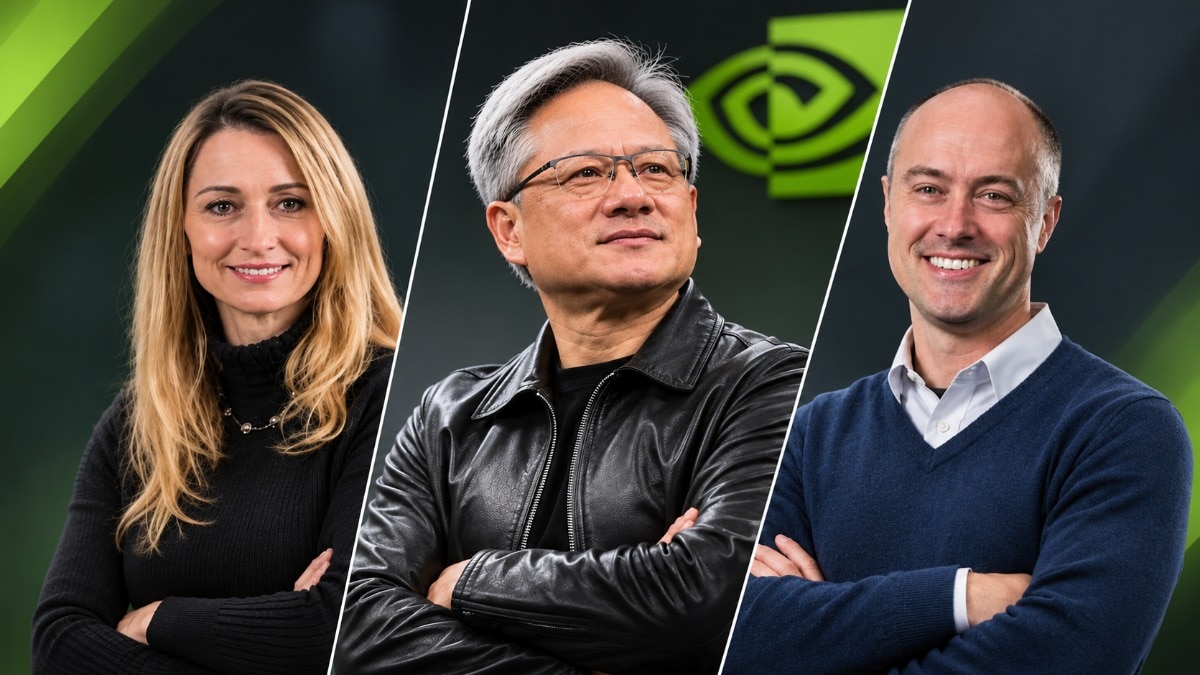
Nvidia's search for a possible successor to Jensen Huang could extend well beyond the company's own leadership team. While Nvidia's chief financial officer Colette Kress and vice-president Ian Buck seem to be top contenders, eight executives outside the chip-making giant are emerging as potential names to watch if the chipmaker has to find a replacement for its long-time leader.
According to a Bloomberg report, Nvidia has tapped an outside firm to identify potential candidates following reports of multiple extramarital relationships involving Huang. The search could prove challenging for the world's most valuable chipmaker, given how closely its strategy, technology direction and business relationships have been shaped by its co-founder.
Among the eight names identified by Bloomberg are executives from Nvidia, Arm, AMD, Apple, Amazon and Google. Buck and Kress are two of the most prominent internal names, while the list also includes leaders who run major technology and semiconductor businesses outside Nvidia.
Nvidia's board met on Wednesday to discuss Huang's future, but has not announced any decision regarding the company's longtime CEO, reported The New York Times.
The development comes amid growing uncertainty over Huang's future. Nvidia's board is examining the controversy surrounding the CEO, while investors are also weighing the potential consequences of losing a leader who has run the company since co-founding it in 1993.WHO ARE THE EIGHT POTENTIAL SUCCESSORS?Colette Kress: Nvidia's CFO and possible interim leader
Kress is Nvidia's executive vice-president and chief financial officer. She joined the company in September 2013 and is among its best-known executives after Huang, particularly among investors.
Before joining Nvidia, she spent three years as senior vice-president and CFO of Cisco's Business Technology and Operations Finance organisation. She also spent 13 years at Microsoft, including four years as CFO of its Server and Tools division. Earlier in her career, she held finance roles at Texas Instruments.
Her experience managing the finances of large technology companies could make her a possible choice to steady Nvidia during a leadership transition. However, finance chiefs are often viewed as interim leaders rather than long-term replacements, particularly at technology companies.
Bloomberg has separately reported that Kress could take over as interim CEO and oversee the search for a permanent successor if Huang exits.Ian Buck: The Nvidia executive behind CUDA
Buck is a vice-president at Nvidia who oversees products for data centres, including the company's AI chips. He is also the inventor of CUDA, the software framework that helps developers use Nvidia's chips for AI and other computing applications.
His technical expertise and familiarity with Nvidia's customers make him an important internal candidate. He is also a familiar face to the company's data centre customers.
However, Bloomberg noted that Buck lacks the operational experience that investors often look for in the head of a large publicly listed company.
In a separate Bloomberg report on prediction markets, Buck emerged as the favourite to replace Huang on Kalshi and Polymarket, attracting around a third of bets on both platforms. Kress ranked second. These rankings reflect market expectations, not an official Nvidia shortlist.Rene Haas: The former Nvidia executive now leading Arm
Haas is the chief executive of Arm Holdings, a major chip-design company with a close partnership with Nvidia.
He previously worked at Nvidia and now manages a complex network of customers and partners, giving him insight into the semiconductor industry and the wider technology market.
Nvidia itself attempted to acquire Arm in 2020 in a deal involving SoftBank, but the transaction eventually collapsed after facing antitrust scrutiny.
His experience running a major chip-design business and his familiarity with Nvidia could make him a potential name in the search.Lisa Su: The leader of Nvidia's closest rival
Su is the chief executive of Advanced Micro Devices, Nvidia's closest competitor in the market for AI chips and high-performance computing.
Under her leadership, AMD has strengthened its position in the semiconductor industry and overtaken Intel in several areas of technological leadership. Its shares have also surged nearly 170-fold during her tenure, according to Bloomberg.
Su brings extensive experience in chip engineering and running a large semiconductor company. However, AMD remains considerably smaller than Nvidia, and its AI chips have yet to match Nvidia's level of adoption.
Her inclusion would be notable given that she currently leads one of Nvidia's biggest competitors.Johny Srouji: The man behind Apple's custom chips
Srouji is Apple's chief hardware officer and has led the company's in-house silicon programme.
He has overseen the development of custom chips used in the iPhone, Mac and other Apple devices. His experience gives him strong credentials in chip design, product integration and long-term technology planning.
However, Bloomberg noted that much of his experience has been built within Apple's tightly controlled business structure. He has also not been tested in the kind of high-profile salesmanship and public-facing role that Huang has built at Nvidia.Matt Garman: The Amazon executive running AWS
Garman is the chief executive of Amazon Web Services, the cloud-computing business of Amazon.
He oversees a large operation that rents computing power through an extensive network of data centres and also develops Amazon's own chips.
Like Huang, Garman combines technical and operational experience. His leadership of a major cloud-computing business could be relevant to Nvidia, given the importance of data centres and AI infrastructure to its growth.
One challenge highlighted by Bloomberg is that Amazon was initially seen as lagging competitors such as Microsoft and Google in building AI infrastructure.Sanjay Mehrotra: The Micron chief with semiconductor experience
Mehrotra is the chief executive of Micron Technology, one of the world's leading memory chipmakers.
He has experience steering a semiconductor company through industry cycles, including periods of weak demand and strong growth. Micron's shares have risen more than 2,700% during his tenure, helped by increasing demand for memory chips amid the AI boom, according to Bloomberg.
However, his experience is rooted largely in memory chips and manufacturing, rather than graphics processing units and the software ecosystem that has helped Nvidia dominate AI computing.Amin Vahdat: Google's AI chip specialist
Vahdat oversees Google's tensor processing unit programme, which develops the company's in-house AI chips.
His technical credentials are significant, particularly as Google builds alternatives to Nvidia's GPUs for AI workloads.
However, Bloomberg noted that he has less experience running a large publicly listed company with Nvidia's scale, commercial complexity and investor scrutiny.WHAT ABOUT JENSEN HUANG'S FAMILY?
Three members of Huang's family also work at Nvidia: his children Madison and Spencer, and his son-in-law Nico Caprez.
Madison oversees product and technical marketing, while Spencer works in product management in Nvidia's robotics division. Caprez holds the more prominent position among the three as vice-president of global AI infrastructure growth and is involved in discussions with emerging cloud companies and data centre deployments.
Huang has previously said he does not wish the burden of running Nvidia on his children. He has also said that if they aspire to lead the company, they would have to earn the position.
Their presence at Nvidia is part of the wider succession discussion, but Bloomberg's list of eight potential candidates does not identify them as formal contenders.WHY REPLACING JENSEN HUANG WILL BE DIFFICULT
Huang has led Nvidia since co-founding it in 1993 with Chris Malachowsky and Curtis Priem. Over more than three decades, he has helped transform the company from a graphics-card maker into a dominant supplier of chips and technology used in artificial intelligence.
His role extends beyond product development. He has shaped Nvidia's relationships with customers, suppliers, partners and start-ups, while also playing a prominent part in promoting the wider AI industry.
Bloomberg has highlighted how central Huang remains to the company's daily operations. Around 60 senior executives report directly to him, and major decisions continue to flow through the CEO.
This creates what is known as key-person risk: the possibility that a company depends too heavily on one individual.
The challenge for Nvidia is therefore not just finding someone with semiconductor expertise. The next CEO would need to combine technical understanding, operational experience, investor confidence and the ability to maintain relationships across a vast AI ecosystem.
For a company that has been shaped by one leader for more than three decades, finding someone who can take on that role may be one of its most consequential decisions.- Ends


