Ohanaeze At 50: Celebrating five decades with ideas, sober reflection - Vanguard News
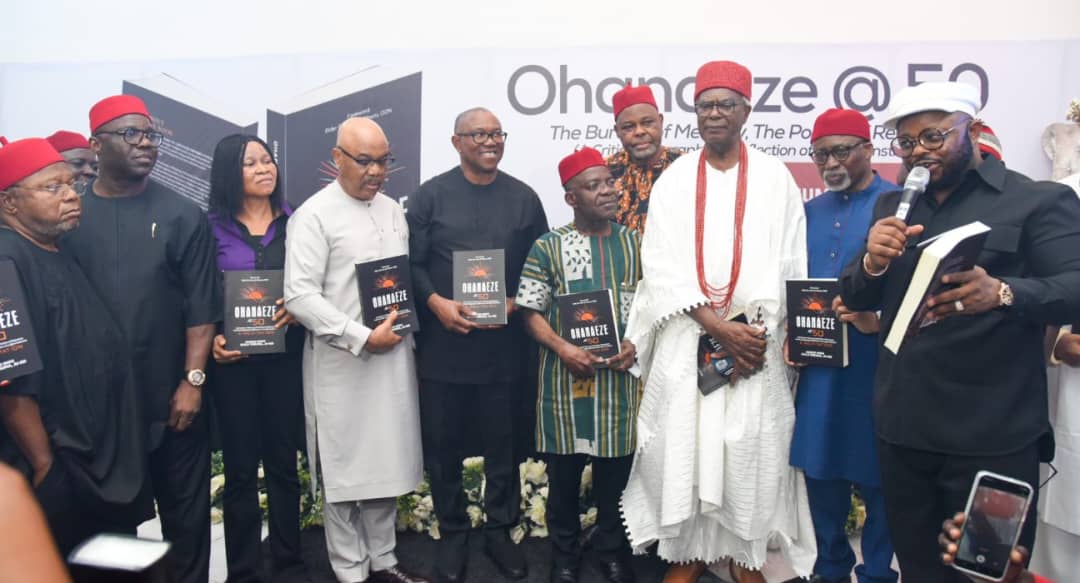
From left: Joe Okei-Odumakin (3rd from left); Elder U.K. Eke; Mr Peter Obi; Gov Alex Otti; Igwe Alfred Nnaemeka Achebe; Senator Enyinnaya Abaribe; and others at the 50th anniversary of Ohanaeze Ndigbo in Lagos.
It was a roll call of eminent Igbo sons and daughters at Dover Hotel, Ikeja, during the week as traditional rulers, political leaders, business captains, and cultural icons all gathered for a different kind of golden jubilee.
For its 50th anniversary, Ohanaeze Ndigbo, the apex Igbo socio-cultural organisation founded in 1976, chose intellectual engagement and sober reflection over the usual drums and dances.
Present were Abia State Governor, Dr. Alex Otti; Chairman of the occasion, Elder U.K. Eke; His Royal Majesty, Igwe Alfred Nnaemeka Achebe; Eze Kalu Kalu Ogbu IV, Enachioken of Abiriba; former Anambra State Governor, Mr. Peter Obi; Senator Enyinnaya Abaribe; Prof. Okey Anueyiagu, who reviewed the book; Prof. Anya O. Anya; Dr. Joe Okei-Odumakin; Chief Emeka Mba; Chief Dr. Ifeanyichukwu Odii, chief launcher; Ada Agina-Ude; Kanayo O. Kanayo; and many others.
The high point of the convergence was the unveiling of a 602-page book, “Ohanaeze at 50: The Burden of Memory, The Politics of Relevance,” written by Agbeze Ireke Kalu Onuma, Executive Director of the Ndigbo Lagos Foundation.
The book is a critical biographical reflection on the history, evolution, challenges and continuing relevance of Ohanaeze to the socio-political development of Ndigbo.
Its significance is even deeper because the author witnessed the birth of the organisation and has followed its trajectory for five decades.
Welcoming guests on behalf of the President-General of Ndigbo Lagos, Chief David Ogbodo said the event celebrates “ideas, knowledge, creativity, perseverance and the power of the written word.”
He described the book as more than a collection of pages, but a moment to ask hard questions: Have the objectives of the founding fathers been achieved? How does Ohanaeze compare with similar groups like Afenifere and the Arewa Consultative Forum?
He commended the author for “his courage, discipline and commitment, noting that the book “promises to stimulate discussion among readers.”
In his remarks, Chairman of the occasion, Elder U.K. Eke, said the book was driven by “an urgent need for institutional renewal.”
“After 50 years, Ohanaeze stands at a historic crossroads. The author did not write to flatter our ego, but to provide a diagnostic mirror that challenges us to move from reactive agitation to structured, proactive and strategic regional governance,” Eke said
Delivering a speech titled Ohanaeze at 50: A Book That Holds Up the Mirror, Special Guest of Honour, Governor Alex Otti, said the book goes beyond the story of Ohanaeze.
“It is often said that a people who do not remember where they came from may struggle to determine where they are headed. This book is much more than a book about Ohanaeze. It is a book about memory, identity, leadership, responsibility and the future of a people,” he said.
At 50, an institution deserves celebration, but it also deserves reflection. Rather than merely recounting 50 years of Ohanaeze Ndigbo, the author invites us to confront a more difficult question: What has Ohanaeze become, what should it be, and what must it do to remain relevant to generations of Ndigbo yet unborn?”
According to Otti, the book examines Ohanaeze’s triumphs and disappointments, leadership transitions, internal disagreements, relationship with political authority, and its struggle to define its place in a changing Nigeria.
“But perhaps the most important contribution is that it refuses to merely celebrate the past,” he noted.
“An institution cannot live indefinitely on the strength of its history. Heritage gives an organisation legitimacy, but relevance must be earned continuously.”
Otti said the book raises fundamental questions about institutional renewal, generational transition, and the bond between leadership and the people, with a strong message for younger Igbo.
“The future of Ndigbo cannot be secured by nostalgia alone. It must be built through institutions that understand the aspirations of young people, embrace technology and innovation, engage the global Igbo diaspora, and translate cultural identity into economic, intellectual and political strength.
“As Ohanaeze turns 50, we should reflect on renewal — a point where an institution looks honestly at its past, learns from it, and summons the courage to imagine something greater,” Otti stated.
Comments expressed here do not reflect the opinions of Vanguard newspapers or any employee thereof.