
Oil set for fourth monthly gain as Hormuz tanker attack highlights supply risks from war - The Express Tribune
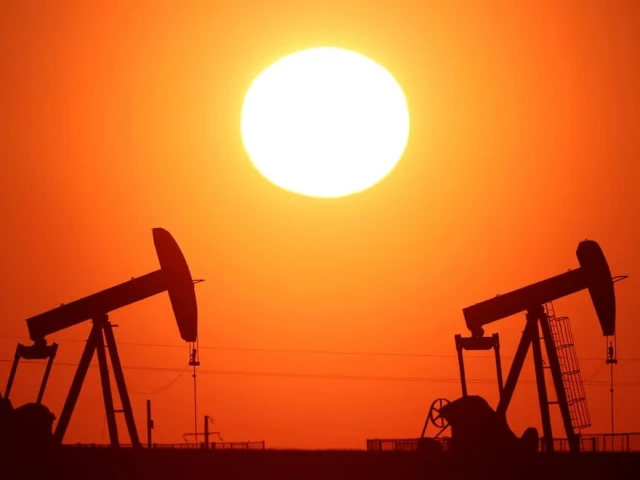
Brent crude futures for December, which expire on Friday, rise $2.27, or 1.98%, to $117.15 a barrel
Oil prices rose on Friday and were on track for a fourth monthly gain as traders braced for a potential escalation in the US-Iran conflict after US midterm elections, with an attack on a tanker in the Strait of Hormuz highlighting supply risks from the war.
Brent crude futures for December , which expire on Friday, were up $2.27, or 1.98%, at $117.15 a barrel as of 0845 GMT. The more-active January contract gained $2.19 to $112.99.
US West Texas Intermediate (WTI) crude futures climbed $1.79, or 1.75%, to $103.79.
For the month, Brent was on course to finish 13% higher, while WTI was heading for a 15% jump.
"The oil market is getting increasingly spooked as we approach the midterms," said Ole Hansen, head of commodity strategy at Saxo Bank. Some investors and analysts are expecting another resumption of US attacks on Iran after the elections, he said.
On Friday, a tanker in the Strait of Hormuz — the key sea outlet for Gulf crude and fuel supplies — was hit by explosive devices attached by a small boat, the UKMTO said. It was not immediately clear who was behind the attack.
"Continued kinetic action around the Strait of Hormuz amidst doubts of a viable diplomatic pathway are keeping oil prices elevated in expectation of an escalation of the conflict in coming weeks," said Saul Kavonic, head of energy research at MST Marquee.
Qatari mediators returned to Tehran on Friday as part of coordinated efforts to reach a deal between the US and Iran, an official briefed on the talks told Reuters.
Despite this, "we're still seeing a higher likelihood of an escalation and supply disruption", said Giovanni Staunovo, commodity analyst at UBS. "Officials from Iran have been cautious about whether a deal is possible in the short term."
On Thursday, Yemen's Iranian-backed Houthi militants said they had attacked several sites in Saudi Arabia, including its largest oil refinery, Ras Tanura, the Rabigh refinery and a production facility in Abqaiq owned by state company Saudi Aramco.
A Saudi-led coalition also said it had intercepted a cruise missile launched by the Houthis towards the kingdom's western region.
US President Donald Trump said on Thursday that Vice President JD Vance had reached out to Iran to help the country get medical supplies, after US media reported Vance had written to Tehran's top security official to revive peace talks.
Iran has received a letter from Vance, but it has not responded to it yet, the country's semi-official Tasnim news agency reported, adding that Tehran wants the US to meet its conditions and "any position that contradicts this framework is unacceptable".
Amid the security concerns in the Middle East, ExxonMobil and Chevron have cancelled plans for their executives to travel to the United Arab Emirates' biggest oil show next week, two sources familiar with the developments told Reuters.
Oil prices could become even more volatile in the next couple of weeks due to Israel's parliamentary election and the US midterm congressional vote, according to a Saxo Bank briefing in Singapore on Thursday.
The heightened uncertainty made it difficult to forecast prices, but crude is expected to trade in a higher range of $70 to $90 a barrel compared with a pre-war level of $60-$70 even after the conflict ends, the Danish bank said.
It cited the risk of renewed hostilities and the need for inventory replenishment.
Comments are moderated and generally will be posted if they are on-topic and not abusive.
This material may not be published, broadcast, rewritten, redistributed or derived from. Unless otherwise stated, all content is copyrighted © 2026 The Express Tribune.


