
On stage and the screen, Russell Crowe is the rock star he always wanted to be
You have reached your maximum number of saved items.
Remove items from your saved list to add more.
His musical abilities may be limited, his bands mocked by critics and he has been a figure of ridicule in South Park. But in What Love Builds, a self-directed, self-produced film about his musical life, Russell Crowe shows that he can laugh that off. Whatever anyone says, up on stage he is the rock star he wants to be.
What Love Builds was one of two very different Australian films that had their world premieres at the Venice Film Festival. The other was Agata the Writer, which stars Mia Wasikowska. Showing out of competition in the main program, the documentary tracks Crowe’s enduring musical ambitions, from the acquisition of his first guitar in 1970, through to his forthcoming tour with his current band, Indoor Garden Party.
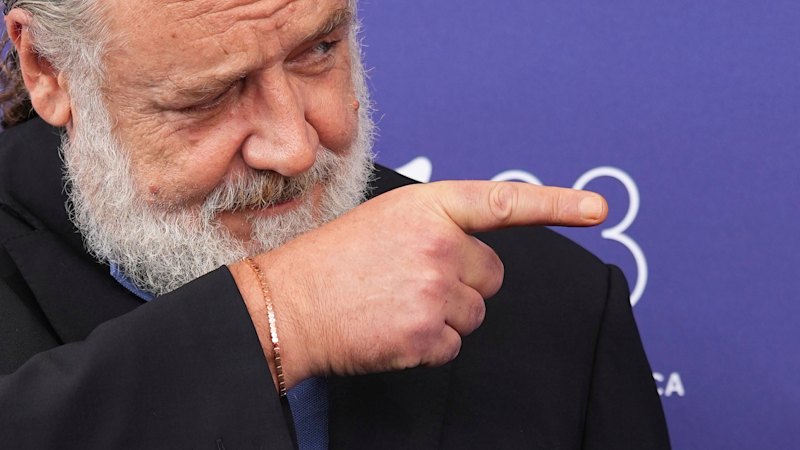
Russell Crowe in Venice for the premiere of his self-produced, self-directed film What Love Builds, about his musical life.APCrowe’s surprisingly entertaining chronicle is a story of focus, ambition and persistence, despite what he said was a lack of confidence. We see him working as a schoolboy in a ’50s rock ‘n’ roll disco in New Zealand, wearing a jacket emblazoned Russ le Roq, then auditioning for a touring production of The Rocky Horror Show. Realising there is no way to move upwards in New Zealand, he heads west to Australia, then auditions successfully for his breakthrough film in Hollywood, LA Confidential. The point he wants to make, however – with a project that took 15 years from its inception – is that he always saw himself just as much as a musician as an actor.
Music, he says in the film’s voiceover, is the beginning of everything. “I knew what my intention was. The intention was to answer the question I probably get asked the most, which is to define the difference between music and acting,” he says in a press conference in Venice. “As the film attempts to explain, there is no difference.
“Everything comes from the same creative source; the two are completely entwined. Everything I do as a film actor is informed [by the fact] I know how to drive an audience. Even if they’re not in the room, I still carry an expectation and understanding of what the audience is going to get out of any single moment. That doesn’t mean I’m any kind of slave to the audience, just that I’m aware. And that comes from rock ‘n’ roll and coming out of theatre.”
Would he have rather been a famous musician or a famous actor? “The funny thing,” says Crowe, “is the implication that any of this has been a choice. I’ve rolled with opportunities as they’ve come along. I didn’t have a plan and I still don’t … I think I’ve made it pretty clear that I’ve mismanaged my relationship to Hollywood, but always to my benefit. It’s taken a long time for people to realise I’m not American because in my first flush of success people just made a huge assumption.
“But I’m not driven by the same things that people from that culture are driven by – and my sense of humour has got me into trouble so many times because we like to call things as we see them, where I come from, and that’s not always appreciated.”
Crowe performing with his band Indoor Garden Party.Getty ImagesCrowe would agree with that, however different his own choices have been. He only does a film, he says, if reading the script makes his skin tingle. “Even if I’ve already decided I’m not doing it, if I read that script and I get that feeling, I have to do it.” He says he needs a good reason to get up at 4.30am to go to a film set and pities actors who don’t believe equally fervently in what they’re doing, because nobody functions well at that time of day.
Turning up to sing on a stage in Coffs Harbour, however, clearly doesn’t require weighing up. He’s there in the opening sequence of What Love Builds, sweating spectacularly through his version of Dire Straits’ Romeo and Juliet, giving it his dramatic all. He tours Eastern Europe with the band next year; beyond that, anything might happen. “There is so much for me to accomplish yet,” he says. “I don’t think I’ve even scratched the surface of things creatively I want to do.”
His film’s brash rock ‘n’ roll vibe was in sharp contrast to the only other Australian film in Venice, Agata the Writer, which stars Wasikowska as a young novelist who goes on a research trip to Bosnia, thinking that as a Polish-Australian she should be able to tell a story set in the Balkans. As the debut film from visual artist Kuba Dorabialski, Agata the Writer is experimental and elliptical. Different though the two films are, both deal with their directors’ sense of identity.
Dorabialski is 47. His art work has often focused on his own history, growing up speaking Polish with parents who maintained Polish household customs. In Australia, he says, it is easy to think of Eastern Europeans as a cultural bloc.
“It’s such a small diaspora, that you have necessary kinship with other Slavic-speaking cultures. But then, once you get to these places, you realise you’re not what you thought you were in terms of cultural identity. Sometimes I go to Poland and people say, ‘How can you identify as Polish? You haven’t been here for decades’. Or they are just as likely to say, ‘Oh, you’ve come home’.” Home is another word that defies a final definition.
He started writing with Wasikowska, whose mother is Polish, in mind. She grew up watching her mother and grandmother struggling to belong; her mother was 12 when her family emigrated. Wasikowska was born in Australia, but that sense of displacement trickled down to her generation; she couldn’t imagine living in Poland, but never feels entirely settled. “There are times I feel really comfortable in Australia and times when I feel really at odds with it, so I’ve come to accept that it isn’t consistent for me.” Agata the Writer was the first Australian film to play in the Venice Days section of the festival. It will screen next month at Adelaide Film Festival.
Wasikowska has starred in high-profile films such as Tim Burton’s Alice in Wonderland in 2010 and Guillermo del Toro’s Crimson Peak in 2015. Since then, however, she has worked mostly in independent film and television in Australia, including directing her own short film. She, too, never had a plan, she says.
“I’m definitely very appreciative of that period of time in the US and those experiences,” she says. “But it’s not like I pursued that lifestyle with great ambition to keep going. I chose not to do certain things, chose to do other things. The sum of your career is just random choices you made one day.”
Must-see movies, interviews and all the latest from the world of film delivered to your inbox. Sign up for our Screening Room newsletter.

