Once guests at the show, now stars of the show: India's two-wheeler industry at EICMA
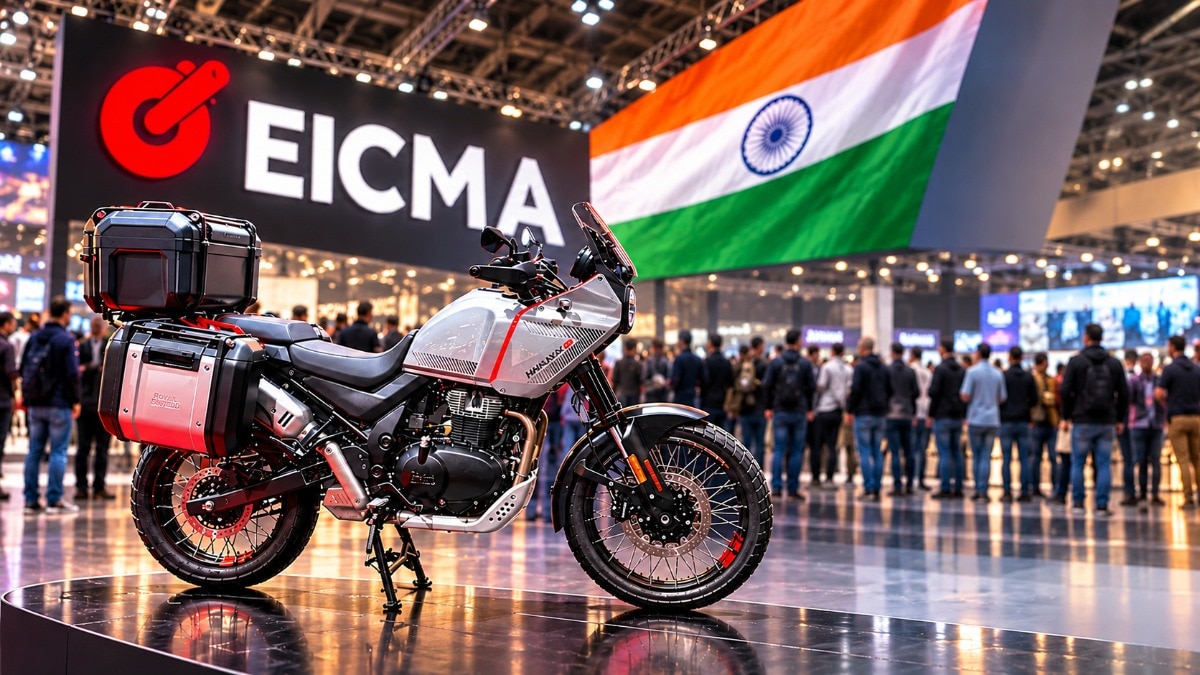
There was a time when an Indian visiting EICMA in Milan would return with a wishlist of motorcycles that one could only dream of buying back home. But times have changed. Today, the world is our oyster, and perhaps for the first time, the EICMA press day was kicked off by an Indian manufacturer - Royal Enfield.
For the uninitiated, EICMA is one of the oldest and most prestigious motorcycle shows in the world. And the moment you step into Fiera Milano, you realise just how well organised the entire affair is. Visitors begin by posing for a photograph with the iconic Fiera Milano sculpture before proceeding to security, which is surprisingly smooth and civilised. Royal Enfield Himalayan 750 at EICMA
Entry is equally well regulated. There are no complimentary passes floating around. On Press Days, access is restricted to the media, organisers and exhibitors. Media passes have to be applied for online, well in advance, and are valid only for the Press Days. There are no complimentary meals either. Once the show opens to the public, even members of the media have to purchase an entry ticket.
It's a well-structured affair where access, privileges and protocols are clearly defined. And perhaps that's what lends EICMA a certain sense of class.
But beyond the organisation and the sheer scale of the exhibition, what struck me this time was how much India's relationship with the global motorcycle industry has changed.The wishlist has changed
EICMA used to be an aspirational exercise for Indian motorcycle enthusiasts. You walked through the halls, spotted a Ducati, BMW, KTM or Triumph, and wondered whether any of these machines would ever make it to India. Even if they did, their prices often placed them well beyond the reach of most enthusiasts. The show was, in many ways, a window into a world that seemed distant from our own.
That distance has considerably narrowed. International motorcycle brands are no longer unfamiliar names that exist only in magazines or on the internet. Most Indian enthusiasts today either own an international motorcycle, have access to one, or are familiar with brands that once seemed out of reach. Premium motorcycles have become more accessible, the market has matured, and manufacturers have realised that India is no longer a market that can be ignored.
Price and performance have also found a better balance. Motorcycles that were once considered prohibitively expensive are now being developed, manufactured or assembled with India in mind. More importantly, Indian buyers are getting increasingly sophisticated. They want performance, technology, character and quality, but they also expect these to come at a price that makes sense.
As a result, the Indian motorcycle market is no longer just about entry-level commuters or affordable motorcycles. It has become an important part of the global industry's growth story.India is no longer just watching
Perhaps the biggest change is that the conversation at EICMA is no longer limited to what international manufacturers can bring to India. Increasingly, it is about what India is offering the world.
Royal Enfield's presence at the centre of the opening press-day proceedings was symbolic of this change. The company has evolved from being a manufacturer with a strong domestic following into a global motorcycle brand with a distinct identity. Its motorcycles have found audiences in markets where Indian manufacturers were once barely considered serious contenders.
And it isn't just Royal Enfield. The Indian industry's influence is visible across several international partnerships and brands. Triumph Bonneville T40
Take Triumph, for instance. Its partnership with Bajaj Auto has brought products such as the Speed 400 and Scrambler 400 X to global markets. The relationship has also helped Triumph reach a much wider audience without compromising its international brand identity. The Bonneville adds another dimension to this collaboration, with the partnership increasingly becoming an important part of Triumph's product strategy.
Then there is Norton, a historic British motorcycle marque now under TVS Motor Company's ownership. TVS has made it clear that it sees Norton as a global premium brand, with ambitions that extend well beyond the Indian market. It is a fascinating reversal of the traditional relationship between Indian and international manufacturers. An Indian company is now responsible for reviving and taking forward a British motorcycle name with considerable heritage. The BMW F 450 RR made its appearance at EICMA 2026. Like the F 450 GS, the sportbike is likely to be manufactured by TVS in India.
The BMW Motorrad-TVS relationship is another example. The partnership, which began with the G 310 range, has evolved considerably. The new BMW F 450 GS, developed with TVS, demonstrates how Indian engineering and manufacturing capabilities can contribute to motorcycles carrying a globally recognised badge.
Bajaj Auto's relationship with KTM is perhaps one of the most significant examples of India's growing influence. What began as a manufacturing and technology partnership has developed into a much deeper association, with Bajaj emerging as a controlling shareholder in KTM's parent company. It is no longer simply about making motorcycles for an international brand; Indian capital is now deeply involved in the future of one of Europe's most recognisable performance motorcycle manufacturers.advertisementThe new Indian motorcycle ambitionThere are also companies such as Ultraviolette, which are attempting to put India on the map through electric performance motorcycles. Its ambitions extend beyond selling products domestically, with international markets forming an important part of its plans.
Meanwhile, Italjet's arrival in India through Motohaus India is another reminder of how the market has become more receptive to specialised international motorcycle brands. The Italian company brings a very different approach to two-wheelers, with its unconventional design and distinctive products. It is a reminder that the Indian market is increasingly diverse, with room for products that cater to enthusiasts rather than just everyday mobility.
What is particularly interesting is that foreign manufacturers and enthusiasts are also paying greater attention to Indian companies. Royal Enfield, for instance, is no longer seen simply as an Indian manufacturer exporting motorcycles. It has built a global community around its products and has become a brand with a recognisable identity outside India.
That is perhaps the biggest achievement. For years, Indian manufacturers looked towards Europe and Japan for validation, technology and inspiration. Today, some of those same companies are collaborating with, investing in or acquiring international brands. Others are developing products that are being showcased on the same global platforms as established European and Japanese manufacturers.