Once rejected for physicality, Kirti Sharma silences critics with historic archery gold
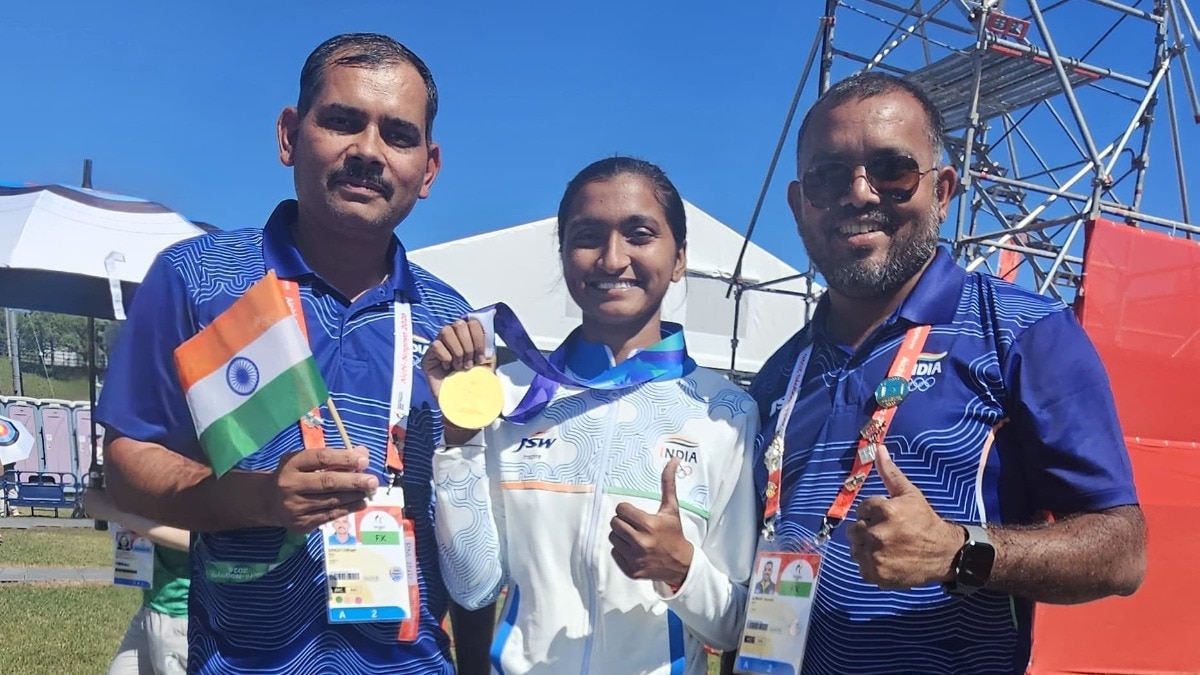
For years, Kirti Sharma was told that her body was not strong enough for archery. The girl from Ritauli village in Haryana was considered too thin to pull a bowstring, and there were people who questioned whether she should even pursue sport. On Friday, the 19-year-old gave the loudest possible answer, helping India win a historic women’s recurve team gold at the Asian Games in Aichi-Nagoya.
Kirti, Ankita Bhakat and Kumkum Mohod defeated South Korea 5-3 in a tense final at Okazaki Chuo Sogo Park. India had never won the women’s recurve team gold at the Asian Games and had never previously reached the final in the event. The victory also ended South Korea’s 28-year reign, with the Koreans having won every women’s team recurve title since 1998.
“I was suffering from poor health since childhood. I had to listen to a lot of negative comments from various quarters doubting my ability to make it big in archery. Since I was not in good shape physically, initially I found it difficult to even lift bows with heavy poundage. But I was determined to do whatever it takes to prove my critics wrong,” Kirti told SAI Media from Aichi-Nagoya, Japan.
“My father is a farmer. But he has always supported me and has taken care of all expenses related to my sports career despite financial constraints,” Kirti said.
“Many people told my father that he should not allow me to go into sports since I was a girl. They also expressed doubts over my ability to succeed due to my poor health. But my father has always believed in me.”
Those words capture the battle Kirti fought long before she stood on the Asian Games podium.REJECTED, THEN GIVEN ANOTHER CHANCE Kirti Sharma was once considered too physically weak to handle a competitive bow. Courtesy: Reuters
Kirti’s introduction to archery came when coach Uddham Singh visited her area near Jind to scout young talent. But the first impression was not a positive one. She was too thin and lacked the strength needed to handle a competitive bow.
According to her father Vijay Sharma, Kirti had a very limited diet as a child and sometimes survived on just a glass of milk for an entire day. Singh initially decided that she needed more time before she could take up the demands of archery.
When the coaches returned in 2019, she got her second chance. She began training seriously, spending years building the strength and stability needed to shoot a recurve bow. Her transformation was not merely technical. It involved changing her diet, developing her shoulder strength and adapting her body to the demands of the sport.
The family also made sacrifices. Vijay, who owns around three acres of land, took a Rs 60,000 loan from a local commission agent in 2022 to buy his daughter a recurve bow.
For a farmer’s family, it was a significant investment. But Vijay believed in his daughter when others did not.HAZARIBAGH CHANGED EVERYTHING
Kirti’s next major turning point came when she moved to the Sports Authority of India centre in Hazaribagh, Jharkhand. The distance from her village was daunting, but the move brought her into a more structured high-performance environment.
The star archer, who trains at the SAI training center in Hazaribagh, asserted that the SAI and her coach Uddham Singh deserves all the accolades for paving the way to Asian Games glory.
"My family and my coach have always supported me and made me believe that I can do wonders. In fact, I appeared for the trials at SAI, Hazaribagh only because my coach Uddham Singh was transferred there. In fact, during my initial years, I used to train at an academy started by Uddham sir," Kirti said.
"I went to SAI, Hazaribagh four years ago. Since then, my career has improved by leaps and bounds. SAI and Uddham Singh sir are responsible for whatever I have achieved."
The work behind that improvement was considerable. Singh has said that Kirti initially needed extensive work on her bow-arm strength, stability and body alignment. At Hazaribagh, the team also worked with nutritionists to help her develop the shoulder muscle power required for elite archery.
The girl once considered too physically fragile had slowly become an international-level archer.STANDING TALL AGAINST KOREA Kirti Sharma rose against the odds against Korea in the Asian Games gold medal match. Courtesy: SAI Media
By the time Kirti arrived in Aichi-Nagoya, she was no longer the girl being judged for what she could not do. She was part of an Indian team capable of challenging the biggest force in Asian recurve archery.
And the final was every bit as tense as expected.
South Korea and India tied the opening two sets, leaving the match level at 2-2. India then produced a crucial 55 in the third set to take a 4-2 lead. In the final set, the Koreans mounted pressure, but India held its nerve. Kirti’s first arrow was reviewed after the final sequence, with officials determining it had scored a 9 rather than an 8. That gave India the set point it needed for a 5-3 victory.
It was India's first-ever Asian Games gold in the women’s recurve team event.
And it was particularly significant for Kirti, whose journey had begun with people questioning whether she was physically capable of holding a bow.
South Korea had won seven consecutive Asian Games titles in the event since 1998. India had never even reached the final. Yet Kirti, Ankita and Kumkum walked into the contest without allowing history to intimidate them.
Kirti’s gold, therefore, is more than a medal. It is the culmination of a journey from a Haryana village to one of Asia’s biggest sporting stages — from being rejected for her physicality to helping India knock down the biggest wall in women’s recurve archery.
The critics had questioned whether she belonged.