One light-day away, a Goan singer's raga sails on Nasa's Voyager 1 Golden Record
Light takes eight minutes to reach us from the Sun.
To reach Voyager 1, it now needs a whole day.
At 3:46 pm Indian time on November 18, 2026, the little spacecraft becomes the first human-made object to drift one light-day from home, about 25.9 billion kilometres into the dark, Nasa calculates. A radio whisper from Earth now takes 24 hours to find it. A reply takes another 24.
It carries no crew. It does carry a woman's voice.
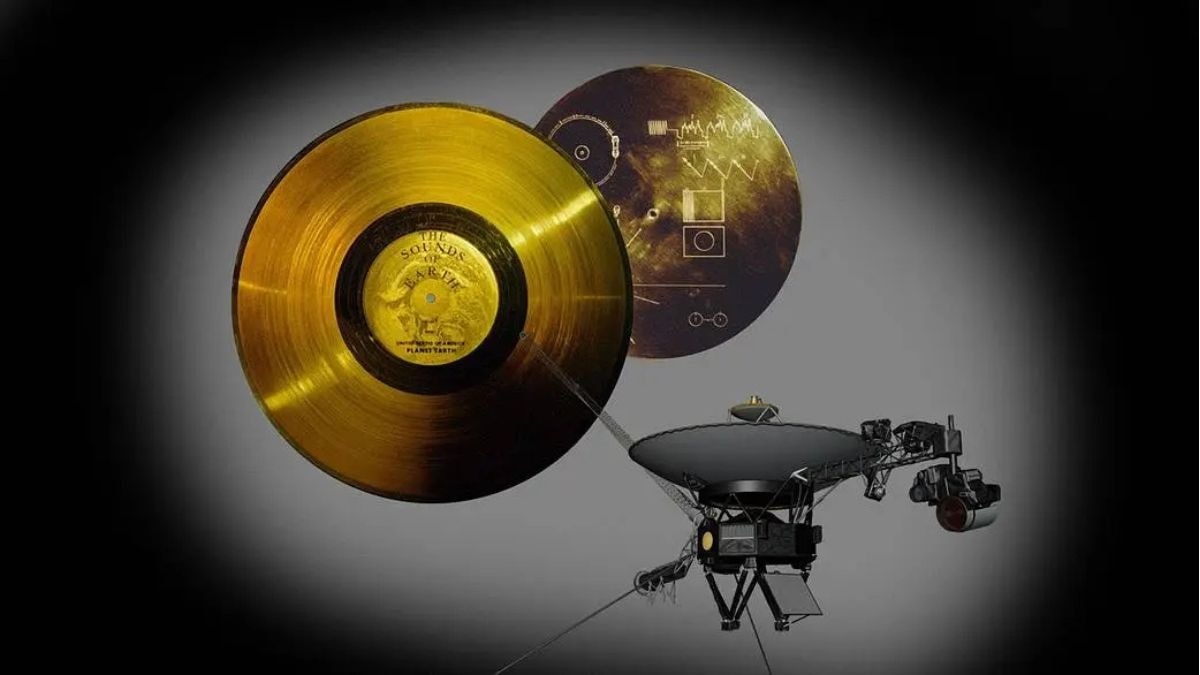
Bolted to its side is the Golden Record, a 12-inch, gold-plated copper disc, humanity’s letter to whoever, or whatever, might one day find it. It holds 115 images, the sounds of wind, thunder and birdsong, greetings in 55 languages and 27 pieces of music. Bach is there. So are Beethoven and Chuck Berry.
And between them, for three minutes and 30 seconds, India sings.WHOSE VOICE IS TRAVELLING THROUGH THE DARK?
The recording is Jaat Kahan Ho, in raga Bhairavi, sung by Kesarbai Kerkar. The title asks a traveller’s question: where are you going?
No song could have chosen its journey better.
Kesarbai was born on July 13, 1892, in Keri, a village in Goa, then a Portuguese colony. She trained under Ustad Alladiya Khan, the founder of the Jaipur-Atrauli gharana, and rose to become one of the most formidable khayal singers of her century.
The American ethnomusicologist Robert E Brown, who helped choose the music, called her Bhairavi the “finest recorded example of Indian classical music.”HOW DID A SINGER WHO SHUNNED MICROPHONES REACH THE STARS?
Here lies the poetry. Kesarbai distrusted the machinery of sound. The music writer Susheela Misra described her as “allergic to broadcasting.” She refused to cut a long-playing record.
When HMV, a historic record label, pressed her to re-record old discs, she vowed never to enter its studio again, according to accounts gathered by the Vijaya Parrikar Library. Kesarbai Kerkar, born in Goa in 1892, was one of the great voices of the Jaipur-Atrauli gharana. (Photo: Vijaya Parrikar Library)
The woman who guarded her voice from the world sent it farther than any voice in history.
She died on September 16, 1977, aged 85. Voyager 1 had left Earth just 11 days earlier.WHAT DID INDIA SAY TO THE UNIVERSE?
Hers is not the only Indian voice aboard. The record speaks in ten Indian languages, Nasa’s archive shows: Bengali, Gujarati, Hindi, Kannada, Marathi, Oriya, Punjabi, Rajasthani, Telugu and Urdu.
The Hindi speaker sent “greetings from the inhabitants of this world.” The Oriya speaker addressed “the inhabitants of the universe from the third planet Earth of the star Sun.” The Rajasthani voice offered the gentlest wish of all: “We are happy here and you be happy there.” The record's cover carries instructions to play it and a map to find Earth. (Image: NASA/JPL-Caltech)
Those voices are there because of one man. Bishun Khare, a senior physicist at Cornell University’s Laboratory for Planetary Studies, was “responsible almost single-handedly for the participation of the Indian speakers,” Nasa’s account records.
He telephoned friends and members of Cornell’s Indian community, explained the project and asked them to speak to the stars. The entire record was made in a matter of weeks.WHERE IS SHE GOING NOW?
Voyager 1 is not playing the record. It simply carries it, silent and sealed, its surface etched with a single line: To the makers of music, all worlds, all times.
In about 40,000 years, the spacecraft will pass within 1.7 light-years of a star called Gliese 445, Nasa says. No one can say who, if anyone, will ever lower a needle onto that golden groove.
But the question has already been asked.
Kesarbai sang it first. Voyager is still answering.- Ends
Radifah Kabir tries to make the universe slightly less mysterious as Senior Sub-Editor at India Today’s Science Desk. A lifelong lover of physics and mathematics, she has spent four years (and counting) translating complex physics papers into English, chasing scientists for interviews, and writing explainers that don’t put readers to sleep. Off-duty, her heart belongs to Lana Del Rey's melodies, Quentin Tarantino's films, poetry, the Star Wars universe, good English movies, series and books, and one very demanding cat.