
Ontario deficit hits record $16.9B as Trump tariffs batter economy - Toronto Star
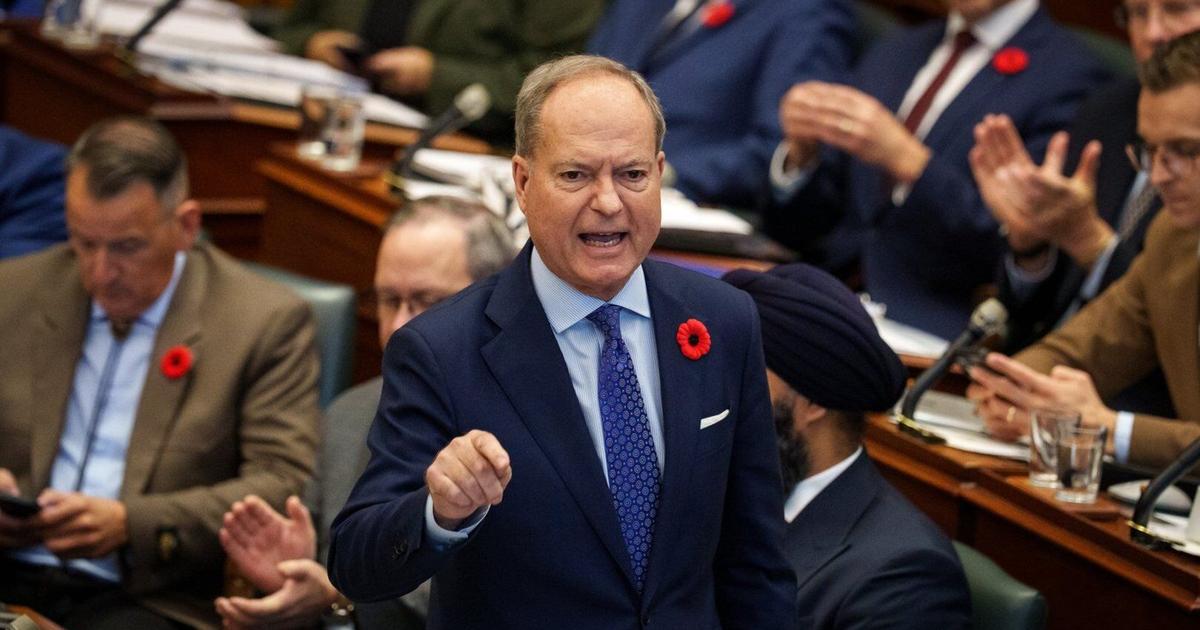
Trump's levies on steel, autos and other goods have forced the Ford government to earmark billions in relief subsidies to shore up impacted industries and their workers.
Ontario minister of finance Peter Bethlenfalvy speaks during question period at the Ontario legislature in Toronto on Tuesday, Oct. 27, 2026.
U.S. President Donald Trump’s trade war and global uncertainty are roiling the Ontario treasury in ways not seen since the most turbulent days of the COVID-19 pandemic.
Trump’s levies on steel, autos and other goods have forced Premier Doug Ford’s government to earmark billions in relief subsidies to shore up impacted industries and their workers.
That has led the Progressive Conservatives to raise this year’s deficit forecast by $3.1 billion to $16.9 billion, eclipsing the record $16.4 billion shortfall in 2020-21 at the height of the global health emergency.
In a speech to the legislature, Finance Minister Peter Bethlenfalvy justified the 22.5 per cent deficit increase in just seven months.
“This is perhaps the most consequential time in our country’s recent history. We are living in a post free-trade, protectionist world,” Bethlenfalvy said Thursday in the fall economic statement.
“The impact of U.S. tariffs which, have hit, among others, our steel, auto and manufacturing sectors and global conflicts such as the Strait of Hormuz impacting energy prices, has led to the world awash in a sea of instability,” said Bethlenfalvy.
“Canada is not immune from these forces. Many of our values are being challenged and events are impacting our country,” he said, also blaming “higher global interest rates, slower economic growth, heightened uncertainty, along with tax cuts for people and businesses” on the flood of red ink.
Bethlenfalvy later told reporters he hiked the province’s contingency fund to $3.8 billion in anticipation of further threats to the economy from the U.S. president.
Among other effects, the tariff war and other Trump policies have resulted in Stellantis moving planned production of its Jeep Compass from Brampton to Illinois, leaving thousands of workers idle and an empty assembly plant, layoffs at Stelco in Hamilton and a two-year delay in Volkswagen opening a massive, $7-billion electric vehicle battery plant near St. Thomas, south of London.
In May, Honda scrapped plans for a $15-billion electric vehicle plant near Alliston, where it has been making the Civic for decades. That factory would have brought another 1,000 jobs to the area.
As first disclosed by the Star last week, Ford and Prime Minister Mark Carney unveiled $8.7 billion to help the auto and steel industries battered by American tariffs and to boost the nuclear energy and critical minerals mining sectors.
“These actions are helping businesses adapt, attract investment, create good-paying jobs and strengthen Ontario’s resilience,” insisted the treasurer.
“While deficits are not desirable in the long term, they are necessary in the current environment,” he said.
To that end, the Tories are forecasting a $12.7 billion deficit next year — more than double what had been projected last March — and a $6.7 billion shortfall in 2028-29 instead of the pre-election $600 million surplus that had been promised.
Bethlenfalvy added there will be a “return to balance by 2029-30,” suggesting Ford’s party hopes to seek a fourth consecutive mandate back in the black.
Coincidentally, the Tories have delayed the path to balance by a year four times since 2024.
The short-term economic outlook is grim — the real gross domestic product forecast has slipped from one per cent growth to 0.5 per cent this year. That increases to 1.5 per cent growth next year, down slightly from the 1.7 per cent that had been anticipated. In 2028, the projection remains at 1.8 per cent growth with 2 per cent the following year.
Ontario’s exports to the U.S. have fallen from 77 per cent in 2024 to 72 per cent last year and 64 per cent in the first eight months of this year.
Overall, last March’s then-record $244.2-billion budget is now a $247.3-billion spending plan.
The Tories will spend $100.7 billion on health — 40.7 per cent of program expenditures — and $40.2 billion on primary and secondary education, $13.9 billion on post-secondary education, $21.4 billion on children, community and social services, and $7.2 billion on justice services.
Interest payments and other charges related to servicing Ontario’s debt of about half a trillion dollars will eat up $17.4 billion or seven per cent of the budget.
Still, Bethlenfalvy emphasized “we are in a strong position.”
“In fact, our government has received two credit rating upgrades. This is almost unheard of not only in Canada but around the world. Our borrowing costs are the lowest they have been in decades,” he said.
But NDP Leader Marit Stiles said the fiscal update is “an admission of failure,” because “never has a government spent so much and gotten so little for the people of Ontario.”
Interim Liberal leader John Fraser noted “people are in a hard spot — Ontario lost 20,000 jobs last month, hospitals are treating up to 2,000 patients a day in hallways, and students are losing access to education through no fault of their own.”
Green Leader Mike Schreiner said “this is where eight years of Doug Ford has gotten us — record deficits and no money to pay for the things we need.”
Noah Jarvis, Ontario director for Canadian Taxpayers Federation, said “Ford is being irresponsible by ratcheting up government spending and piling up more debt on the backs of taxpayers.”
“Taxpayers are already paying massive debt interest costs and Ford’s increased spending is making that problem worse.”
Error! Sorry, there was an error processing your request.
There was a problem with the recaptcha. Please try again.
You may unsubscribe at any time. By signing up, you agree to our terms of use and privacy policy. This site is protected by reCAPTCHA and the Google privacy policy and terms of service apply.
Robert Benzie is the Star’s Queen’s Park bureau chief and a reporter covering Ontario politics. Follow him on social media: @robertbenzie.
Rob Ferguson is a Toronto-based reporter covering Ontario politics for the Star. Follow him on Twitter: @robferguson1.
