Opinion | How and why I became Canada’s Minister of the Environment — and why I left - Toronto Star
A small act inspired me to care for the world.
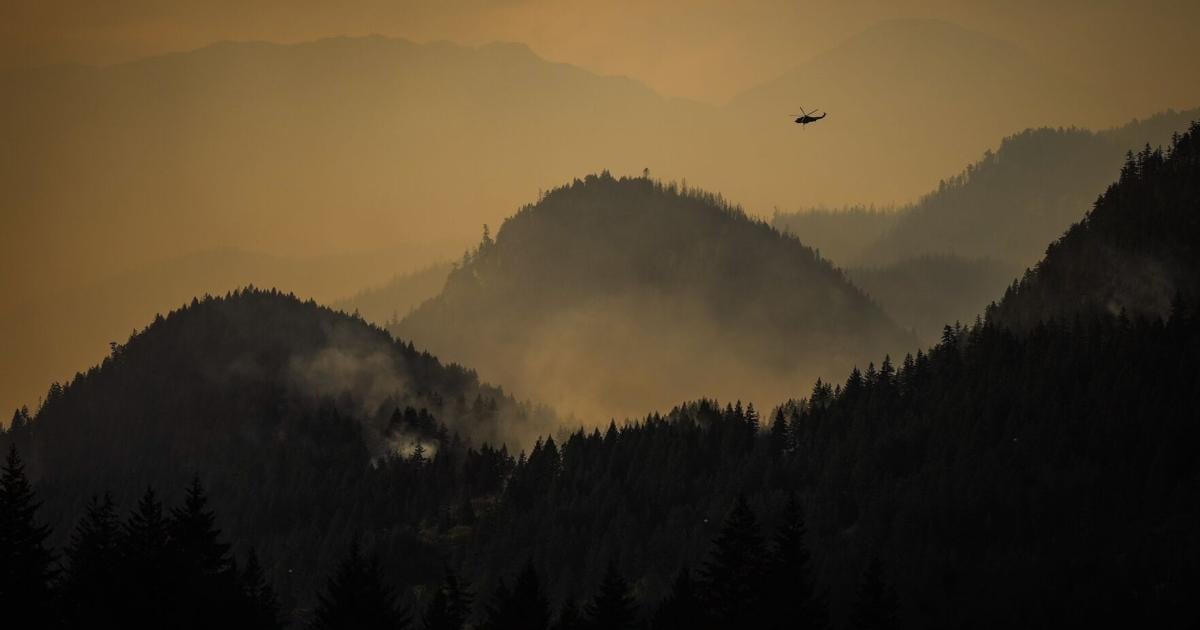
Wildfires, like the one pictured here in Boston Bar, B.C. on Thursday, July 9, 2026 are among the many phenomena we are seeing more intensely or more frequently due to climate change.
Steven Guilbeault is the Liberal member of Parliament for Laurier–Sainte-Marie. He previously served as the minister of Canadian identity and culture under Mark Carney. Prior to that, he was the minister of the environment and climate change from 2021 to 2025, as well as the minister of Canadian heritage from 2019 to 2021.
It all started about fifty years ago, in the backyard of my parents’ house in La Tuque, a small town roughly 130 kilometres north of Shawinigan.
Our home sat on the edge of town, and just behind it was a gorgeous forest — my playground, my refuge, my world. Then one day, a work crew arrived and began cutting it down to make way for a new residential development. I ran inside and told my mother: “Mom, they’re cutting down our forest. What can we do?” She looked at me and said: “Well, if you climb a tree, they won’t be able to cut it.”
And so, at the age of five, with my mother’s blessing, I climbed to the very top of a tree and stayed there for the rest of the day.
I am not sure why my mother told me to climb that tree; she was not an activist by any stretch of the imagination. But that moment planted something in me that has never left. It showed me how something so immensely beautiful could also be very fragile and by encouraging me to act this way, my mother showed me I wasn’t powerless.
I didn’t realize it at the time, but I came down from that tree that evening a slightly different person — I had learned that showing up counts.
Fast forward to 1995. A few months after I turned 25, I embarked on my first overseas trip — one that, without my knowing it, would set the course of my entire life. I was heading to Berlin for what was the very first Conference of the Parties on climate change, COP 1. History was being made, and I was lucky enough to be in the room.
For two weeks, I shared a gymnasium floor with 600 young people from around the world, in what had been, just a few years earlier, East Berlin. We shared a common goal: to convince the world’s governments to agree on an ambitious plan to fight climate change. We were idealistic, impatient and absolutely certain that the facts were on our side.
Steven Guilbeault makes his way to the Liberal Party of Canada caucus meeting on Parliament Hill in Ottawa, on Wednesday, May 27, 2026.
In so many ways, that meeting in Berlin reminded me of the tree I had climbed. The scales were different, of course — we were not talking about one forest here. Instead, the focus was on how climate change was going to impact entire ecosystems. And this time, I wasn’t alone. I discovered a community of people from around the globe who shared my concerns, my anxiety, but also my passion. Many of these people are still in the climate fight even after all those years, and I’m proud to call many of them friends.
Until then, like so many young people, I wasn’t sure what I wanted to do in life. But these climate change events paved the way not only for what I would do over the decades that followed — they would shape the person I became.
I remember that on the last day of the conference, there were a few dozen of us holding two banners in front of the main entrance of the conference centre: one inviting negotiators to commit to an agreement that would set the path to ambitious pollution reduction, and another, to climate catastrophe. I knew then what I would be doing for the decades to come: showing up where decision makers are — whether a UN meeting, a parliament, a provincial legislature — and reminding them of their responsibility toward the planet and its inhabitants.
A few years later, I decided to put the climbing skills I had honed as a child to use on something slightly taller than a tree near my backyard: the CN Tower. I was working for Greenpeace at the time, and we were trying to get Canadians to pay attention to the issue of climate change. We thought that scaling what was then the tallest free-standing structure in the world might help. It worked. The action made national and international headlines and sparked a genuine conversation about climate in this country. Some years later, Canada eventually ratified the Kyoto Protocol. I remember my mom calling me as I was dangling 370 metres above the ground to ask me what the hell I was doing there (I would usually call her before pulling stunts like that, but I had completely forgotten to do it that time); I reminded her that she was the one who started me on that path when she encouraged me to climb that tree!
Forest fires, like the one pictured here, on the town line of Ouray and Ridgeway, Colo. on Sunday, June 28, 2026, have become a stark reminder in recent years of the threats posed by climate change.
For the next two decades, I continued working on sustainability — with Greenpeace, with Équiterre (one of Canada’s largest environmental organizations, which I co-founded around the time of COP 1), and later in the private sector with Deloitte and as an adviser to a venture capital fund dedicated to clean technologies.
Then, in 2018, I was having breakfast in Ottawa with a friend — a close adviser to Prime Minister Justin Trudeau — who dropped what felt like a small bomb in my life. “Steven,” he said, “we would like you to run for us.”
It wasn’t the first time I had been asked. In fact, every major federal political party had approached me at one point or another — with the obvious exception of the Conservative Party of Canada. But this time felt different.
For one, there was the possibility of being part of a government that was showing real ambition on climate, nature and plastic pollution — of finally being able to implement many of the things I had spent decades arguing for: making the oil and gas sector do its fair share on climate, enshrining the right to a healthy environment in Canadian law for the first time in our country’s history, banning single-use plastics.
I had said to myself on that gymnasium floor in Berlin that those were the types of the places I imagined showing up for the rest of my life: a gym with a group a people, a church basement, or with thousands, sometimes ten of thousands of people on the streets. I hadn’t expected one of those places to be a seat in government, rather than a seat at the table pushing government from the outside. But listening to my friend describe the ambition this team was bringing to climate, nature and plastic pollution, I realized the distinction I had drawn in my own head — of inside versus outside — had never been the point. It did not matter where one did the work. The point was always showing up where the decisions got made. The government of Canada was simply a bigger table.
Along the way, other opportunities arose, such as the chance to help convince 196 nations to protect 30 per cent of the planet in Montreal in 2022 at COP 15, the Nature COP, when we worked alongside China to deliver the Kunming-Montréal Global Biodiversity Framework. It remains one of the most significant conservation agreements in history.
Flooding, as pictured here in the swollen Assiniboine River west of Brandon, Man., is a costly effect of climate change that is increasingly being borne by individual Canadians and Canadian taxpayers.
Six years later, I look back on that decision to enter politics with no regrets — and with clear eyes about what was accomplished and what was not.
Some have said that the climate plan I and others painstakingly built simply wasn’t working. The facts say otherwise. Projections published by Environment Canada at the end of 2024 showed Canada on track to reduce emissions by 36 per cent below 2005 levels by 2030 — within reach of our Paris Agreement targets. Those numbers have since been revised downward by the new government, to about half of where we were tracking to be, partly as a result of a deal struck with Alberta that weakens the framework we built. That is a political choice, and Canadians deserve to understand it as such.
Nor was our plan a burden on Canadians, as some have claimed. It’s not about affordability — many of the measures we had implemented would have helped Canadian households save a lot, in many instances thousands of dollars per year.
Others have claimed that our climate policies hurt the Canadian economy. Again, the evidence points in a different direction. Canada attracted a record $85.5 billion in foreign direct investment (FDI) in 2024 — its best performance in a decade — and ranked as the second-largest destination for FDI relative to the size of its economy among G20 nations. Clean growth and economic prosperity are not in conflict. They never were.
But I would be less than honest if I didn’t acknowledge where things went wrong — at least for me.
There are things we could have and should have done better during my tenure as environment minister. One obvious example is the way we handled communications on the important issue of consumer carbon pricing, a piece of legislation that was applauded around the world.
Looking back, we were too focused on defending the mechanism and not focused enough on making people feel the fairness of it. Most Canadian households received more back in rebates than they paid — but that fact lived in a quarterly deposit with an unfamiliar name, not in something people could see and connect to the policy. We should have made that cheque impossible to miss, and impossible to mistake for anything other than what it was: money back in your pocket. Instead, we let our opponents define the policy as a tax first, and spent years trying to correct a story that had already taken hold. That is a communications failure for which I take responsibility.
There are also decisions I regret making — the Bay du Nord oil platform off the coast of Newfoundland is certainly one of them — but such is the exercise of power, and as the saying goes, you don’t always get what you want.
As Justin Trudeau stepped down and Mark Carney became prime minister in early 2025, I expected some things would change. Early on, one of the first casualties of this shift was the consumer carbon pricing mechanism. It was a difficult decision for me to accept, but I understood it: the policy had become a political hot potato.
I was, however, reassured by commitments made numerous times by the government that we would make up the loss in pollution reduction through the use of other measures.
Steven Guilbeault, former Minister of Environment and Climate Change, writes that he first began to care about the environment when trees near his childhood home were soon to be razed.
In November 2025, I resigned from cabinet. The immediate cause was an agreement reached with Alberta that, in my view, sacrificed many critical elements of our fight against climate change and provided a path for the oil and gas sector to continue expanding emissions while receiving public subsidies. I could not, in good conscience, defend that agreement. And so I left.
I have deep respect for Prime Minister Carney and many of the people in his government. The disagreement I have is not personal — it is substantive. I believe, as I always have, that markets are a powerful tool in the fight against climate change. I used them as a minister. But markets alone will not stop a crisis that is already reshaping the lives of millions of Canadians.
The evidence is everywhere: intensifying wildfires, more frequent flooding, record heat waves, catastrophic storms. According to the Insurance Bureau of Canada, the cost of natural catastrophes in this country has risen from an average of $600 million per year in the early 2000s to $8 billion in 2024. The bill is arriving. The question is who pays it — and when.
And yet, I am optimistic — genuinely, stubbornly, unreasonably optimistic.
It is not because the situation is not serious. It is. But because I have spent more than thirty years watching people — scientists, activists, Indigenous leaders, farmers, young people, city councillors, engineers — I refuse to give up. I have seen what happens when human beings decide that something matters enough to fight for. I have stood in rooms where history was being made, and I have learned that history is not inevitable. It is chosen.
When I climbed that tree in La Tuque at the age of five, I did not have a plan. I just knew, in the wordless way that children know things, that what was happening was wrong and that someone had to do something about it. My mother gave me permission to act.
Fifty years later, that is still what I believe: that we have permission — and a responsibility — to act. The climate crisis will not be solved by any one government, any one policy, or any one person. It will be solved by the accumulation of millions of decisions made by people who refuse to accept that the world cannot be different from what it is.
I have left elected office. But I have not left the fight. Not even close.
Error! Sorry, there was an error processing your request.
There was a problem with the recaptcha. Please try again.
You may unsubscribe at any time. By signing up, you agree to our terms of use and privacy policy. This site is protected by reCAPTCHA and the Google privacy policy and terms of service apply.
Steven Guilbeault is the Liberal member of Parliament for Laurier–Sainte-Marie. He previously served as the minister of Canadian identity and culture under Mark Carney. Prior to that, he was the minister of the environment and climate change from 2021 to 2025, as well as the minister of Canadian heritage from 2019 to 2021.
Opinion articles are based on the author’s interpretations and judgments of facts, data and events. More details