Opinion | What Canada should learn from China on fighting Trump - Toronto Star
As a China specialist who has watched Beijing face Trump twice, the lesson for Ottawa is blunt: retaliate to change behaviour, not to keep score.
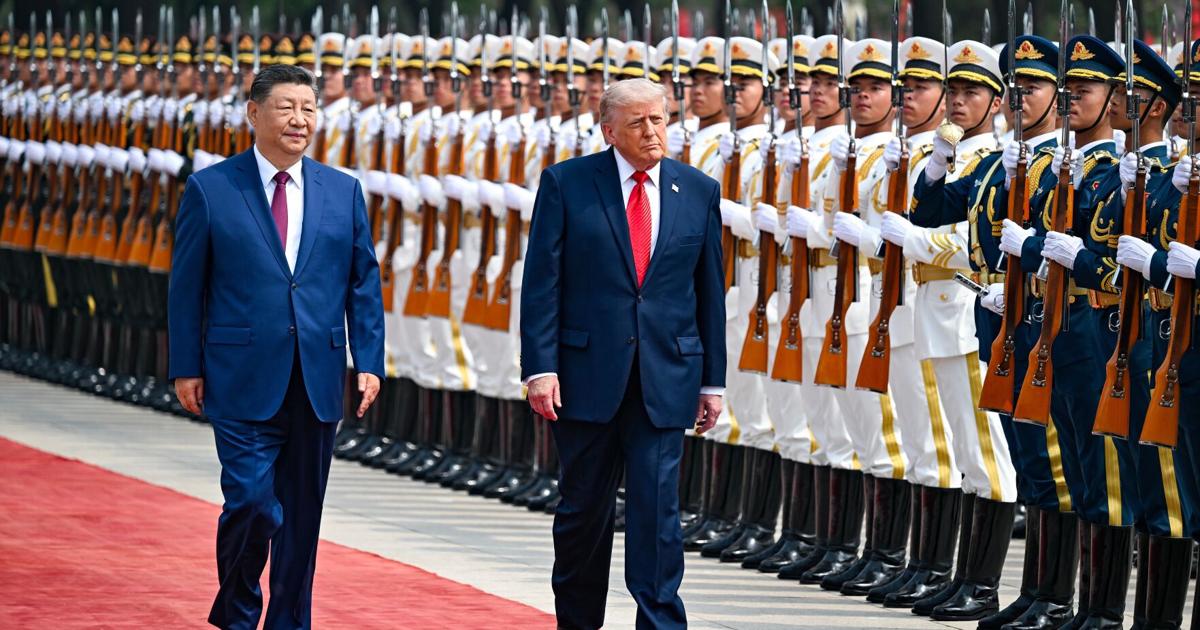
U.S. President Donald Trump reviews troops with China’s President Xi Jinping at the Great Hall of the People, Thursday, May 14, 2026, in Beijing. Canada should mimic China’s method of fighting a trade war with Trump, writes Wenran Jiang.
Wenran Jiang, the founding director of the China Institute and MacTaggart Research Chair Emeritus at the University of Alberta, is the president of the Canada-China Energy and Environment Forum and an adviser at the Institute for Peace and Diplomacy.
Last week, Canada’s dollar-for-dollar tariffs on $27.6 billion of U.S. goods took effect — 15, 25 and 50 per cent on steel, aluminum, dairy, appliances, farm equipment and electronics, plus $7.5 billion in relief.
These measures are necessary as a signal, but matching Washington tariff-for-tariff is the weakest part of any trade fight. As a China specialist who has watched Beijing face Trump twice, the lesson for Ottawa is blunt: retaliate to change behaviour, not to keep score.
Look at the 2025 U.S.–China round. When Washington imposed 34 per cent “reciprocal” tariffs, Beijing matched, then bundled in export licences on seven medium and heavy rare earths, entity-list restrictions and WTO suits. When the U.S. escalated to 84 and then 125 per cent, China matched once and then refused further increases as “meaningless,” letting rare-earth licensing do the work. The Geneva truce rolled back most incremental tariffs while leaving Beijing’s licensing and consultation leverage in place.
The lesson is not “use rare earths” — Canada cannot. China is a great power; Canada is not. But the point is not size — it is leverage.
A smaller economy cannot win a tariff war of attrition, but it can impose costs by targeting bottlenecks the other side cannot quickly replace. It is to pair visible tariffs with a bottleneck we actually control, and to stop mirroring once the numbers stop hurting the other side more than us.
China’s response to Canada’s own EV tariffs is the better template — and it shows de-escalation can work. Ottawa imposed a 100 per cent duty on Chinese EVs and 25 per cent on Chinese steel and aluminum in October 2024, largely following Washington. Beijing responded with targeted, legally wrapped measures on canola, pork and seafood — conditionally reversible from the start.
After Prime Minister Mark Carney’s January 2026 Beijing visit, both sides stepped back: Canada abolished the 100 per cent EV tariff and China also scaled back its tariffs on Canadian agricultural products and seafood and paused WTO panel fights while talks continue. Canola oil, pork and some seafood remain taxed, so this is not total surrender by either side — it is a managed off-ramp that restored most Prairie access without either capital losing face.
One reason Beijing moves faster is structural: a centralized system can launch a probe, set tariffs and issue export licences under one authority. Canada cannot and should not copy that; in a federal democracy the equivalent of speed is consent-based co-ordination.
Ottawa should institutionalize a whole-of-federation trade-retaliation mechanism — first ministers and relevant ministers, with relevant sectoral representatives and labour at the table. Preauthorize standby instruments (export permitting, relief, quota administration) so that, when Washington acts, Canada responds within days instead of after intergovernmental brinkmanship.
Saskatchewan and Manitoba can align on canola and potash, Alberta on energy egress, Ontario and Quebec on autos and manufacturing; a shared playbook is what makes retaliation credible and reversible. Size alone does not determine who blinks first; leverage does.
For the U.S. fight, Canada should borrow the method, not Beijing’s targets. Keep the current counter-tariffs, but legislate an export-licensing framework for potash, uranium, nickel and selected critical minerals: not a ban, not an National Energy Program-style oil weapon, but discretion that creates uncertainty for U.S. buyers where substitution takes years.
Pair this strategy with accelerated LNG and Pacific crude egress so the signal is “we may sell to others,” not “we will cut you off.” Energy, potash and uranium were carved out of Washington’s Section 338 list; that tells us where American dependence already lies.
Just as important is the exit ramp. As the China case shows, retaliation should name the conduct that triggers relief — drop the 2027 auto-to-50 per cent threat, stop using Section 338 on CUSMA-compliant goods and respect the poison-pill and cultural red lines Carney has set.
Retaliation that merely mirrors a larger economy invites escalation; retaliation that is legal, sector-precise, hard to substitute, federally co-ordinated and tied to a defined exit changes the other side’s calculus.
Error! Sorry, there was an error processing your request.
There was a problem with the recaptcha. Please try again.
You may unsubscribe at any time. By signing up, you agree to our terms of use and privacy policy. This site is protected by reCAPTCHA and the Google privacy policy and terms of service apply.
Wenran Jiang, the founding director of the China Institute and MacTaggart Research Chair Emeritus at the University of Alberta, is the president of the Canada-China Energy and Environment Forum and an adviser at the Institute for Peace and Diplomacy.
Opinion articles are based on the author’s interpretations and judgments of facts, data and events. More details