Organized crime and drug-related deaths rise Germany
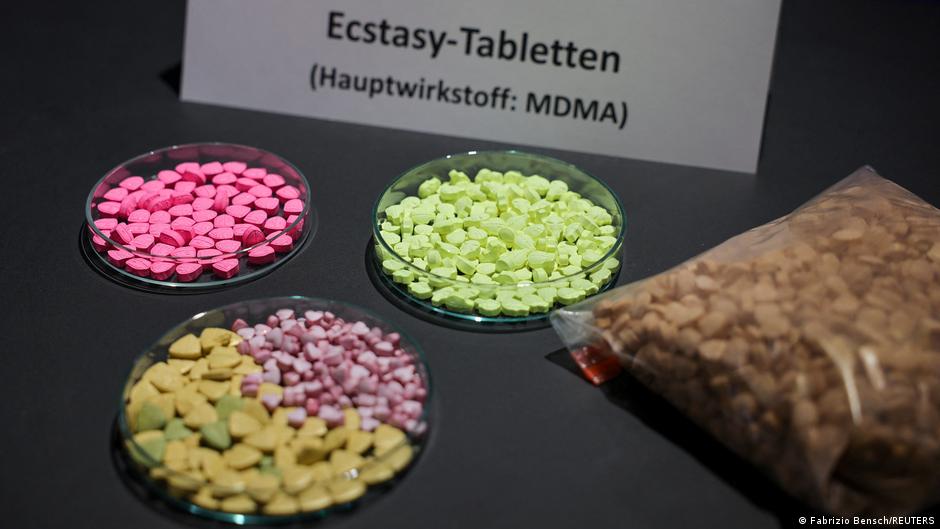
There were more drug-related deaths in Germany in 2025 than in the previous year Image: Fabrizio Bensch/REUTERSAdvertisement"We are experiencing a flood of cocaine in Germany," German Interior Minister Alexander Dobrindt, from the Christian Democrats (CDU), said earlier this week as a new police report was presented. "We are experiencing a record number of drug-related deaths. We are seeing children being exploited as criminals."
Standing alongside Dobrindt, Holger Münch, the president of the Federal Criminal Police Office (BKA), and Hendrik Streeck, the German government's drug and addiction commissioner, presented findings described as alarming.
Last year, 10 tons of cocaine were seized, two thirds of that amount in German ports. And 2,150 people lost their lives because of drug use, 13 more than in 2024.
Profits generated from drugs by international organized crime networks are often invested in real estate to conceal their origin. Münch said that 195 cases of money laundering, amounting to almost €1.4 billion (ca. $1.6 billion) had been investigated in 2025.
"They [the criminals] use their considerable financial clout to bribe and to exert influence," he said. "And they launder the money and funnel it into the legal economic system."
He added that the most widely used drug was cocaine and that it posed a threat to the state, the economy and society as a whole.
"It is not only the state that is being damaged," said Streeck. "Above all, it is people who are being damaged."
About 83% of the drug-related deaths concerned men, whose average age was 41.
"They are all customers of a market that deals in deadly substances and is driven by violence, environmental destruction, extortion and exploitation," said Streeck, who trained as a doctor.
He insisted that there should be zero tolerance for those who profited from addiction and zero indifference to those suffering from it. His focus is on preventative measures, which include a public awareness campaign about the impact on health and the environment.
He explained that in some countries, rainforests were being cleared to make way for cocaine production. Streek pointed out that toxic substances used for processing the drug, such as kerosene or battery acid, ended up in the soil and water. Farmers and their families were blackmailed. He lamented the fact that cocaine had become more popular in Germany.
"There is blood on every gram of cocaine consumed for pleasure," the drug and addiction commissioner stated.
Streeck added that the situation had changed significantly in recent years and the market had gone digital.
"Dealers are no longer on the street corner; they're on the phone. For example, people can order so-called 'cocaine taxis' [cars that deliver drugs to any location] via QR code," he said.
"What is particularly alarming is that criminal groups are recruiting minors through social media or gaming platforms," he added. "Organized criminals look for recruits in the places where young people spend their free time."
Münch noted that this development posed a particular challenge for German and international law enforcement agencies. He said that, more and more, the cliched image of organized crime — discretion, isolation and closed structures — was a thing of the past. The fact that people can purchase criminal services on the dark web represents a paradigm shift, according to Münch: "It's not just a question of who commits a crime, but of who ordered it, who financed it, who is profiting from it?"
Moreover, there is a suspicion on the part of investigators that state actors are increasingly involved in opaque crime activities, launching attacks as "hybrid threats."
Münch said that "money laundering, corruption and violence can contribute to social destabilization."
In 2025, there were about 600 investigations into cases of organized crime in Germany, which has been the average for the past five years. The German police considers one of its major successes to be the shutdown of the Archetyp Market, an online drug marketplace on the darknet. Its administrator was arrested in June 2025. He had overseen the sale of cocaine, heroin, cannabis and other drugs, amounting to 250 million. When the platform was shut down there were 3,200 registered sellers and 612,000 customer accounts according to the police.
This article was translated from German.