Pakistan’s environmental ranking improves yet air quality lags
Direct Source Verification:
This story is aggregated from The Express Tribune (tribune.com.pk). Full reporting rights and copyright belong to the primary publisher.
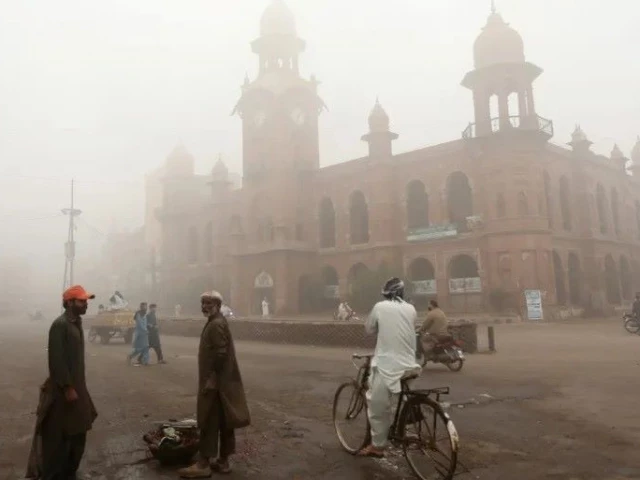
Lahore’s average AQI in the first 23 days of September was 96, up from 80 during the same period last year
Pakistan has improved 22 places in the 2026 Environmental Performance Index (EPI), ranking 157th out of 177 countries, but its performance in air quality and environmental health remains among the weakest globally, raising questions about whether the overall improvement reflects actual progress in controlling pollution.
According to Yale University’s 2026 Environmental Performance Index report, Pakistan scored 29.03 overall, with an environmental health score of 14.57 and an air quality score of just 7.54. Pakistan ranked 179th in 2024, but changes to the methodology and indicators in the 2026 index mean the two rankings should be compared with caution.
The 2026 index includes 47 indicators across 12 major environmental categories. Experts say the improvement in Pakistan’s overall ranking cannot, therefore, be taken as direct evidence that air pollution has declined.
Available air-quality data indicate a different trend. During the first 23 days of September 2026, Lahore’s average Air Quality Index (AQI) was approximately 96, compared with about 80 during the same period last year. On September 23, Lahore recorded an AQI of 153, compared with 97 on the same date last year.
Rawalpindi also recorded a higher average AQI during the first 23 days of September 2026, at approximately 116, compared with about 75 during the corresponding period last year. In Lahore, pollution levels also tend to rise during morning and evening hours, further affecting air quality.
Environmental expert and lawyer Rafay Alam said smog should not be viewed solely as a winter problem, as transport, power generation and industrial emissions remain important sources of pollution throughout the year. He noted that changes in temperature and air pressure during winter cause pollutants to accumulate closer to the ground.
Alam called for sustained, long-term policies, better public transport, greater use of electric vehicles and alternative energy, stronger controls on industrial emissions and improved fuel standards.
Read More: Call to protect capital's shrinking green cover
According to data from the Punjab Environmental Protection Agency (EPA), fines totalling Rs305.1 million were imposed for violations of environmental laws during 2025-26, 66 per cent more than the previous year. During the same period, 5,461 sites were sealed and 1,467 polluting units were demolished, while 101,159 inspections of brick kilns and industrial units were conducted.
During a one-week period, 577 anti-pollution operations were carried out across 40 districts of Punjab. Of 7,203 field visits, 607 violations were identified, fines of more than Rs22.8 million were imposed, 483 properties and industrial units were sealed and 30 cases were registered.
Authorities also confiscated 12,906 kilograms of banned plastic bags during the same period. In Lahore, 180 properties were sealed during 181 enforcement operations.
The owner of an industrial unit on Mahmood Booti–Band Road, speaking on the condition of anonymity, said the EPA had made it mandatory in 2023 for such industrial units to install emissions-control systems. According to him, steel mills and other industries that installed the systems were not shut down during the 2023 smog season, while industrial closures during smog began in 2024 and 2025.
"Repeated fines and temporary closures led some industrialists to prefer paying penalties rather than installing emissions-control systems," said the industrialist, who called on the government to focus not only on fines and closures but also on ensuring the installation and effective monitoring of emissions-control systems.
According to the industrialist, a standard emissions-control system can cost several crore rupees, although effective systems are also available at comparatively lower costs.
The available data do not establish that Punjab’s recent anti-pollution enforcement efforts caused Pakistan’s improvement in the global environmental ranking. Experts say their impact can only be assessed through continuous, long-term monitoring of air quality and industrial emissions using a consistent methodology.
Original Source
https://tribune.com.pk/story/2632806/pakistans-environmental-ranking-improves-yet-air-quality-lags