Paris artist reveals heatwave’s devastating impact on homeless in stark drawings
As Paris transitions into the cooler temperatures of autumn following months of intense heat, the memory of France’s hottest summer on record remains vivid — preserved in the work of illustrator Marina Antonova.
While the French capital is globally renowned for its architectural and aesthetic charm, the city repeatedly featured in international news as record-breaking temperatures rose beyond 40C (104F) on its sun-baked streets.
In a collection of illustrations titled "Chronicles of a Heating Planet", Antonova has depicted a city under acute heat stress, highlighting the impact on the homeless population in particular.
"The heat wave made it so much worse," Antonova told The Associated Press in a recent interview at the Paris apartment where she drew much of her work. "Usually winter is the hardest part for homeless people; now we have a situation where both winter and summer are horrific."
Her drawings portray rough sleepers hunched forward in despair, clutching their knees, or collapsed on pavements.
"It was such a contrast, people working in posh air-conditioned offices and homeless people sleeping in front of those offices," Antonova, 37, said. "I cannot imagine how people survived."
Since relocating to France from Russia four years ago, Antonova has moved between temporary accommodation. Despite support from friends, she frequently endured poor living conditions, mental strain, and limited financial resources.
The intense suffering of those living on the streets resonated with her, leaving her distressed by an inability to provide further help.
While extra blankets can offer warmth during winter, relieving body heat during periods of extremely high daytime and night-time temperatures presents a different challenge. "You bring them water and ice but it never stops," said Antonova, who reflected the aggression of an unyielding sun through her choice of palette.
"In my images there is a lot of yellow, an acid color," Antonova said. "Usually you associate the sun with something nice, this year it was very different for everyone. It felt very aggressive and dangerous, there were also fires around the country."
Other works in the collection show animals disorientated inside burning forests, with deer running directly towards fires as escape routes disappear.
"What happens to beauty when the landscape itself turns hostile?" Antonova asks. "Wildfires burned across southern Europe and then — in a place long thought safe from them — at the edge of Paris itself. In July, fire swept through the forest of Fontainebleau."
Unprecedented fires also destroyed vast areas of forest near Bordeaux, forcing thousands of residents from their homes. Countries across Europe, including Italy and Spain, recorded extreme heat on a continent recognised as the fastest-warming in the world.
During successive heatwaves this year, France registered at least 7,200 more deaths than expected, according to estimates by the national public health agency using statistical models based on historical data.
"Chronicles of a Heating Planet" examines the reality of daily life when climate change shifts from a future forecast to an ongoing condition.
"These paintings are not illustrations of a single event," added Antonova, who began drawing as a child. "They are observations of a future that has already arrived."
As extreme temperatures severely affected daily life, navigating Paris in the sun became increasingly difficult.
"I have an artist friend who still lives in Russia. When I sent her my new drawings of Paris, she said ‘Oh thank you, I will never go to Paris after this,’" Antonova said. "We called this series ‘anti-postcards.' The kind of postcards where you don't want to go to the place. It's a kind of sad joke."
The series prompts questions about whether recurring heatwaves might eventually deter visitors from standing in long queues at the city's popular landmarks. "In five or 10 years Paris could get so hot people might not want to go here, not in summer, anyway," Antonova suggested.
"My series about the heat wave gave me the opportunity to look at very familiar places with a new angle," she added. "To rethink the tourist attractions in a more sinister and dangerous atmosphere."
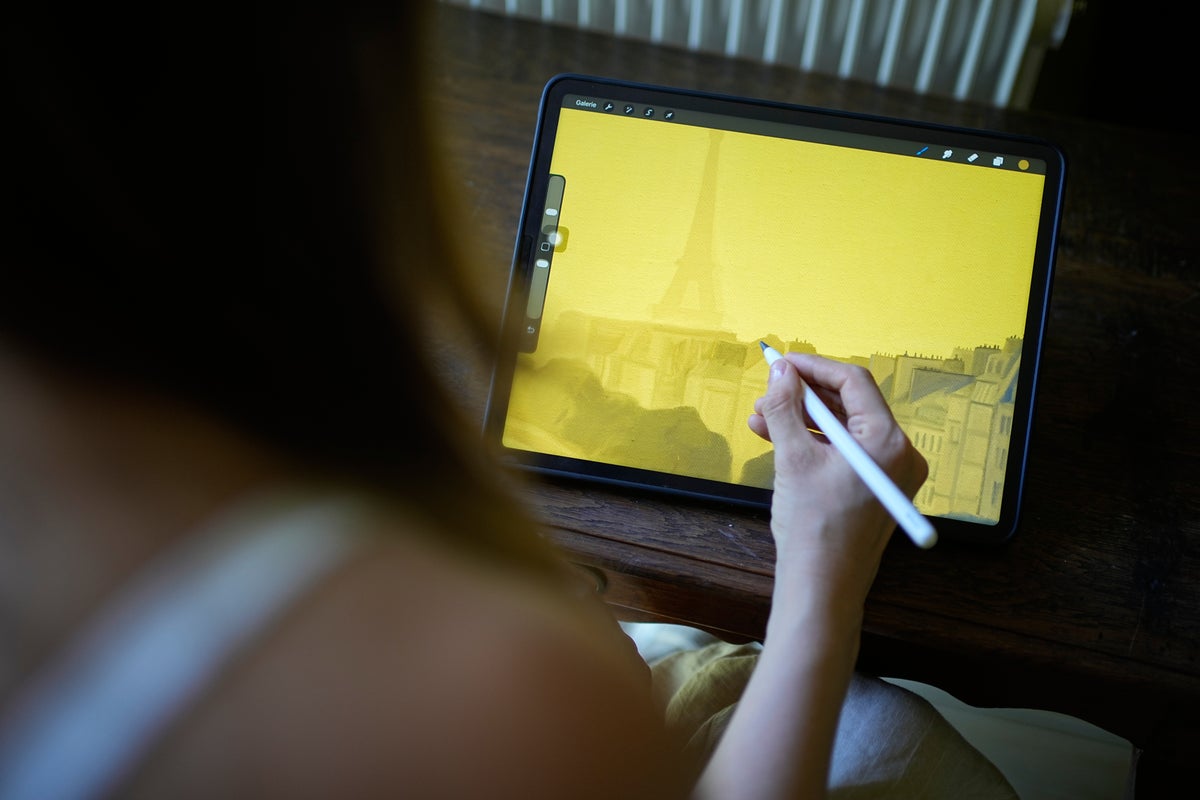
Antonova created the digital illustrations on an iPad, using photos taken on her mobile phone across various parts of the city.
"Since I became an immigrant it was difficult to organize studios every time I moved, so I started working more with digital illustration," she explained.
"Usually I wouldn’t do drawings about something on the news because I would need a longer time to process and create the painting. Ipad gives you the immediacy because it’s so much faster."