‘Pay up your one cent’: SARS admits error over bizarre tax demand - IOL
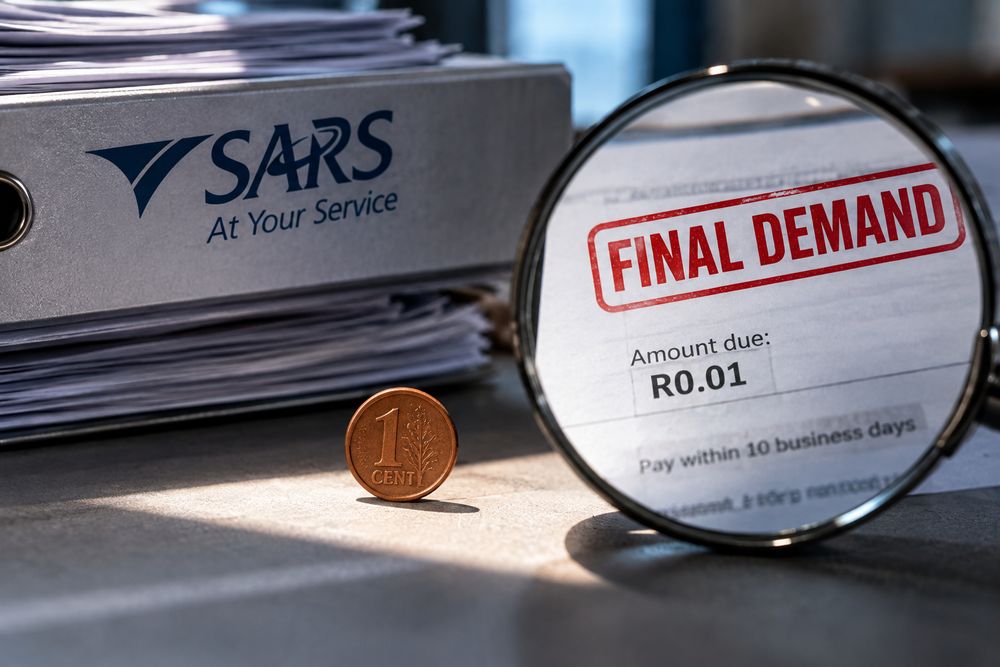
SARS says it made a mistake when it sent a letter of demand for R0.01.
The South African Revenue Service (SARS) has admitted it mistakenly issued a taxpayer with a final demand to pay an outstanding tax bill of just one cent.
Responding to questions from IOL, the revenue service acknowledged that the demand should not have been sent. “The letter was issued in error,” SARS said.
The tax man did not explain how the error occurred or respond to IOL's other questions, including whether there is a minimum amount below which it does not pursue outstanding tax debt.
It also did not say whether an outstanding balance of just one cent could affect a taxpayer's compliance status or refund or potentially trigger further collection action.
It is not the first time errors by SARS have surfaced in tax disputes before the courts.
In a 2016 Tax Court case, SARS's own mistakes were taken into account when the court reduced additional tax imposed on a taxpayer from 50% to 35%.
The dispute concerned the taxpayer's 2009 tax affairs. During the process, SARS issued an assessment showing that no tax was payable because of a system error. A later assessment indicated that more than R10.4 million was due to the taxpayer, which SARS also acknowledged resulted from an error on its part.
The court said: “The court has considered all the facts, as well as the fact that SARS itself is not blameless, as it has admitted to two errors at two different times in the assessment of the appellant’s taxes, namely on 16 September 2010 and again on 8 February 2012.”
The taxpayer's appeal succeeded and the additional tax was reduced to 35%, or about R3.82 million. However, the court did not find that SARS was wrong to impose a penalty at all, and each party was ordered to pay its own costs.
In a separate case in 2019, the Supreme Court of Appeal noted that SARS had made an “obvious error" in the three respects when calculating a taxpayer's liability.
The errors were identified and corrected by a SARS forensic auditor while preparing for the tax appeal. The taxpayer ultimately lost the appeal, which was dismissed with costs.
The latest error was first reported by Moneyweb after an unnamed taxpayer supplied the publication with a copy of the final demand with identifying information removed.
Moneyweb reported that the taxpayer was instructed to settle the R0.01 outstanding amount within 10 business days. Along with the demand came instructions setting out options normally available to taxpayers facing outstanding debt.
These included applying to defer payment, disputing and seeking suspension of the debt, applying to compromise part of it or seeking a waiver of penalties once the capital amount had been paid.
In this case, the capital amount was one cent. The taxpayer told Moneyweb they believed the demand had been generated automatically and questioned whether there was human oversight of correspondence being sent to taxpayers.
Moneyweb also reported that this was not the first time a relatively small amount owed to SARS had caused problems for a taxpayer.
In another case cited by the publication, a taxpayer expecting a R323,000 refund discovered it had been blocked because SARS regarded them as being R50 behind on their pay-as-you-earn tax profile.
According to Moneyweb, neither the taxpayer's accountant nor a SARS consultant initially understood why the refund had been blocked, and the matter had to be escalated.
The consequences of an outstanding tax debt can extend well beyond the amount itself.
SARS's own guidance says a final demand can be followed by the appointment of a third party, including an employer or bank, to pay money it holds or owes to the taxpayer directly to SARS to settle outstanding tax debt.
Moneyweb also reported that SARS acknowledged another correspondence error in 2013, when taxpayers were sent final demands when they should instead have received reminders. At the time, SARS told affected taxpayers: “we unfortunately issued you with a final demand letter instead of a friendly reminder”.