
Pezeshkian Exclusive: Iran President Calls US, Israel "Real Terrorists" | India Today Global
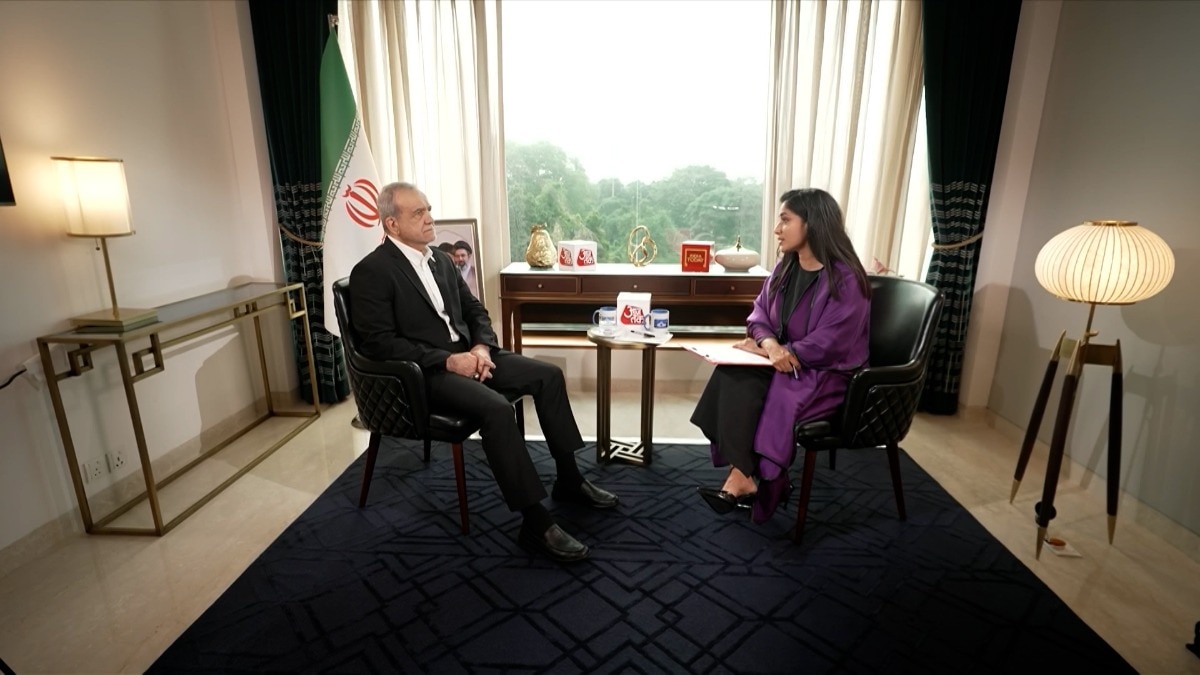
Iran arrives at the BRICS Summit in India at perhaps the most consequential moment of the past decade, still reeling from war with the United States and Israel while grappling with mounting economic strain at home. President Masoud Pezeshkian insists his country has emerged more united, not weaker, and argues that institutions such as BRICS offer a genuine path towards a multipolar world. In this exclusive conversation with India Today Global, he addresses the blockade at Hormuz, stalled negotiations and accusations levelled at Washington and Tel Aviv.
GEETA MOHAN: India is hosting leaders of the BRICS at an extraordinary moment for the world. Wars and sanctions, economic stress, and an increasingly contested international order. Among leaders in New Delhi is the President of Iran, who comes at perhaps the most consequential moment his country has faced in decades. Iran comes to BRICS while confronting the United States of America and Israel, looking at economic stress back home, and arguing that institutions such as the BRICS can help build a multipolar world. Now, can it? Let's find out. I'm being joined in an exclusive conversation with the President of the Islamic Republic of Iran, Dr. Masoud Pezeshkian.
GEETA MOHAN: Honourable President, thank you so much for joining us. Welcome, President.
MASOUD PEZESHKIAN: Thank you for this interview. In the name of God, we are happy to be here among the dear people of India and all the viewers and listeners. I would like to say greetings to them.
GEETA MOHAN: Thank you so much. Let's begin with your bilateral meeting with Prime Minister Narendra Modi. One is the iconic photo where the leader was holding your hand and walking you through the gallery. And secondly, a 45-minute-long conversation. Tell us what really happened. What was the focal point of the discussion? What was the focal point of the discussion?
MASOUD PEZESHKIAN: I would like to say that our relation with the Honourable Prime Minister of India, since the time that I took office, is increasingly engaged, getting better on a daily basis. And in fact, because of that deep cultural relations that we had with each other, the two countries of Iran and India enjoy a long history within several millennia. And this is not something which would change during time. And naturally, we are trying to improve these relations on a daily basis, and base it on the deeply rooted culture. And we would be able to build a new structure upon that and help each other in order to counter the totalitarianism which is developing in the world, and help out each other.
GEETA MOHAN: Okay, that's a very important point that you make. But we're talking about a country that now is at war. And India has to take a step back. And India has to take a step back. In terms of strategic interests in Iran, Chabahar port is an important one. How viable do you think Chabahar is for India and continues to be for India amid war, conflicts, and attacks that we've seen in Chabahar?
MASOUD PEZESHKIAN: There was a war in Chabahar. You see, we did not start the war. They started the war. And based on no international recognisability, they started the war. And the war is still going on. The war is still going on.
And we have to start from the beginning. The war is going on. And if you want to look at this issue, they attacked our country without any established framework. They martyred our leader. They martyred our military commanders. They martyred innocent students at school during one day. They martyred all of them. They martyred our scientists. And they bombarded our infrastructure. And unfortunately, what they did cannot be recognised according to any internationally recognized principles. Therefore, the trend they are following, actually, we defended ourselves. And regarding Chabahar and its relation, and the relation that we can have with India, I would like to say that Iran is located in a geopolitically spot that, in terms of public transportation and regional connectivity, it's a crossroads. It can connect south to north, west to east, and each country is together. And this is the easiest and most economical route for the regional countries in establishing economic ties, cultural, political, scientific, and social relations. And it used to be, since the past, Iran was a spot in the Silk Road, and the connectivity among civilisations were developed through these routes. Now we can revive it. We are ready to revive this route again. We should actually help each other in this regard. And naturally, it will help us to exchange experiences and cultures.
GEETA MOHAN: Right, President, sir. Did this Chabahar and investments of Indian Chabahar come up during discussions with the Prime Minister?
MASOUD PEZESHKIAN: During the discussion that we had with each other, overall, we talked about various orientations and approaches. India can invest there. Currently, it has, there are some investments, and it is underway. It can come and have a partnership, or maybe in terms of trade, we can have a kind of partnership or cooperation with each other. So we can, regarding various issues, we can have a network of interactions. So we are ready, and in all those choices, we are ready to cooperate.
GEETA MOHAN: Right, President, sir. You also addressed the business, economic forum. How viable is Iran for investors to look at Iran? Because at a time when you're looking at sanctions, they're not international sanctions, they are U.S. sanctions, they're country-based sanctions. No country should be honouring them. But nonetheless, amid those sanctions, how can Indian businesses work in Iran or with Iran?
MASOUD PEZESHKIAN: President, sir, I would like to talk about India. You see, the objective breaks. And what we have come here for is that regarding the trend which has begun by the U.S., and, you know, actually, it sanctions any country it wishes. On the other hand, the BRICS intention is to break this kind of totalitarianism. That is why BRICS was developed. And we're supposed to change the type of interactions and the type of trade and cooperation, regardless of and independent from the fact that one country may be, you know, at whim to sanction other countries. So we are here to help each other and to support each other so that this unilateralism can be fought against. And this is the objective of this summit meeting, with great countries of the region, countries of the world, like China, India, and Russia. So we are here, and we try to derail America from this unilateralism. This is the mission and responsibility of this summit that we have to fulfil.
GEETA MOHAN: But the success of the BRICS will also come if there's a joint communique. And it does seem like problems between the UAE and Iran have become a great impediment in getting a joint communique.
MASOUD PEZESHKIAN: We have no problems with the UAE. We have no problem with any of the regional countries. We have problem with the American bases located in these countries, and from which they are attacking our country. The UAE, the Emiratis, and other countries of the region are our brothers. We have been living together for a long time. And we have had trade. We have supported each other. So this is the U.S. who has come here and established bases. And from those bases, they martyr our children. They attack our infrastructure and target our leaders, commanders, and people. In fact, the problem is that the friendly and neighbouring countries should not allow enemies to utilise their soil to attack our country. Right now, we have a good relation with the UAE, and we can expand it. And with other countries, the same happens. So we would like to have a sincere relation with all of them. However, it is the U.S. which does not want this to happen. And the reason is that they want to utilise our petroleum reservoirs of the region. And instead, they are selling weapons and missiles to the region. And the reason is that they want to use the U.S. as a weapon against the U.S., in order to scare us from each other and pit us against each other. It is actually exploiting the capital of the region. And also, it is destroying the peace and stability. We, with the neighbouring and regional countries, can share our powers in order to help each other and establish security and help our people. Right now, we have a good relation with the UAE, and we can expand our infrastructure and target our leaders, commanders, and people, in order to promote our culture and economy again.
GEETA MOHAN: Right. I'll talk about the UAE, Saudi Arabia, and countries in the Arab world. But before that, can we be hopeful that there will be an outcome document, that there will be a joint communique this time?
MASOUD PEZESHKIAN: Do you mean in BRICS?
MASOUD PEZESHKIAN: As for BRICS, we are trying so that this would happen. And this trend is currently getting better and improving on a daily basis. In all these issues, we can cooperate with each other. And the new development bank of BRICS, which has been established, aims at the fact that the member countries will have joint investment and support each other, and we will promote development. Well, naturally, it relies on some considerations of the countries regarding the U.S. According to the current trend, the U.S. has made all the countries dependent on itself. There is a steady struggle so that this dependency on U.S. economy, or U.S. dollar, should be weakened and reduced. Well, it takes time to resolve. That's the ideal. However, all the efforts of these countries is directed toward the fact that we would be able to eradicate unilateralism, and we'll have not a unipolar world, in which we would be able to have interaction with each other, and we would be independently proceeding.
GEETA MOHAN: Okay, then your honest assessment on where Iran stands six months into the confrontation. Are you weak? Are you weaker or stronger, militarily, economically, strategically?
MASOUD PEZESHKIAN: You know, it applies to all countries, especially the developing countries. They have their own problems. And we had some problems. We still have them. But what the U.S. did, it made us more united, even the people, the people of the region. And now they are more hateful toward America because we were oppressed. They attacked our country unprovoked just because they have power. They envisioned that just like Venezuela, they would be able to, you know, conquer our country within 24 hours. And they would be able to establish their own puppet government in Iran. They thought it would be like what they did in Syria. They thought that within a few days, after martyring our leader and military commanders, managers, directors, ministers, then the society would remain quiet and they would be able to reach their own objectives. Not only did this not happen, but only the people came to the street, with full power. And now it is more than several months that the people take to the streets, and our military forces are sacrificing themselves to stand against the enemies. With all the technologies they have, they have resisted against the enemy. And despite all the efforts of the enemies in order to topple down the government, the government, with the help of the people and with the support of the military and armed forces, has been able to resolve itself. But what is the real problem? The problem is that the people have their own problems, and they did not imagine it. And based on what they did, we are getting united on a daily basis. Even those people who were somehow discontented in our country — yes, we did have some internal disputes — but even they insisted on the territorial integrity of our country. And they, I mean, regarding the attack and aggression of the government, they did not have a right to do anything. But the people who were somehow discontented in our country, yes, we did have some internal disputes, but even they insisted on the territorial integrity of our country. Enemies, they actually did not allow that, and even those Iranians living out abroad returned back to our country.
GEETA MOHAN: So you make a very important point, sir, because, you know, the West thought they'd be able to break Iran. Is Iran more united today?
MASOUD PEZESHKIAN: Yes, that's true. Despite all the problems that we have currently, you know what America did. It actually tried to militarily topple down the government. It failed. Then it attacked the infrastructure. Again, it failed. Now it is blocking the route for the importation of goods, even food and medicine, and they have blocked the naval routes. It wants to even block the ground routes. So they, America, is a claimant of human rights. Now they are treating our people, our patients — they want to starve our people to death, or bring about some other problems for them. They want us to yield and surrender. This is not humane. This is the most savage thing they can do. They are blocking the routes of medicines and goods. We are doing business and trade, but they are destroying our culture, we are destroying our society, and we are destroying the space, we are destroying other people's life, we are destroying our economy, we are destroying our every single population in the world, we are destroying everything, life is in danger. So a very big protectionist sort of thing, in that sense, against us. What have we done? This is a catastrophe. They are telling the world that Iran is seeking nuclear weapons and weapons of mass destruction. Are we seeking nuclear weapons and weapons of mass destruction, or they, who are actually killing people in Lebanon and Gaza on a daily basis? But unfortunately, the world is looking at their beautiful appearance and think that they are telling the truth.
GEETA MOHAN: Are you, are you seeking nuclear weapons? Are you seeking nuclear weapons? Is nuclear enrichment a non-negotiable for Iran? What's the status on that front, because that's exactly what President Trump keeps reiterating.
MASOUD PEZESHKIAN: You do know that the, the US is doing some propaganda. It is just propaganda. We are a member of NPT, and its regulations is clear. They exercise the greatest amount of monitoring regarding nuclear activities in Iran on a daily basis. They came and monitored, but we did everything and worked within the framework of international principles. If we were seeking nuclear weapons, we wouldn't have become a member of NPT. Now they are bringing about alibis and pretexts to attack our soil. Our martyred leader, who, in terms of leadership and status, has a high status, and even in terms of our religious belief, what he says is the final say, had announced several times that we are not seeking nuclear weapons. How can we say that we are not seeking nuclear weapons? What kind of substantiated document, have they found, that they allow themselves to attack us? It is lies. It is.
GEETA MOHAN: What is the objective here? Is it to stand for the cause of Israel? What is, what is the objective in saying that Iran possesses nuclear weapons or is on the way to nuclear weapons, because we've heard it for decades from Israel.
MASOUD PEZESHKIAN: You think that Israel is seeking not to be nuclear? Israel is not a member of NPT, and they have nuclear weapons on a great order. So is there any international institution, and, you know, protesting why they have this kind of nuclear weapons? So you have witnessed what they are doing in Gaza and Lebanon. They have killed more than seventy thousand innocent people, and they are bombarding these territories on a daily basis. What kind of human conscience would accept that people should be treated like this? They have blockaded the routes of water and food and everything. The whole world is seeing that and understands that. But why is nobody saying anything to Israel? This is a kind of civil war in which some are allowed to kill people, children and women, and bombard hospitals and schools, but still they defend them. It's a catastrophe regarding the oppressive behavior of Israel and the U.S. We are opposing them, and we say they should not oppress other people and kill innocent people. Since we say that we oppose them, we have to be killed. So this is oppression, and the whole world is just watching this, and sometimes they show sympathy.
GEETA MOHAN: President, sir, I have been tracking the Iran-U.S. conflict for a long time. Please give us an assessment on what's the status of the war. Are we at war? Is there a halt? Why are the ceasefires and the negotiations both failing?
MASOUD PEZESHKIAN: Yes, we had some dialogues. We had negotiations, and for several rounds we have entered negotiations. When they embarked on the first terms of the war, we were on the negotiating table. After that, again we came to the negotiating table. We were about to reach a final agreement, and then they again attacked us. Again we had some dialogue. After all of these savage attacks, we came to a kind of understanding. We signed a memorandum of understanding, but then, very simply, they just tore it up. How can we start negotiation again and make sure that they would be abiding by their commitments? They write down something, but then, very simply, as easy as pie, they just tear it up. So what kind of world is it in which we cannot negotiate and have a dialogue and stand on it? So this is our problem right now. From our side, there is no problem. We are not seeking war. Iran has not been an aggressor during the past 100 years. Have you seen Iran attacking another country? That's an important point. GEETA MOHAN: Okay, but then again, President Trump continues to say that he's talking to the real leaders of Iran, and it's not part of this government. The government and their new leaders, who are these new leaders that President Trump is talking to?
MASOUD PEZESHKIAN: And the real leaders, I think you have to ask him, because he is saying something every day. One day he wants to destroy Iran, another day he says we are a friend of Iran. One day he says he accepts us, another day he says he doesn't accept us. So we are not sure what kind of statement we should, you know, accept and proceed based on.
GEETA MOHAN: Okay, but negotiations went on with Pakistan mediating, and there was a memorandum of understanding, but the deadline ended on the 17th of August, if I'm not wrong. So has the Pakistan negotiation failed? Was it a failure, or is it a failure?
MASOUD PEZESHKIAN: I don't know, I don't know. Oman is a better negotiator. Pakistan is a friendly and neighboring country, and in this regard it has made a lot of efforts so that we would be able to establish peace and tranquillity. Also, Qatar was helping, the same MOU in Islamabad. I don't know what was the problem with what we wrote down in Islamabad, because they want us to renegotiate. What kind of illogical issue did we mention, what, what did we say which was outside of the internationally recognised principles, that now we have to sit down and say something else? The main issue is what we talked about, and that was the fact that America should, you know, terminate all its terminations, it should not talk to us in a bullying way, it should open up the ways and routes so that we would be able to live like other people in the world. We are ready to act within the framework of internationally recognised principles to have interactions with others. These things, they say we have to change these issues and talk about something else. No, we said what we said. They have to terminate the sanctions. We did not wage the war, and they were supposed to stop the aggressions, they were supposed not to attack us, and then we would not attack them back. Some part has attacked us, and we have defended ourselves. What else should we talk about in these negotiations? Regarding the nuclear issues, we were supposed to sit again, within the NPT and international principles, and negotiate. We are ready to do that.
GEETA MOHAN: Are you ready, if President Trump seeks direct talks with Iran without preconditions, are you ready right now?
MASOUD PEZESHKIAN: We cannot make a decision, you know, think about that. They have martyred our leader. On what basis, now, a side which has martyred our leader wants to directly talk to us? It is very difficult for our society. You know, imagine a society whose leader has been assassinated and martyred, and then you expect other members of the society to come directly talk with them. So our people are very much concerned, and this catastrophe, which they should not have brought upon us, will not be eradicated from the memory of the people. It is very difficult. Our leader was not only a leader, he was somehow lodged within the hearts of the people. So it is very difficult for our people to just forget. We have written down something, and we have signed. The atmosphere of trust should be established again. We have to make sure whether they are telling the truth, and they would stand and proceed within the same framework. From the first day, they have to try to topple down our government.
GEETA MOHAN: Right. President, sir, what's Iran's reaction to the Mecca pact? Because we're looking at, and I'll come back to the Arab world, Saudi Arabia, Pakistan, Turkey together, and you, at present, are at war with Saudi Arabia. There are attacks that are happening by the Houthis.
MASOUD PEZESHKIAN: We are not at war with Saudi Arabia, and the Houthis have their own problems. I have said many times before that all the regional countries should and must sit together and establish peace and security in the region. There is no reason for this region to be in conflict. How come, in Europe, those countries sit together and talk despite wars which took several hundred years, they wrote down a law for themselves, their interactions, and they open up routes for each other, they have trade with each other, they support each other? So what is the reason that we won't be able to have the same for our region? Each country, with their own interests and ideas and thoughts, can exist, but within the same framework of security we can negotiate and talk with each other. War and conflict is not the way. A human should not kill another human, actually, and a human should not deny another human life. That is savage. Thank you.
GEETA MOHAN: I'm glad you're saying this about Europe and the West, because I said to you earlier that I'll ask you about the UAE and Saudi Arabia, and I come to you now on that. We're looking at expansion and retaliation against the U.S., with attacks on Middle East countries and the Gulf countries. Isn't this exactly what the West wants, to keep you divided? Do you have any doubts in this regard?
MASOUD PEZESHKIAN: Actually, they say divide and rule. Inside our country, those incidents that took place in January, the same American government said that they want to keep you divided. They wanted to topple down our government. Right now, there are various ethnicities in Iran. They want to pit them against each other and sow the discord and bring about problems in order to topple down the government. The same happens in the neighbouring countries. If you look at the writings, and they have already published them, their intention is to pit Arab countries against Iran, so that we would be in quarrel and fight against each other. And then they will exploit our oil. And then, regarding that, they will sell weapons to the Arab countries, and we are just kept fighting. So what is the rationale behind that, that in a region one country should be scared of another country? Should humans be scared of each other? Therefore, what the Americans are doing is sowing the seeds of discord. And from the day that I took office, my utmost effort was to preserve unity and consistency inside the country, and to, you know, convert these differences of opinion and taste into unity, not discord. And we stretch the hand of humanity and kindness. And that is what we are doing. But they do not want us to proceed.
GEETA MOHAN: Why doesn't Iran, President sir, reach out to the Arab world? This is the Muslim world. Break the divide between Shia and Sunni that the West has created for so long. Why doesn't Iran, President sir, reach out to the Arab world?
MASOUD PEZESHKIAN: Because we have spoken to all of them. We have done the same before. Even in the holy month of Ramadan, and on other, you know, occasions, we have had telephone conversations with the leaders of the Muslim countries. But the problem is that the U.S. has established military bases on the soils of these neighbouring countries, and from these bases they are attacking. Why? Because when they attacked us without any reason, we did not attack them, we just defended ourselves. So if we want to defend ourselves, which place should we target? The same place from which their airplanes, you know, scrambled against our country. So naturally, this has brought about some, you know, problem with the regional countries. Yes, they allowed the enemy to be located on their own soil, and to attack our people from those bases. But you expect us not to do anything?
GEETA MOHAN: Okay, but the result of that is a blockade of the Strait of Hormuz. The world is suffering. India certainly is feeling the heat of the blockade. What's the status of the Strait of Hormuz? President Trump says that he's renaming it the Strait of Trump. So what's the status of Hormuz, and has the war expanded to Bab al-Mandab with the help of the Houthis, Hezbollah, Hamas? What's the status, sir?
MASOUD PEZESHKIAN: You see, neither Hezbollah, nor us, I don't think initiated that. All of these groups are defending themselves. Which of them actually attacked initially? The enemies are attacking, and these are defending themselves. On what basis are the Americans attacking our region, and blocking our routes, and we should do nothing? From the same route, they are bringing weapons and hatching plots, and they don't allow peace and tranquillity to be established in the region. So what do you think we should have done? Well, naturally, this is a reaction by us against their attacks. If we are alive, we have to respond. We will not respond when we are dead. So we are alive, and we will respond. If Americans stop this blockade and sanctions, you know, sanctions mean killing the patients, it means making people unemployed, it means poverty, discontent, and thousands of problems. If they want to make war, they should do it with military personnel. Why are they doing it to civilians? And now they project that it is Iran doing that. No, it is not us. We are under sanctions, and they are doing the worst things against us so that they bring about poverty and diseases and problems for our people, in order to exacerbate the internal situation. And now that they have not been able to reach their objectives through war, they are doing it through economic activities. They will fail. BRICS is one of the places and platforms where we can open up this closed route, and this relation that we have with the neighbours and other countries is one of the ways through which we can have better trade and interactions. Of course, the maritime routes are easier, but it is not the main route. If they block them, we will not surrender. It has been a long time that they have been thinking, in their mind, that if they put sanctions on us, if they block it, they can make us surrender. They will fail.
GEETA MOHAN: Are there assurances that you gave to the Indian premier when it comes to India's security of seafarers who are in the Strait of Hormuz, the vessels that need to pass through the Strait of Hormuz? India is feeling a massive energy crisis and is facing that.
MASOUD PEZESHKIAN: In this regard, we are dealing and having negotiations with Oman regarding a specific maritime framework. On Monday, the foreign ministers of the Arab countries — who wanted us to quarrel with each other — will have a meeting with Oman in order to have a kind of agreement about the Hormuz Strait, and the IMO will announce this status. So, within the internationally established principles, the waterway would be opened up on the condition that the U.S. will terminate its blockade and its coward activities.
GEETA MOHAN: There is another accusation by the West, all the time, that Russia and China continue to support Iran, militarily, strategically, and technologically, including real-time intelligence. How would you respond to that?
MASOUD PEZESHKIAN: What's the kind of help? Russia and China are friends. They are also our neighbours, and we have relations with them. Right now, we want to deepen our relation with your country as well. Since thousands of years ago, we have had this kind of relation. So do you expect us not to have this relation? And then, if we have relations, they accuse us of exchanging intelligence. The technology is at the hands of the U.S., Israelis, and Europeans. They have their own satellites and their spies, and they do whatever they want. So why can't they analyse how the Iranian people stood against such a great power? They cannot even imagine that. It is our people who stood against it. It is not the technology. In fact, they bombarded and targeted any place they wished, but our people stood against that. And now, we are finding a kind of way out of these problems automatically. And since they cannot defeat us, they think that we are being supported from outside. They know what kind of technologies we do have, but what has led to our sustainability and resilience is not tools, it is the unity and consistency among the people inside Iran.
GEETA MOHAN: Okay, I cannot end the conversation without one important aspect, of which a lot of conversation, a lot of reporting, misreporting, disinformation has taken place. And that has to do with your new supreme leader. How is he, sir? Because there is so much speculation and intrigue.
MASOUD PEZESHKIAN: You know, show me the leader. I know that. With the same data that they have, they have targeted most of our leaders and commanders, our scientists, even in their houses, next to their family members. No human framework would allow them to do something like this. Therefore, they are, you know, deepening this kind of speculation. Well, thank God our supreme leader is alive, and it has a kind of sincere relation, and he's doing his job within the same framework. And since they cannot locate his exact place, they are spreading such speculations regarding our supreme leader, to do the same to him as well. But the bitter truth is that, with their technologies, actually they are the real terrorists in the world. You look at Israel and America, no difference. What they are doing in Syria, in Lebanon, in Gaza, Iraq, Qatar, even in Iran, they assassinate anybody they wish. And then they assassinate, but they claim that these people are terrorists. So it's a weird world. They kill people very easily. For a single person, they kill a whole family and they destroy a whole building, then they say they killed a terrorist. So this is, I think, a new way of committing crimes in a world in which we live. It's a catastrophe. They are real terrorists, they are state terrorists. The list of those targets is written down by them and they disseminate it. And then they say they are terrorists. These people include leaders and scientists and students of a society. They are targeting bridges, factories. Are they terrorists? And then, when they do that, they claim that they are fighting against terrorists. So this is, I think, a new logic for them.
GEETA MOHAN: The transition of authority, where do the negotiations stand? Who takes the final call? Is it the Ayatollah? Is it the IRGC? Or is it you?
MASOUD PEZESHKIAN: Well, naturally, in our country it is the supreme leader who has the final say. It has been the same from the first day, and now it is the same. Naturally, he is the person who will have the final say.
GEETA MOHAN: On that note, President, thank you so much.
MASOUD PEZESHKIAN: You're welcome. I hope all the listeners and viewers would know that a group of people who are totalitarian, and they don't want other countries to have a sound and healthy relation with each other, and anybody who would not bend against them should be eradicated. But we stand by it. We stand here, and we will not allow this to happen. Thank you so much.
GEETA MOHAN: That was Iran's President, Masoud Pezeshkian, a leader in a rare and candid interview, coming from a country that has weathered loss, damage and pressure from every direction, yet refuses to be counted out. To Washington and the world, the message is clear: engage, don't dictate. As the famous Persian saying goes, till there's breath, there's hope. And by the conversation we just had with the leader, it seems like Iran isn't done breathing yet. Thank you, sir. Thank you so much. Thank you.- EndsPublished By: indiatodayglobal Published On: Sep 12, 2026 19:37 IST


