Phoenix murder victim’s family opposes possible parole for two convicted killers - IOL
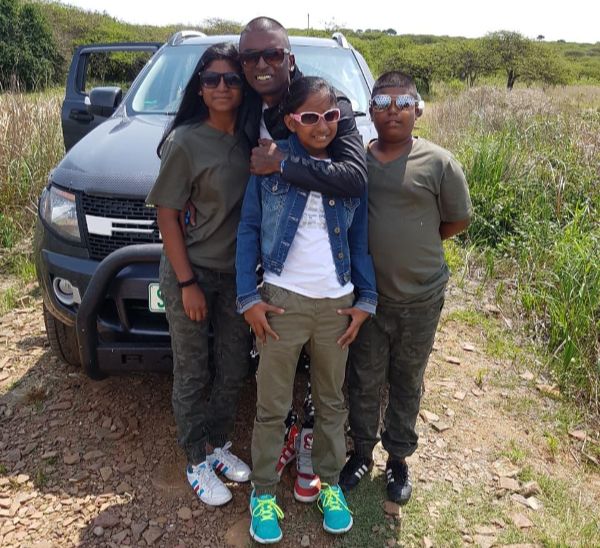
From left: Paige Naidoo, Donavan Naicker and his two children, Chaslynn and Owen Naicker.
MORE than eight years after 37-year-old Donavan Naicker was brutally beaten and stoned to death in Phoenix, his family says they are being forced to relive the trauma.
They recently learnt that the two men convicted of his murder could be considered for parole early next year.
Naicker’s sister, Natasha Naidoo, 43, a businesswoman from Durban North, said they were vehemently opposed to the release of Phalco Floyd Reddy and Karl John Pretorius.
Both men were each sentenced to 15 years in prison for murder following a violent attack on Naicker on March 10, 2018.
Naidoo they only became aware that her brother’s killers were being considered for parole, after a Westville Prison official visited her home on August 22.
She claimed they were not given an opportunity to make representations or object to the parole.
But, Naidoo has vowed to challenge the parole.
“They are up for parole in February 2027. However I will interdict the process if I am forced too. A life was taken and they want to only serve seven years? I will protest,” Naidoo said.
She said her brother’s death had devastated their family and permanently changed the lives of those he had left behind.
“Donovan was my only sibling, my best friend, my heartbeat. When I close my eyes, all I see is his beaten bloody body. I am no longer the happy person I was; a heartbeat is missing. When he died, I died with him. My body is just floating,” she said.
Naicker had been at home on the afternoon of March 10, 2018, when a friend went seeking help.
Naidoo said her brother went outside after hearing the plea for assistance.
“He went to help a man called Junior and then Karl Pretorius and Phalco Floyd Reddy turned on my brother, chased him and stoned him to death,” said Naidoo.
At the time, the court heard that an initial altercation had taken place where Naicker struck or stabbed Reddy in the lower back.
Reddy and Pretorius then pursued Naicker for approximately 200 metres, eventually cornering him near a gravel hill embankment close to Cardinal Road.
The two men attacked Naicker with bricks and stones and kicked him while he was on the ground.
Naidoo said the violence continued even after her brother had been rendered helpless.
“When he lifted his body Karl kicked him in the throat and he died.”
The post-mortem examination found extensive injuries to Naicker's head and face, including abrasions and lacerations, a fractured skull and bilateral subarachnoid haemorrhages.
The court heard that Naicker had sustained 11 separate blows to his head.
At the time, Reddy had claimed he acted in self-defence after being attacked and confronted with a knife, while Pretorius denied physically participating in the assault.
However, the Verulam Regional Court magistrate P Rawheath rejected the defence’s version.
The court found that the pursuit of Naicker was aggressive and unlawful and that the accused had created the danger themselves by chasing him.
The court also found that the violence used against Naicker went far beyond what could have been justified as self-defence.
Eyewitnesses testified that both men participated in the chase and attack.
Evidence also placed Pretorius as having kicked Naicker in the neck area while he was lying motionless.
The court found that this corresponded with a significant neck injury recorded in the post-mortem examination.
The magistrate found the State witnesses, who were friends of Naicker, to be credible and consistent.
The court concluded that the attack was unlawful and that the blows inflicted by both accused caused Naicker's death.
Both men were consequently found guilty of murder, acting under common purpose.
In rejecting the self-defence argument, the court found that the accused had other options available to them.
If they believed they were in danger, they could have retreated rather than pursuing Naicker and taking the law into their own hands.
The court had also noted that Reddy, Pretorius and a third initial co-accused, Jensen Reddy, had previously been discharged on earlier counts of assault and defeating the ends of justice at the close of the State's case.
Following their murder convictions on August 8, 2019, Reddy and Pretorius remained in custody pending sentencing.
On August 16, 2019, Rawheath sentenced both men to 15 years' imprisonment.
Donavan Naicker with his sister, Natasha Naidoo.
Naidoo said the impact of the murder extended across the entire family.
She said she stopped working for two years while pursuing justice and that the family struggled to celebrate milestones following Naicker's death.
“For almost four years we never went on holidays, never celebrated birthdays, Christmas, never took out photos, absolutely nothing. We stopped living.”
Naidoo said she now cares for two of her late brother's children, Chaslynn and Owen Naicker bringing the number of children in her care to four.
“My mum is broken. My family is broken. Both kids look to my husband as a father figure. He guides them and does everything for them.”
She said Naicker had been a loving and generous man who was deeply loved by his family.
“My brother was a humble, caring person that could give his last meal to people. He was my biggest fan. He was playful and the light of our lives. When he walks into a room, it lights up.”
She said the impact of his death had also influenced her daughter's future.
“Donovan was my daughter's best friend, partner in crime and she decided to study law rather than medicine because of the impact this has had on the family.”
Naidoo says the prospect of parole has reopened wounds the family had spent years trying to heal.
“There is no remorse, they have not changed,” she said.
Naidoo also alleged that her family had been harassed and threatened after the conviction.
“I received threatening messages from prison. I reported it to the prison three times and nothing was done.”
Naidoo said the family participated in a Victim-Offender Dialogue (VOD), but described the experience as deeply traumatic.
She said the process forced her to revisit the circumstances of her brother's death and look again at evidence and photographs that she had tried to move beyond.
“We were just healing and this VOD has just opened all the wounds; I had to go through his post-mortem and the photo album of him lying there.”
She said the emotional fallout had also affected Naicker's children.
Naidoo said she was left overwhelmed by anger, frustration and grief.
“I broke down in tears. Anger, frustration.”
She said the family's experience during the VOD had reinforced her belief that the men should serve the sentence imposed by the court.
Naidoo said the family was not asking for anything beyond what it believed the court had already ordered.
“All I want is for them to serve 15 years.”
She said the family's opposition to parole was not about revenge, but about ensuring that the punishment imposed following the murder was served.
“I don't think anything can compensate for the loss and the brutal murder, but 15 years served will give us ease knowing there is some punitive measure.”
“I will continue fighting for my brother. Both his children are distraught. Their words to the offenders was if you will feel any remorse spend the 15 years in jail. They begged me to fight so they do not get parole. We will continue the fight for justice,” said Naidoo.
Logan Maistry, Deputy Commissioner of Communications for the DCS said parole eligibility was governed by the Correctional Services Act, Act 111 of 1998.
“In terms of the Correctional Services Act, Act 111 of 1998, offenders become eligible for consideration for parole after serving the prescribed minimum detention period, subject to compliance with their sentence plan including participation in rehabilitation programmes and related requirements.”
“According to DCS records, the two offenders have not yet appeared before the Correctional Supervision and Parole Board (CSPB). No date has been set for such consideration and no decision regarding placement on parole has been made.
“Consequently, DCS cannot confirm any possibility of their release in the coming year. The victims will be afforded an opportunity to duly make representations when the matter is to be considered by the CSPB,” he said.
Maistry also acknowledged ongoing challenges with the smuggling of contraband and cellphones, into correctional facilities.
“Various technological and security interventions are being implemented to curb this. Offenders found in possession of contraband are charged in terms of the Departmental disciplinary code, which may result in loss of privileges and reclassification,” he added.
He further confirmed that he was aware of a Facebook post made in 2025 linked to one of the offenders.
“The offender was charged and the matter was dealt with through disciplinary processes,” he said.
“Furthermore, the offender participated in a Victim-Offender Dialogue (VOD) session facilitated by DCS in August 2026. DCS has no record of formal complaints lodged regarding alleged threatening messages,” said Maistry.