
PM Modi plants banyan tree with BRICS leaders, calls it symbol of shared future
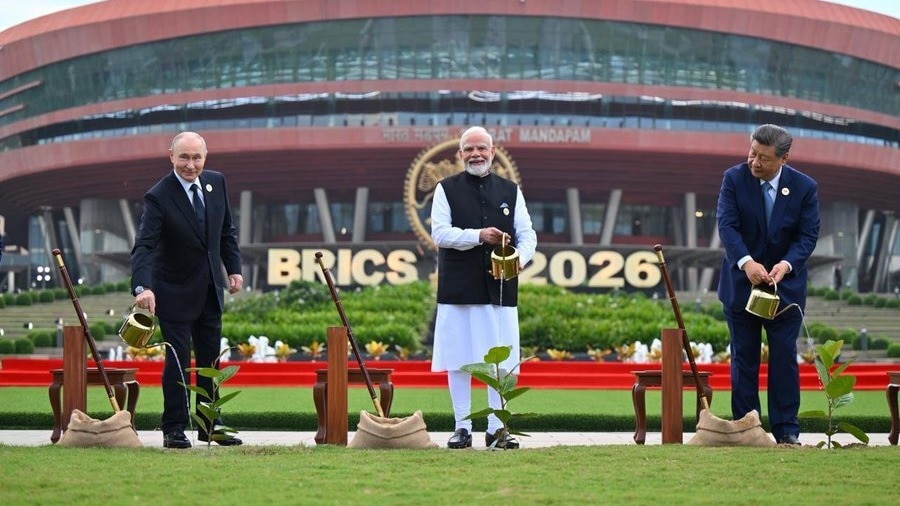
A banyan tree now stands as a quiet symbol of the first day of the BRICS Summit in Delhi.
Prime Minister Narendra Modi, joined by fellow BRICS leaders, planted the tree at the end of the first day of the BRICS 2026 Summit outside the Bharat Mandapam in the national capital. The leaders gathered around the sapling, turning what could have been a routine ceremonial moment into one of the more evocative images from the summit.
The symbolism became clearer in PM Modi’s post after the ceremony.
Describing the moment, PM Modi wrote on X, “Planted a banyan tree with fellow BRICS leaders in Delhi. It is a fitting symbol of what BRICS stands for: deep roots, growing strength and coming together for a shared future. May our partnership continue to grow in the times to come.THE SIGNIFICANCE OF CHOOSING A BANYAN TREE
Unlike a tree defined by a single trunk, the banyan spreads. Its branches reach outward and send roots back towards the ground, allowing it to grow wider and stronger with time. What begins as one tree can eventually become a vast network of trunks and roots, all connected to the same organism.
That makes it an apt metaphor for a BRICS that is itself changing.
The grouping that began with five countries has now expanded to 11 full member countries and 10 partner members, giving it a larger economic and geopolitical footprint. With that expansion comes the challenge of keeping the partnership anchored even as its branches stretch in different directions.
The Delhi Declaration adopted at the summit offers a sense of what those roots are meant to hold on to.
The document emphasises dialogue, diplomacy, multilateralism and respect for international law, while voicing concern over unilateral tariffs and other coercive economic measures. It also calls for greater representation of emerging markets and developing countries in global institutions, reflecting BRICS' broader push for a stronger voice for the Global South.
In that sense, the declaration gives substance to the first part of PM Modi's metaphor — deep roots. The expanding grouping is seeking to anchor its growing influence in principles and institutions that its members can collectively defend, even as they remain a diverse group with differing interests.
The second part — growing strength — is visible in the expanding reach and ambitions of BRICS. Its members have sought greater cooperation on economic resilience, development and global governance, while the grouping's enlarged membership gives it a wider footprint across the Global South.
And then comes “coming together for a shared future” — perhaps the most important part of the metaphor.
The Delhi Declaration attempts to translate that idea into collective positions on some of the world's biggest challenges. From conflicts and humanitarian crises to terrorism and global economic governance, the members have sought to speak through a common document, calling for dialogue, diplomacy and greater cooperation.
That is what makes the banyan tree more than a backdrop to the summit's closing moments. Its roots, expanding branches and interconnected growth mirror the larger ambition emerging from Delhi — a BRICS that remains rooted in its founding principles even as it expands, gains weight and brings a more diverse group of countries under one increasingly broad canopy.
The tree will take years to grow. So will the partnership it was chosen to represent. But the Delhi Declaration offers an early glimpse of what those roots are intended to support — and how far those branches could eventually reach.- EndsPublished By: Akash ChatterjeePublished On: Sep 12, 2026 22:45 IST

