Porsche’s new $313,300 convertible features a six-speed manual transmission and a screaming 9,000 RPM redline - Toronto Star
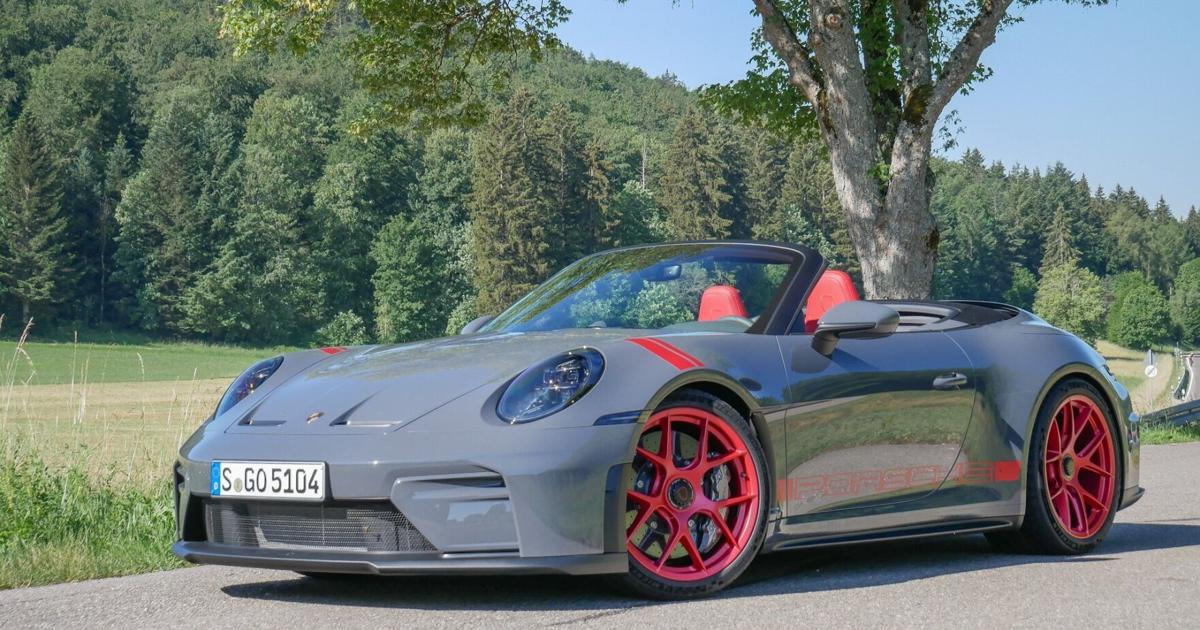
We took the first-ever convertible version of the GT3 racing car for the road onto Germany's Swabian Alps to see if it delivers the same thrills.
Special exterior graphics and interior colours all come as part of the Street Style package, making the already spectacular-looking GT3 Sports Cabriolet even more so.
Stuttgart, Germany — The road unfurls ahead of me, into a pleasing widescreen display of rolling hills and farmers’ fields stretching all the way to the bright blue, cloudless horizon. The sky is the sign of the times this early summer’s day in June, and the temperature — a balmy 40 degrees — is following suit.
Luckily, I’m in a convertible. Not just any convertible, but the newest sports car offering from Porsche: the 2027 911 GT3 S/C. S/C stands for Sports Cabriolet and my oh my, does it ever have the goods to back it up.
It comes only in rear-wheel-drive and only with a six-speed manual transmission — that’s right; with a clutch pedal and all. Let’s not forget the power on tap: that’s 502 horsepower and 331 pound-feet of torque from a four-litre flat-6 engine … that revs to a stratospheric 9,000 RPM redline.
A six-speed manual transmission is your only choice. There are two gear knob styles though.
As my hands grip the thin leather-wrapped rim of the perfectly angled three-spoke wheel, I take a minute to contemplate this car’s story.
We’ve seen the GT3 moniker before, but throughout the many 911 generations that it’s existed, its roof has always been intact. According to Porsche, the time is right and the demand is finally there to attempt a droptop version of this racing car for the road.
On any car, the roof forms a key part of its structure. You can’t just take a Sawzall to it and let it loose on the road. Tweaks have to be made to ensure it doesn’t, you know, collapse in on itself. Extra chassis reinforcement, different suspension tuning and so on. Thing is, that tends to add weight, and weight is the enemy of a performance-focused car like this.
Interior is a cacophony of colour with plaid-look leather inserts on the seats and inside the glovebox lid.
Porsche insists that the GT3’s chassis and suspension tuning was so honed that only a little extra chassis reinforcement was required to make the convertible feel just as competent. The suspension settings remain the same and to make up for the added weight, Porsche gave the S/C a number of lightweight adds as standard. Magnesium wheels measuring 20 inches and 21 inches at the rear save almost 10 kilos; carbon-ceramic brakes save an additional 20 kg or so and a roof mechanism constructed partially of magnesium bits means there’s less of a weight penalty there, too. Not sure if that also affects how quickly the top operates, but it takes a brisk 12 seconds to deploy.
Magnesium wheels are standard, but red paint is optional.
Fabric straps that act as interior door release handles, a manual-adjust tilt and telescope steering wheel and no back seats keep the weight down.
If you want to save even more, you can spec options like carbon-fibre bucket seats. Personally, I find these too narrow and prefer the 18-way power items that come as part of the “Street Style” package. That adds a host of style touches such as woven-look inserts (that require over 660 metres of leather for every square meter of material), a wooden shift knob, special wheel colours and additional exterior graphics. A multitude of colours are available, including a 150-plus catalogue of special “paint-to-sample” options.
Yes. That is the door release lever, all in the name of saving weight.
I couldn’t see all of that from behind the wheel, but that doesn’t matter because the full-on assault on the senses that comes with piloting a car like this means it could be painted in a charming kaleidoscope of flat white and beige and my hairs would still stand on end.
Since there is no turbocharging, power delivery is instantaneous and it feels like that whenever I depress the throttle, no matter the revs, no matter the speed. It’s just a seemingly infinite swell of torque that feels so much more than the numbers on paper. The sound it makes is absolutely guttural, too, shrieking all the way to that 9K redline.
Strange to see this famous moniker on the sills of a convertible.
I stab the light clutch, snag fourth from third and it all starts all over again, that addictive, transcendent wave of power thrusts me down this beautiful road just outside of Stuttgart, part of a network in the Swabian Alps where cars like this are tested and honed by the manufacturer.
If the any gear, any speed acceleration is thrilling in the hair raising, the steering and handling is thrilling on a more cerebral level. The steering — as is the Porsche way, from sports cars to SUVs — hits that perfect note between road feel, weight and responsiveness. Since I’m sat so close to the front axle it feels like I’m quite literally on top of it. That means that it’s so easy to get in tune with what’s happening with the front end, making it so easy to place within the lane and through long, sweeping turns with — “pinpoint” isn’t strong enough — laser-point accuracy.
Folding mechanism for fabric top is constructed with lightweight magnesium parts.
At around $313,000 CDN at base, this is an expensive car. It is. Cars like the GT3 S/C exist, though, because every so often, a manufacturer wants to show that they can. That they can take one of the best performance coupes in the world, decapitate it, and have it deliver the same performance, the same handling and the same thrills. It’s a marvel of modern sport car engineering, which is the case no matter the price.