
Protests spread across Europe as cost-of-living pressures fuel public anger - CNA
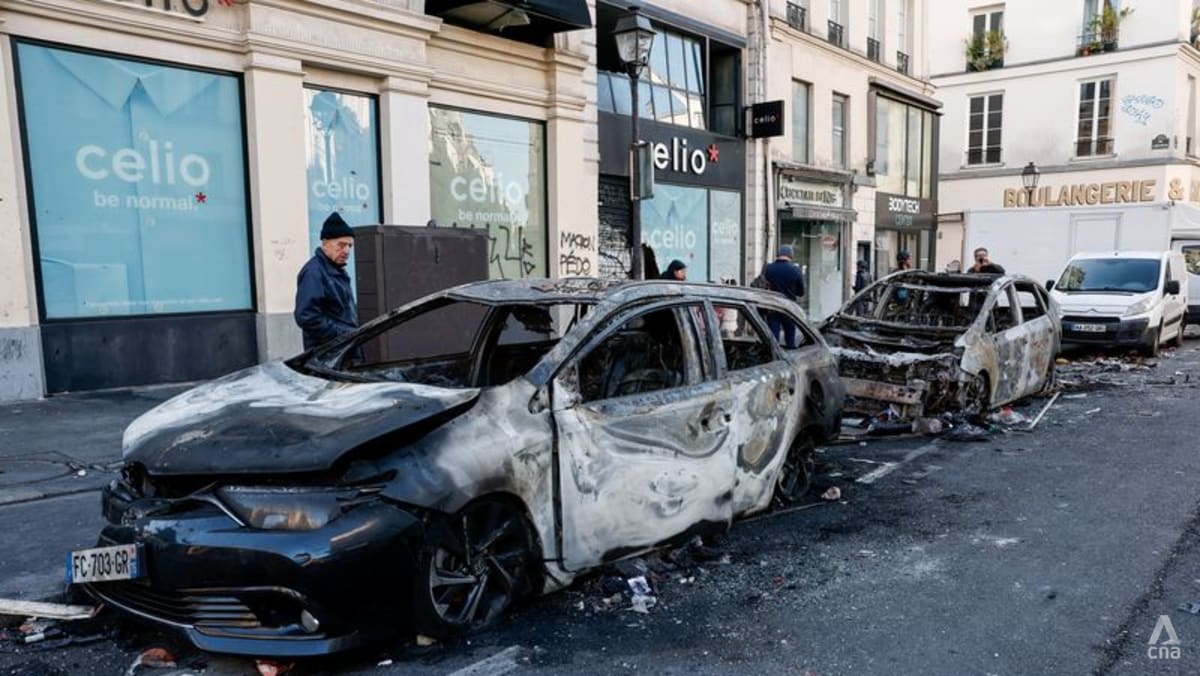
French protesters say new government measures do not go far enough, raising the prospect of further unrest ahead of a presidential election next April.
Burnt cars on a street a day after clashes against the cost of living and rising fuel prices in Paris, France, Oct 18, 2026. (Photo: Reuters/Benoit Tessier)
This audio is generated by an AI tool.
PARIS/BRUSSELS: From France to Spain and Italy, protesters have been taking to the streets across Europe as public frustration over the rising cost of living, housing and public services boils over.
The protests are putting governments under growing pressure, raising the political stakes ahead of elections in several European countries.
In France, protests that began over education reforms have escalated into a nationwide movement challenging President Emmanuel Macron’s government, despite efforts to ease public anger.
High-school pupils and university students frustrated with the education system initially spearheaded the demonstrations.
CNA Games Guess Word Crack the word, one row at a time Buzzword Create words using the given letters Mini Sudoku Tiny puzzle, mighty brain teaser Mini Crossword Small grid, big challenge Word Search Spot as many words as you can Show More Show Less A protester holds a French flag during a demonstration against rising living costs in Lyon, France, Oct. 24, 2026. (Photo: AP/Laurent Cipriani) But the protests escalated on Oct 17, with rioting erupting in cities across the nation, leading to some of France’s worst street violence in years.
While hundreds of thousands protested peacefully, violent fringe groups targeted public buildings, looted luxury boutiques and supermarkets, and attacked police vehicles and officers.
In Limoges, the city hall was set ablaze; in Marseille, black-clad protesters broke into city hall and defaced the building with anarchic graffiti, and in Lyon, protesters torched the city's tourism office.
The unrest on Oct 17 and 18 could cost around 1.1 billion euros (US$1.22 billion) in damage and economic losses, according to a high-end estimate by French think tank Fondation IFRAP.
“What I don’t understand is gratuitous violence just to do damage,” said a business owner who gave his name as Vincent, whose premises were also affected.
“They ransacked small business owners, people who are struggling to get by. It could have been their parents. I don’t understand.”
By Oct 24, the movement had expanded beyond students to include teachers, parents, trade unions, firefighters and healthcare workers.
Around 410,000 people joined demonstrations across the country that day, according to the Interior Ministry, calling for action on the high cost of living, budget cuts and underinvestment in public services.
“The schools are not in good condition, people are struggling, people don't have enough money to eat, to live correctly and we are here to claim our rights,” said one protester.
“Violence is justified here. It's not the end, it's just the means to get what we want,” she added.
The French government on Monday (Oct 26) unveiled a series of measures aimed at easing students’ anger, including plans to cap some class sizes at 28, provide billions of euros in loans for building renovations and overhaul the university admissions system.
Budget Minister David Amiel told broadcaster TF1 that the measures would cost an estimated 5 billion euros, with the spending to be offset by cuts elsewhere.
But student leaders say the proposals do not go far enough.
Sophie Venetitay, the secretary general for teachers' union SNES-FSU, called for class sizes to be capped in more classes and more teachers to be hired to improve learning conditions.
The unrest has exposed a widening gap between Macron’s administration and the French public, according to Tara Varma, a managing director at think tank German Marshall Fund.
“There has been clearly a sense of disconnect between the president and his population, which only seems to be worsening,” she said.
A recent survey by Ipsos-BVA found that 85 per cent of respondents believed France was in decline, while 98 per cent described the country as either angry and highly confrontational or dissatisfied.
With parliament gridlocked and France facing a widening budget deficit, the protests present another challenge for the government ahead of the presidential election in April next year.
Union leaders have called for further protests on Saturday (Oct 31) and a nationwide strike on Nov 5.


