Putin pitches Russian resilience to Apec in swipe at sanctions - The Business Times
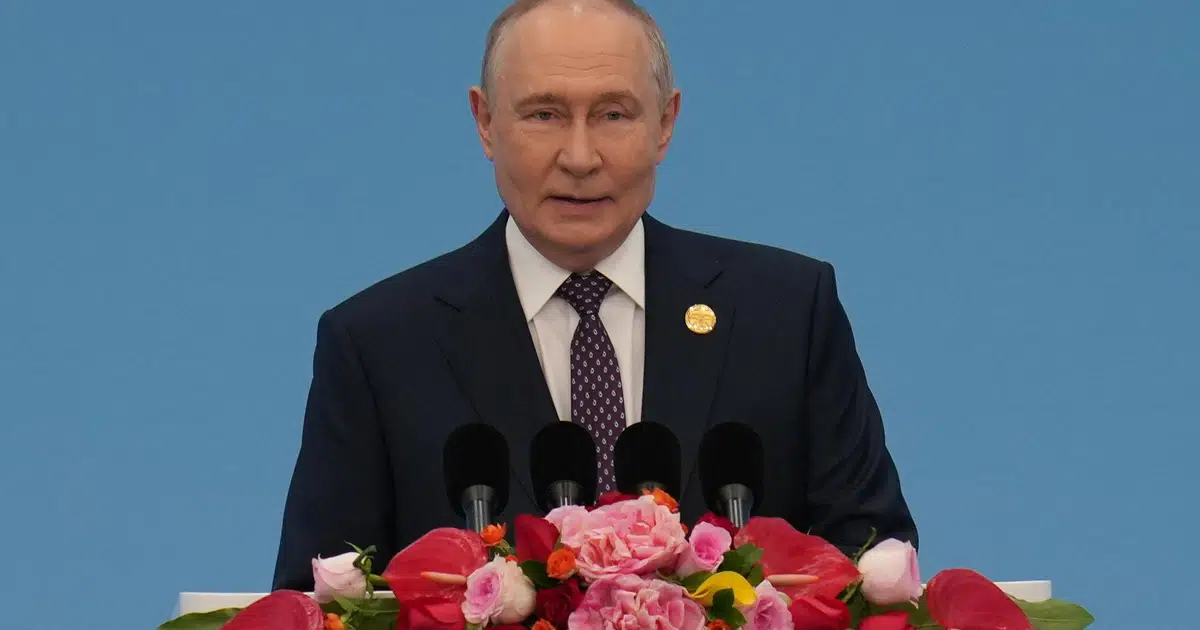
PRSIDENT Vladimir Putin said Russia was thriving despite international sanctions, touting it as a model partner and contrasting what he portrayed as his country’s positive outlook with those of a weakening Europe.
In a speech to Asia-Pacific Economic Cooperation business leaders in China, Putin dismissed “failed attempts to isolate our country” and asserted that Russia was overcoming the challenges “with dignity.”
“We are ready to share our experience,” Putin told the Apec CEO Summit in Shenzhen on Wednesday (Nov 18), before meeting with President Xi Jinping.
“We are moving at full speed ahead, even faster than we had predicted, and we are ready to continue moving forward in the development of mutually beneficial cooperation with the Asia-Pacific region.”
Putin is seeking to use his rare moment on the world stage to sell Russia as not just a desirable place to do business, but as a dynamic economy with huge untapped potential that represents an essential partner for Apec members. In reality, Russia’s economy has slowed sharply.
His bullish outreach regardless shows how the Kremlin leader is emboldened at signs of his rehabilitation, despite being subject to an international arrest warrant and multiple rounds of sanctions as a result of the war on Ukraine he’s been waging for almost five years.
Putin is due to take part in a trilateral summit on Thursday with Xi and President Donald Trump — the world’s two most important government leaders.
In public remarks at the start of his meeting with Xi on Wednesday, Putin praised their partnership in the foreign domain amid “a difficult geopolitical environment,” saying that both pursued “constructive approaches aimed at shaping a fairer multipolar world order.”
The Russian leader was due to hold extensive talks with Xi on major international and regional issues including the conflict in Ukraine, according to the Kremlin.
Putin is expected to brief Xi on his latest contacts with the US side, and the leaders are likely to discuss the planned trilateral talks with Trump, Interfax news wire reported, citing Putin’s foreign policy aide, Yuri Ushakov.
Trump, who is due to attend the Apec summit in Shenzhen, said that he was also open to a one-on-one with Putin.
The Russian president’s meeting with Xi is their fifth since the start of 2026, underscoring the intensity of ties between Moscow and Beijing.
It also speaks to how Russia has become increasingly dependent on China since Putin began his all-out war on Ukraine in early 2022, as sanctions and the collapse of much of its trade with Europe pushed Moscow to redirect commerce, finance and technology links eastward.
In his speech, Putin singled out the European Union for criticism, saying that the 27-nation bloc was “losing its industrial capacity and its competitive position,” with rising debt loads hurting business and citizens witnessing a “humiliating” decline in living standards.
By contrast, the outside pressure “has provided Russia with a powerful incentive,” he said.
His speech drifted into fantasy in parts, asserting that Russia was Europe’s largest economy — it isn’t — and stressing its major logistics capabilities, a claim that stretches belief given that Ukraine is conducting strikes on Russian infrastructure including bridges, oil refineries and warehouses.
Russia’s economy has suffered as businesses and consumers wrestle with high interest rates imposed to slow inflation amid massive government spending on the war.
Gross domestic product grew 1 per cent in the third quarter, following a 1.3 per cent expansion in the previous three months, as Ukrainian attacks knocked out industrial facilities, disrupted logistics and added to inflationary pressures.
Shutdowns at oil refineries drove an 18 per cent year-on-year decline in refining output in the third quarter, the steepest drop in comparable quarterly figures going back to 2020, according to data from the Federal Statistics Service.
Putin brought a large delegation to China that includes dozens of top officials and executives from some of the country’s biggest companies and banks, including Rosneft, Novatek and Gazprom.
According to Russia’s Foreign Ministry, bilateral trade in the first 10 months of 2026 exceeded the total for all of 2025, rising by almost 33 per cent to US$242.5 billion.
Energy remains the main driver, but cooperation has expanded beyond traditional oil and gas supplies into large petrochemical projects, Russian-designed nuclear reactors in China and renewable-energy initiatives, according to Moscow.
One notable area where progress still appears elusive is over a contract that could more than double Russia’s current pipeline gas exports to China. Russia’s gas giant Gazprom PJSC has for years been trying to reach a deal on supplies via the future Power of Baikal route, previously known as Power of Siberia 2.
Details on pricing and volume flexibility have been among the stumbling blocks in talks, even as Russian officials have repeatedly said that remaining difficulties could be resolved quickly.
Deputy Prime Minister Alexander Novak said last month that Gazprom and China National Petroleum Corp may reach a commercial agreement by the end of the year.
Putin told the business forum that there was great potential benefit from the planned trilateral meeting with Xi and Trump.
“Moscow really wants this and is excited about the potential summit more than anybody else for a very clear reason — Moscow is the weakest power among the three,” said Alexander Gabuev, director of the Carnegie Russia Eurasia Centre.
If it goes ahead, for Putin “it’s a matter of symbolic positioning of himself into this kind of league of superpower and the top boys that are sitting at the table.”
Russia, though, “is absolutely not in this league of top tier level powers anymore and is not coming back regardless of the outcome of Putin’s cruel war in Ukraine,” he said. BLOOMBERG
Decoding Asia newsletter: your guide to navigating Asia in a new global order. Sign up here to get Decoding Asia newsletter. Delivered to your inbox. Free.
Is Singapore still South-east Asia’s headquarters haven?
CapitaLand, Far East, Sing Holdings team up for S$1.82 billion bid for Jurong Lake District site