Putin’s Drones Are Learning How To Break Ukraine - Newsweek
A military tech adviser to Ukrainian President Volodymyr Zelensky raised eyebrows Wednesday when he claimed to have made an unsettling discovery among the wreckage of Russia’s latest drone barrage.
Serhiy “Flash” Beskrestnov, appointed by Zelensky in July, said one of Moscow’s drones was carrying what appeared to be a specially designed charge to scythe through thick metal structures such as reinforced pylons, bridges and other key infrastructure.
“I believe the enemy plans to attack critical high-voltage power lines,” Beskrestnov concluded.
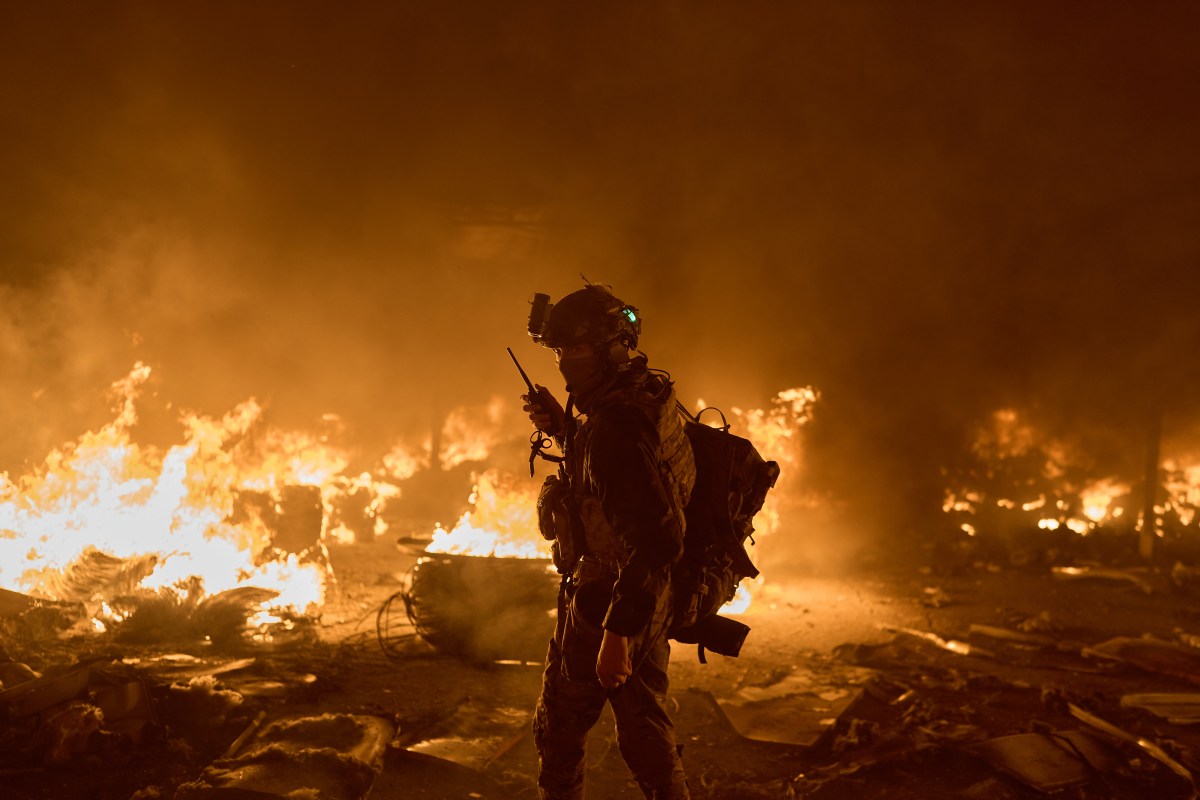
The warning landed on the same day Russia’s Defense Ministry publicly said its forces had struck a litany of critical infrastructure in and around the Ukrainian capital, including Kyiv’s hydroelectric plant, a thermal power plant, a high-voltage substation and a battery-storage park. Moscow separately claimed a strike on the De Novo data center in Kyiv, which it described as a “major internet-traffic exchange point”.
Russia has spent years trying to batter Ukraine into submission, to no avail. Now, as Russian President Vladimir Putin’s drones become faster, more sophisticated, more accurate and more resilient to countermeasures, Moscow is moving to target the connective tissue that keeps Ukraine standing.
Beskrestnov said the jet-powered drone recovered on Wednesday carried what he called a “cumulative-cutting” warhead: a 40-kilogram main explosive charge alongside four additional “modules." This layout focuses the explosive energy to slice through thick metal structures, rather than dispersing it more broadly.
The official’s diagnosis has not yet been backed by an independent technical report, but if correct, it suggests Russia has developed a jet-powered drone optimized to sever the reinforced structures underpinning Ukraine’s energy networks, including “high-voltage pylons,” as Beskrestnov suggests.
This is merely the latest example of how Russia’s strike strategy is maturing.
On August 22, Putin warned Ukraine had “opened Pandora’s box” by attacking Russian commercial and logistics sites used by the likes of Wildberries and Ozon, threatening retaliation against the “most sensitive sectors” of its economy. Eight days later, Russia’s Defense Ministry said it had received orders to prepare mass strikes on Ukrainian energy facilities, and exactly one month ago, Putin publicly confirmed the instruction.
Communications is also a sector particularly attractive to Russian drone operators. Kyivstar, Ukraine’s largest mobile operator and the first Ukrainian company listed on a U.S. stock exchange, was repeatedly hit this month. A drone damaged its engineering office in Kyiv on September 11—the first of several attacks that damaged company facilities, including its Kyiv headquarters.
Other attacks damaged facilities used by various internet providers and data centers. Russia’s Defense Ministry has openly celebrated strike campaigns on Vodafone Ukraine, Datagroup, Ukrtelecom and De Novo, portraying them as military communications targets.
Fortunately, Ukrainian foresight has helped limit the damage. Datagroup said its customer data survived and its services continued running from backup sites because, like many Ukrainian public and private organizations, it had deliberately built redundancy into its infrastructure.
Just before the full-scale invasion in 2022, Kyiv changed its rules to allow government data to be stored outside the country, and dozens of Ukrainian authorities transferred their registers and systems to Amazon Web Services. On March 1, 2022, a Russian missile struck the National Data Backup Center in Kyiv, but not one core state register or critical government service stopped working, according to Zelensky’s office.
Now, as Putin’s drones become smarter and more effective at hunting the weak spots, Moscow and Kyiv are locked in a never-ending game of cat and mouse. Last week, after days of strikes on data centers in Kyiv, Zelensky convened his top military staff to discuss how they could better protect “facilities critical to communications.”
The same goes for the energy sector.
Ukraine's survival through four consecutive winters of misery is a testament to the sector’s resilience and ability to adapt. By July, the government said around 1.8 gigawatts of distributed gas generation had been installed across Ukraine, spreading capacity among smaller local units rather than giant plants. It has also assembled a decentralized reserve of mobile power plants, cogeneration units, boilers and transformers that kick into gear when larger facilities are taken offline.
But the punishment has been extraordinary. DTEK, Ukraine’s largest private energy company, says its thermal power plants have now been attacked more than 230 times, with the vast majority of its generation capacity having been destroyed and rebuilt three times over since the full-scale invasion.
The Geran-3, Russia’s first widely deployed jet-powered drone, was little more than a jet engine strapped to an old, propeller-driven airframe. It was unreliable and couldn’t handle the stresses of high-speed maneuvers.
Now, Russia is shifting production toward purpose-built Geran-4 and -5 variants. Geran-4 cruises around 220 mph and can reach beyond 300 mph at top speed, while the larger Geran-5 can hit 370 mph and carry a 90-kilogram warhead. They also come equipped with electro-optical sensors and electronic warfare countermeasures.
If Beskrestnov is right about the specially designed payload, the adaptation has moved one step further. Russia’s drones are not only becoming faster, more accurate and harder to intercept—their destructive capacities are being tailored to the electrical, thermal and technical sinews holding Ukraine together.
The brute force approach isn’t going anywhere. Russian salvos still kill civilians, flatten buildings and overwhelm air defenses through sheer numbers, as evidenced on Monday by a Russian jet-drone strike on the Presidium building of Ukraine’s National Academy of Sciences in central Kyiv, which killed two people and set its upper floors ablaze.
But Moscow is now pursuing a more methodical approach: identify the vital networks that allow the country to absorb those blows, and cut through them.