Rahul Gandhi’s ‘Chhatron ki Goonj’ strikes a chord, why Gen Z gives Congress a reality check - The Indian Express
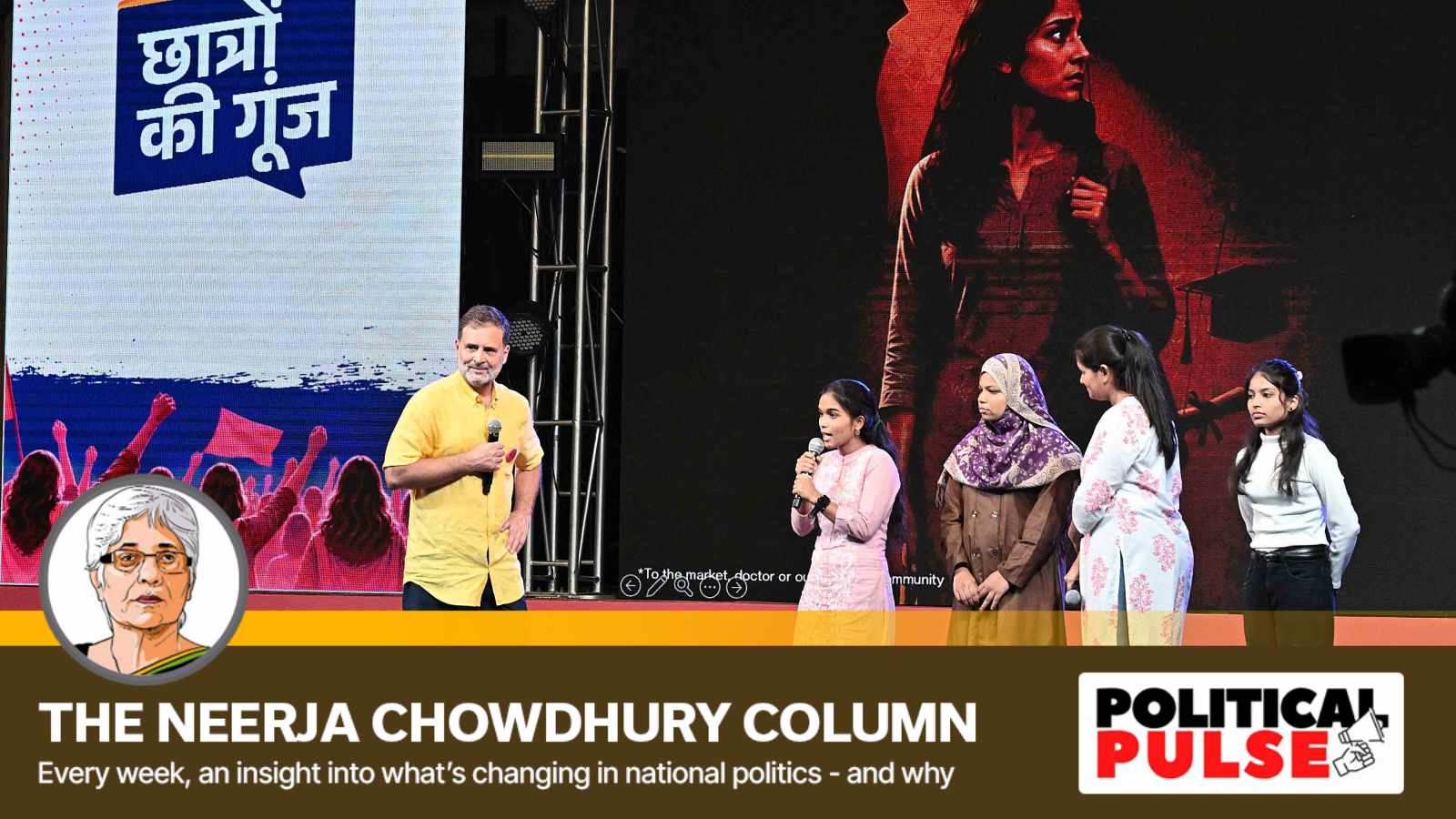
Rahul Gandhi walked up and down the stage in Indore, mike in hand, thousands of young men and women in the audience applauding as he told them what it meant to be a student – one who asks questions – as opposed to the “system” controlled by what he called a handful responsible for people’s woes.
This was the fifth edition of the Leader of Opposition (LoP)’s “Chattron ki Goonj” event aimed at engaging with students. PR agencies which mount such events for political parties could manufacture a response for them only up to a point. Gen Z in Indore – as also in Pune, Dehradun, Prayagraj and
Kota earlier – seemed to be looking at Rahul with new eyes. And he, too, is riding on youth sentiments unleashed by the Cockroach Janata Party (CJP)’s protests at Delhi’s Jantar Mantar two months ago.
Even as Rahul was reaching out to the youth of Madhya Pradesh, Delhi’s Gen Z delivered a different message to his Congress party. The RSS’s student wing ABVP bagged three of the four posts in the Delhi University Students Union (DUSU) elections. The DUSU is not an ordinary student body. Over the years, it has catapulted many a leader to national politics, who include late Arun Jaitley and Delhi Chief Minister Rekha Gupta of the BJP and Ajay Maken, Alka Lamba and Ragini Nayak of the Congress.
Education Minister. However, in the DUSU polls, Gen Z students chose to re-elect the ABVP to the key posts of the president, secretary and joint secretary.
The question is, how did the Congress lose the plot in the DUSU polls when Rahul had succeeded in cornering the Narendra Modi government through the entire monsoon session of Parliament, during which he even sat on a dharna outside the PM’s house to press for Pradhan’s resignation.
Congress student wing NSUI drew a blank in the DUSU polls, where last year it had won the vice-president’s position. The party can argue that this time it nominated a tribal candidate, Vijay Shankar Meena, for the DUSU president in what has been a Jat versus Gujjar battle for two decades, and that Meena registered a 78% increase in votes as compared to the party’s figure in 2025. While this was in sync with Rahul’s new politics of championing the cause of the SCs, STs and OBCs, the point remains that Gen Z is not a monolith but is also a section marked with caste faultlines.
The Congress’s rout in the DUSU polls was aggravated by its loss in the vice president’s election, which indicated the party’s internal rifts. The party is said to have “denied” the V-P ticket to Deepanshu Shokeen, who then contested as an Independent, scoring a resounding win over his ABVP rival Ishu Maurya.
Shokeen, a Jat youth, whose father is a DTC bus conductor and his mother an Anganwadi worker, undertook a spirited campaign barefoot to demand hostels for students in view of the collapse of a private PG building at Delhi’s Satya Niketan in which seven people, including five DU students, were killed. It created resonance among students, reflecting their desire for fresh faces in politics even without any organisation.
The Congress also allegedly betrayed “nepotism” in the DUSU polls, giving its ticket to Veer Chatrath – son of Manish Chatrath, the in-charge of the AICC headquarters – for the V-P post, who finished a distant third. Manish Chatrath was said to have a significant say in the DUSU ticket allotment along with Kanhaiya Kumar, the AICC in-charge of the NSUI.
In the wake of student protests, PM Modi has also stepped up his outreach to Gen Z, even through reels on Instagram. In an unprecedented move, the government also agreed to withdraw all FIRs against students (at the instance of the Supreme Court) who participated in paper leak protests in Delhi and other states. RSS chief Mohan Bhagwat has also tried to connect with youth protesters, saying they were not “anti-national”.
These are pointers to the BJP-RSS efforts to address the concerns of Gen Z, who account for about 26% of the country’s population. It goes without saying that they would be among the decisive factors in the coming elections at the state and central levels.
While Rahul’s image is changing and his Chhatron ki Goonj is resonating in different states, this in itself may not translate into votes for the Congress. Its DUSU debacle is another reminder of this harsh reality for the grand old party.
That the Congress needs to rebuild its organisation – and has done little on this score – is to state the obvious. Without knuckling down to this project, Rahul may only end up effecting the “NGOkaran (NGO-isation)” of the party.
While the Congress has focused on boosting his image, be it through Bharat Jodo Yatra or Goonj, it has not really moved to rejuvenate and streamline the organisation.
Rahul’s Pune Goonj event with young women, for instance, has provided an opportunity to the Congress to bring them on board around a powerful theme of women freedom and empowerment, which has the potential of reverberating nationally.
The Congress’s failure on the organisational front is all the more glaring as it is pitted against an adversary like the BJP, which has consistently displayed a killer instinct in winning elections. The ruling party is quick to course correct, which the Congress has yet to master. The Congress is known to conduct post mortem of its poll defeats and then let their reports gather dust for decades.
Today, elections are a complex business, driven by multiple factors – resources, detailed planning down to the booth level, mobilisation of grassroots workers, digital technology aided by AI, and political marketing.
In sum, metaphorically speaking, Rahul may be firmly under the arc lights, his cheer leaders at hand. But missing in action are countless, faceless men and women behind the scenes, who have to work in unison the lights and cameras, music systems, ticket booths – and coordinating moves and anticipating missteps – to ensure the concert’s success. The Congress has yet to signal it could put such a show together.
(Neerja Chowdhury, Contributing Editor, The Indian Express, has covered the last 11 Lok Sabha elections. She is the author of ‘How Prime Ministers Decide’.)