
Ram's mother, Rahim's wife among 28L women left out of India's first polls. Why?
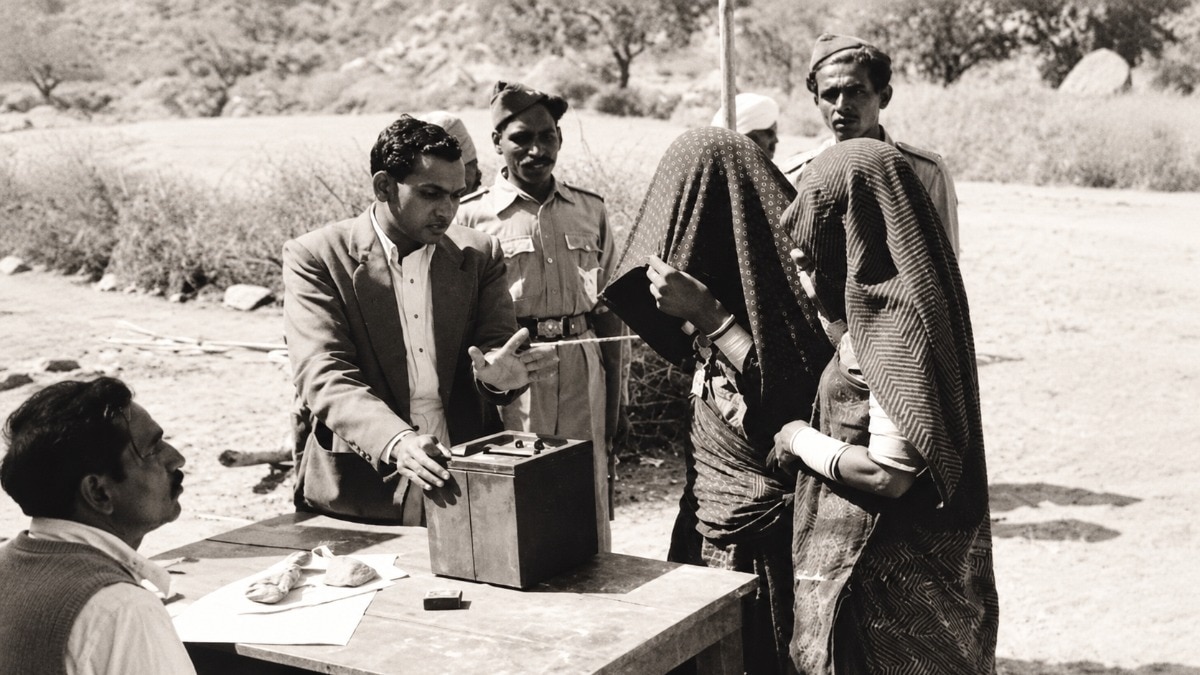
It was October 1951, and in Himachal Pradesh's Kalpa, a young woman walked several miles with her frail mother to vote in India's first general election. Recounting her in his book, India After Gandhi, historian Ramachandra Guha quoted an observer from the London School of Economics. "... For a day, at least, she knew she was important," the person said, according to Guha.
But for more than 28 lakh other Indian women, that opportunity never came in the winter of 1951-52, when Indians were voting to elect the first Lok Sabha and their state Assemblies in the country's first general election after becoming a republic. That's because, back then, several women had been registered through their relationships with men, without their own names, and their entries were eventually deleted. A 2021 Asiatic Society journal article illustrated the practice with "Ram's mother, Rahim's wife" as an example.
This was independent India's first election, and the world had seen nothing like it. Every adult aged 21 and above could vote. At least 17 crore people, including eight crore women, were to vote. It was a gamble which critics doubted a poor and largely unlettered country could pull off. But India did it. Sukumar Sen helped India pull it off. The young nation built roads and bridges to get ballot boxes across rivers, mountains and forests to help people exercise their right to vote.
In a republic where every adult was now to have a vote, India's first Chief Election Commissioner, Sukumar Sen, also had to ensure that the franchise recognised each voter as an individual, with an identity of their own rather than as someone's wife, mother or daughter. Calling the practice of using names of males a "curious, senseless relic of the past", Sen directed officials to replace such descriptions with women's own names on the electoral rolls.
The decision came even as the move faced resistance in several parts of the country. Sen, who had no previous experience of conducting elections, according to Ramachandra Guha, the mathematician in him, helped him master the staggering numbers and logistics involved.
"With an object to rectify the rolls, when the [Election] Commission appeared before these women, most of them refused to be enrolled in their own names and finally, 2.8 million women voters were struck off the electoral rolls. [Chief Election Commissioner] Sukumar Sen personally met most of these women voters and convinced them and finally 85% of 2.8 million women voters were enrolled in the electoral rolls in their own names before the second general election of the country [in 1957]," wrote Kolkata-based academic Nilay Kumar Saha in Sukumar Sen: The Man behind the Screen of Indian Parliamentary Democracy, a Journal of the Asiatic Society.
Now, nearly 75 years later, allegations of wrongful voter exclusion have brought the Election Commission of India, headed by Chief Election Commissioner Gyanesh Kumar, under scrutiny. The Congress has demanded Kumar's removal, alleging partisan conduct during the Special Intensive Revision (SIR) of electoral rolls, saying his decisions led to disenfranchisement of several Indians. The controversy erupted after The Indian Express reported that Election Commissioners Sukhbir Singh Sandhu and Vivek Joshi had raised objections on at least 14 occasions over 10 months to decisions and orders, some allegedly issued without their knowledge.
The Election Commission has asserted that all SIR orders had the approval of all three commissioners and defended the additional declaration accompanying Form 6.
The two episodes are different. The row today centres on allegations that eligible voters were unfairly removed, while in 1951-52, women lost their chance to vote because they did not agree to give their names for the electoral rolls. Yet, according to Ramachandra Guha, Sen saw the uproar as a "good thing", hoping it would challenge the custom that kept women's names out of public view.
Behind the decision was a collision of individual citizenship, patriarchal convention and the poll machinery entrusted with enrolling voters.WHY WOMEN WERE ENTERED AS SOMEONE'S MOTHER OR WIFE
India's first general election, along with Assembly polls, in 1951-52 extended voting rights to adults regardless of wealth, literacy or gender. The Constitution's Article 326 provided for a universal adult franchise, with the voting age then set at 21. But preparing the electoral rolls exposed obstacles that the universal adult franchise alone could not remove. Before Independence, women's access to the ballot depended on qualifications such as property, literacy, or their husband's status, rather than equal citizenship.
Colonial rules also allowed some women to register themselves as a wife or daughter of a male member of their family without giving their own names.
So, when the rolls were being prepared for the 1951-1952 elections, in parts of northern India, women were reluctant to disclose their names to strangers. Officials consequently recorded some women through their relationships with male relatives, as was the norm during British rule.
The Election Commission's report on the first general elections, published in 1955, attributed this reluctance to local customs. This was a naming problem, not evidence that the women were unwilling to vote.
Guha, in his book, described Sen's anger at a practice the former Indian Civil Service officer called a "curious, senseless relic of the past". Officials were instructed to replace relative descriptions with women's real names.
The Commission's position was that an elector's name formed an essential part of individual identity. A woman could no longer appear on the roll solely as an extension of her husband or son.BEATING DRUMS TO GET WOMEN'S NAMES ON VOTER LISTS
Israeli historian Ornit Shani, in her paper, How India Became Democratic: Citizenship and the Making of the Universal Franchise (published by Cambridge University Press) traced the issue to 1948, before Sen became Chief Election Commissioner in March 1950.
As local officials began preparing electoral rolls, several district officers in the United Provinces, now Uttar Pradesh, reported difficulties obtaining women's names. Women wanted to be entered as the "wife of", "daughter of" or "widow of" a male family member, and some officials registered them that way, Shani wrote.
The provincial government, however, made it clear that women had to be registered as individual voters. Elsewhere, East Punjab's instructions for preparing the 1948-49 draft rolls were explicit.
"The actual name of a woman must be entered on the roll," an executive instruction issued by the East Punjab provincial government said.
The challenge was to persuade families to cooperate. A November 1948 letter to Agra's district officer, copied to all district officers in the United Provinces, suggested publicity through newspapers, public platforms and the beating of drums. Officials were also encouraged to enlist women workers to help persuade women to register under their own names.
That was a departure from colonial electoral rules, which had permitted descriptions by husbands or fathers when social or religious objections prevented disclosure of women's names.
However, in independent India, now a republic, women were recognised as citizens in their own right.
So, a woman who refused to disclose her name was not to be registered. If she had already been enrolled through a description of her relationship with a male relative, that entry was to be deleted unless corrected.
Officials were asked to help make those corrections.
"A special extension of one month was given in Bihar for filing such applications so that the number of women voters whose names were liable to be struck off the rolls for this reason might be reduced," according to an official report on the first general elections published in 1955.
"This extension was made good use of and the rolls were considerably improved in that state. Although such an extension was given in Rajasthan as well, the response there was poor and a large number of entries relating to women voters had to be deleted for this defect," the report added.WOMEN'S GROUPS QUESTIONED THE DELETIONS
Israeli academic Shani recorded that Sharda Bhargava, president of Jaipur's Mahila Samiti, questioned why officials had accepted, checked and printed entries identifying women only through their male relatives. Bhargava argued that women unfamiliar with elections could hardly be expected to understand registration rules that the enumerators themselves had failed to follow.
Shanta Trivedi of the Rajasthan Women's Association demanded house-to-house visits to correct registrations. On August 2, 1951, Alwar's Mahila Mandal held a Franchise Day, pressing for acceptance of the entries or restoration at government expense.
Despite the instructions, appeals and additional time, nearly 28 lakh of the country's approximately eight crore women voters remained without their own names on the rolls. The Election Commission's 1955 report said almost all these cases came from Bihar, United Provinces (now Uttar Pradesh), Rajasthan, Vindhya Pradesh (present-day Baghelkhand and parts of Bundelkhand in Madhya Pradesh) and Madhya Bharat (present-day Malwa and the Gwalior-Chambal region).
Those 28 lakh women lost the opportunity to be part of a historic first. Without their names on the electoral rolls, they could not cast a vote in independent India's first general election and respective Assembly polls in 1951-52. However, they were not banned. They could register later for subsequent elections.
Ramachandra Guha wrote that Chief Election Commissioner Sukumar Sen hoped the controversy would weaken the custom of naming a woman in relation to a male member before the next election. Israeli historian Ornit Shani recorded that, at Rajasthan's Bharatpur on October 9, 1951, he assured women whose registrations were defective of enrolment at the next polls.
Looking back in 2024, former Delhi chief electoral officer Chandra Bhushan Kumar called the insistence on names a "very remarkable stand", reported PTI. "It was a tough decision in those days. But the ECI took this view and the result is now available to us. Now, in most of the locations, we see that women are voting in more numbers than men, or their percentage is higher than male voters' percentage, Kumar told PTI in 2024.
Interestingly, Sukumar Sen was in 1953 invited to Sudan to help conduct and supervise its first parliamentary elections, where he served as chairman of the African nation's International Election Commission until the polls concluded in 1954.
So, 75 years after India's first polls, the exclusion of 28 lakh women could be called one of the contradictions of the first election. These women missed the historic vote, but the principle Sukumar Sen insisted on was equally fundamental to the new republic. The right to vote belongs to an individual, and so does an individual's identity.- Ends
Sushim Mukul is a keen observer, with interest in polity, geopolitics, culture and heritage.


