Remote waterhole live stream a window into secrets of NT desert - ABC News & Headlines – Australian Broadcasting Corporation
A wedge-tailed eagle slakes its thirst at the remote site. (Supplied: Jenny Davis)
A continuous live stream from a remote waterhole in Watarrka National Park is giving viewers a real-time look at dingoes, wallabies, birds and other Central Australian wildlife.
The project is also helping researchers monitor water availability and animal behaviour as the climate changes.
Researchers will continue using the live stream to track wildlife activity and changes at the waterhole.
In the red heart of Central Australia, a dingo wanders to the edge of a waterhole.
A wedge-tailed eagle dips its beak for a drink, wallabies move through the rocks and, after dark, frogs announce themselves from the shadows.
The live stream has been running for about a month. (Supplied: Jenny Davis)
A camera been installed at a pool on a temporary stream on the Watarrka escarpment near Kings Canyon, about 350 kilometres south-west of Alice Springs.
The live streaming project is a collaboration between Charles Darwin University's Research Institute for the Environment and Livelihoods and NT Parks and Wildlife.
Freshwater ecology professor Jenny Davis has studied Central Australian waterholes on and off since 1986 and has used motion-sensitive cameras at sites in Watarrka for about a decade.
Jenny Davis says anyone who walks to the site could make a cameo on the stream. (Supplied: Jenny Davis)
"In the last year or two technology has reached the point where we realised we could actually live stream from one of the waterholes," Dr Davis said.
A four-person team installed the equipment. (Supplied: Jenny Davis)
With no mains power or internet connection available, the system relies on solar energy, a Starlink Mini and an onsite computer.
Dr Davis said the installation took about a week, during which the team repeatedly hiked 2 kilometres from the Kings Canyon car park to the site.
"We had to put everything there at the waterhole," she said.
"We were going up and down that 2 kilometres every day and I can tell you by the end of that week I was starting to feel it."
The result is a window into a part of Watarrka that relatively few people will ever spend significant time observing.
Dingoes have already emerged as some of the live stream's regular stars.
A euro is captured by the camera at the waterhole after dark. (YouTube: Watarrka Waterhole Wildlife)
"Sometimes it's a lone dingo, sometimes they're in a mob," she said.
"They're coming in to drink, but they're also quite curious."
Euros, also known as hill wallabies, frequent the area, while birds, insects and the occasional feral cat have also appeared.
At night, viewers may spot frogs by the reflection from their eyes or hear their calls following rain.
Dr Davis said viewers could also hear rain falling, frogs calling and birds, including the grey shrike-thrush.
"There's a lot to take in," she said.
For researchers, what appears on the screen is more than a wildlife spectacle.
The camera overlooks a temporary stream that can shrink or dry completely, making changes in rainfall and water availability particularly important.
Dr Davis said the site had held water more consistently during several wetter years in Central Australia.
"As a freshwater ecologist, I'm really keen to see when there's water present, when it's raining, because this is a very arid environment," she said.
"We're looking for what's happening with global warming because, at this site, the only real impact on the amount of water present is going to be climate change."
Dingoes have been a fixture of the live stream. (YouTube: Watarrka Waterhole Wildlife)
Researchers will also be able to observe which animals use the waterhole and how their behaviour changes over time.
"The live stream allows us to see what's coming in, what's drinking, what the behaviours are and how they might also change as the planet warms," Dr Davis said.
Previous motion-triggered cameras could capture individual moments, but the live stream provides a more continuous picture of what animals are doing.
Dr Davis said the technology could also allow the camera to track and zoom in on wildlife.
"In many ways it's surveillance, but it's providing wonderful information," she said.
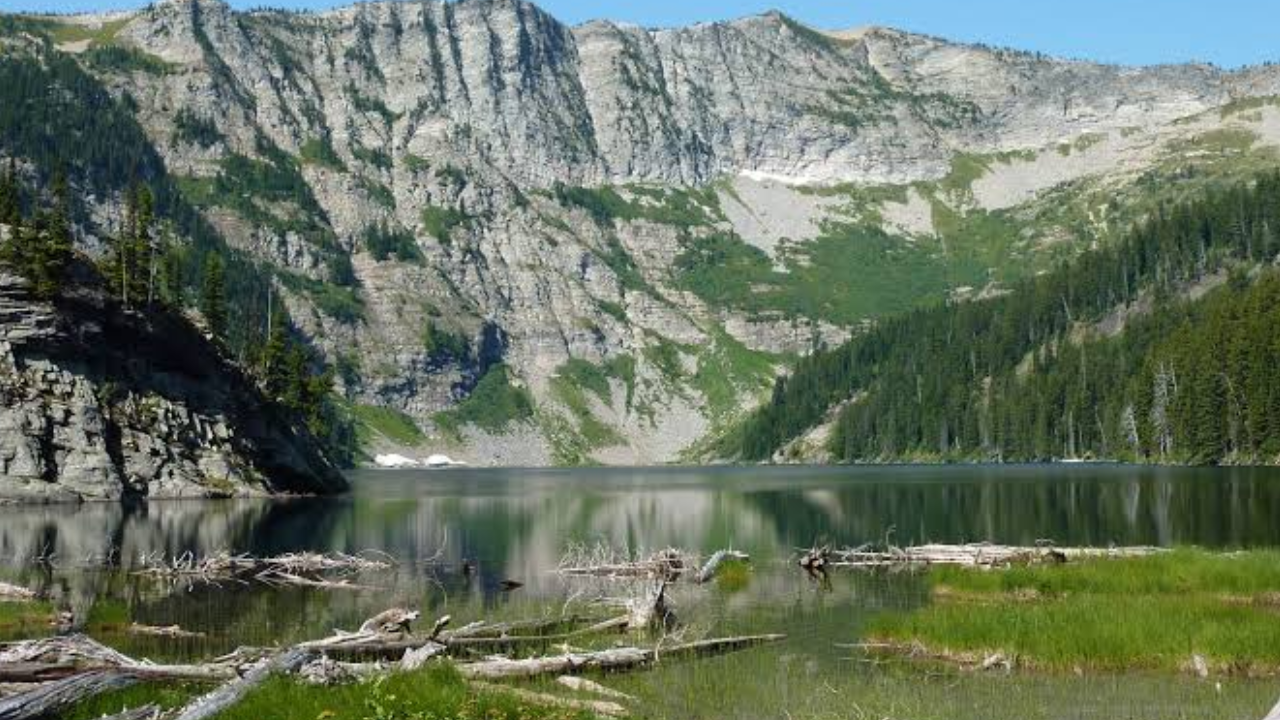
The George Gill Range in the Watarrka National Park. (Facebook: Professional Helicopter Services)
Dr Davis said she hoped watching the waterhole would encourage people to value biodiversity and natural environments.
"The more you understand these systems, the more you do value them," she said.
"That's at the very basis of nature conservation."
A perentie ambling along at Watarrka waterhole. (Supplied: Jenny Davis)
NT Parks and Wildlife senior district ranger Di Bowman said Watarrka was home to distinctive landscapes and wildlife.
"This live stream allows people to experience some of our wildlife and gain an appreciation of life in the outback, all from the comfort of home," she said.Watarrka National Park holds deep cultural significance for the Matutjara people and is internationally known for the sandstone walls and gorges surrounding Kings Canyon.
The waterhole itself is along the Giles Track, away from the park's busiest visitor areas.