Reopening Sandpapergate: Australian cricket has an Odyssey problem
Odysseus returned from the Trojan War a hero. Homer celebrated the tale of a cunning man, one who found a way into the seemingly impregnable city of Troy and took the Greeks to victory with a move so swift that nobody had thought it imaginable at the time.
In Homer's telling, deceit was part of Odysseus's cunning. The grief that might have followed from his actions, however, did not seem to weigh on him.
So when Odysseus returned to his island, many years after the war, having indirectly played a part in the slaughter of his men and having cheated on his wife (he had spent years with the goddess and nymph Calypso), he was still celebrated.
Homer wrote his version of the tale in the 8th century BCE.
Christopher Nolan, in his 2026 (AD) film The Odyssey, reimagines the story very differently.
Odysseus here is troubled by his actions, by the role he played in his men's deaths, and is full of grief when he returns to his wife and his only son.
This is not my reading of the two versions of the story, but one borrowed from a lovely interview of Nolan by political theorist Yiyang Zhuge.SABR CREATES A STIR
I bring this up because this looking at a past incident has made me take note of the Sandpapergate controversy that burst into the limelight this week, courtesy of Usman Khawaja's book.
For a book titled Sabr, which translates to patience in Urdu, it has caused quite a stir in world cricket, and beyond.
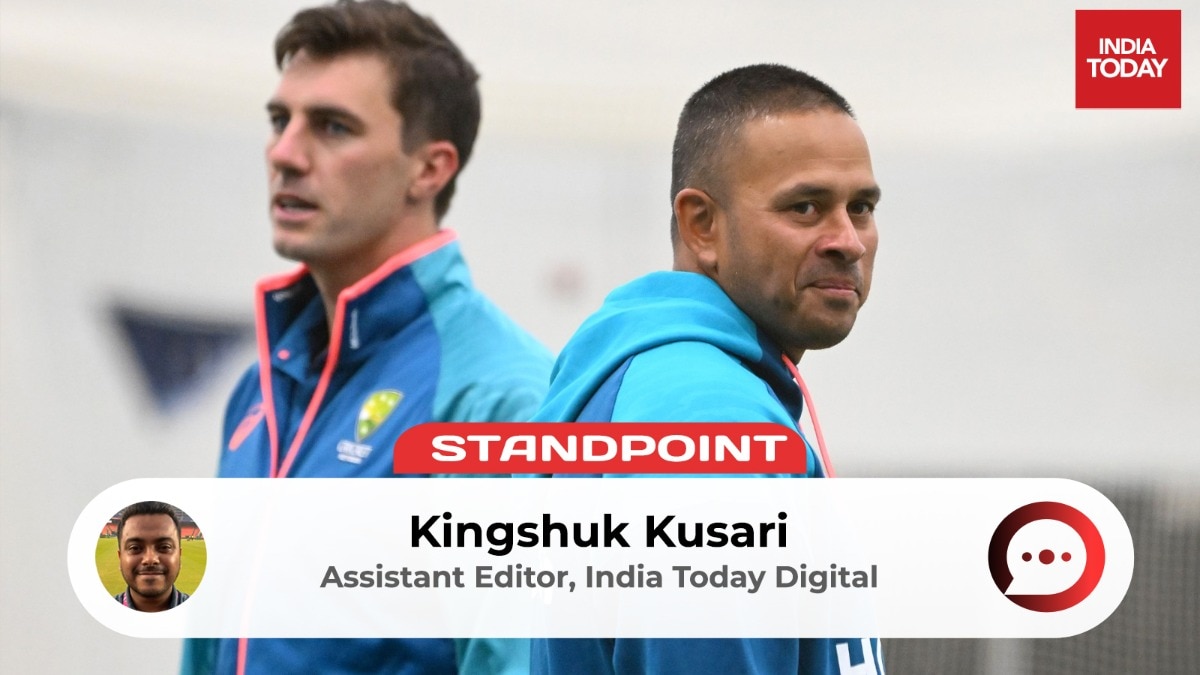
Australia captain Pat Cummins took it upon himself to address the controversy at a press conference on the day of Australia's match against England. Cummins was not part of the playing squad at the Optus Stadium in Perth, but spoke to reporters in Sydney.
Cummins denied the allegations that the entire Australian team, including the support staff, knew about the incident. He said there was no masterplan in which everyone had agreed to use a foreign agent, in this case sandpaper, on the ball.Cummins has denied there was ever a "masterplan" to use sandpaper back in 2018 #cricket #PatCummins #Sandpaper #UsmanKhawaja https://t.co/o0Wjzcs7Cy— Prime Video Sport AUNZ (@pvsportaunz) November 13, 2026
It did not help that this whole saga had already reopened during Australia's tour of South Africa, before boiling over during their ODI series against England.
Of course, it was going to catch fire. Now, what some people have suggested, and what many others have at least thought, is that this case needs to be reopened.REVISITING THE SANDPAPERGATE
But there is a problem, though. An Odysseus-sized problem: we are looking for guilt in the dressing room instead of the boardroom.
During Sandpapergate in 2018, the ICC banned Steve Smith for one match and docked 100 per cent of his match fee. Youngster Cameron Bancroft received three demerit points and a financial penalty as well.
Australian cricket, at the time, was seen as a bully. They had just come off a heated Test series against India in 2017. The national board and its players were also embroiled in a big money dispute.
As vice-captain, David Warner had become the most outspoken public face of the players' fight for their rights. He publicly criticised Cricket Australia administrators for continuing to draw their salaries while roughly 230 players went unpaid after their contracts expired on June 30, 2017. He even warned that Australia might not have a team for the 2017-18 Ashes series if players' revenue-sharing rights were stripped.
When Sandpapergate happened, Cricket Australia perhaps saw an opportunity.
CA handed 12-month bans from international and domestic cricket to both Warner and Smith. As a result, Warner was left off the 2018-19 national contract list, banned from the 2018 Indian Premier League, costing him a Rs 12 crore contract, and dropped by major personal sponsors.
Since that era, Australia have actively tried to be the nice boys of world cricket.
There was a larger exercise at play here. Australian cricket was trying to change how it was perceived, both within the dressing room and outside it. And Sandpapergate gave Cricket Australia an opportunity to draw a line between its past and the future it wanted to sell.
They brought in Pat Cummins as a captain who prided himself on inclusivity. Australia became a force in international cricket again, but this time without the profanities.
Sandpapergate also brought in technological and broadcasting changes. The pitch-side audio that we hear so often during international matches was a direct result of the scandal.
And now, in 2026, with the wounds reopened, Usman Khawaja alleges that there is more to what meets the eye. He says that three cricketers took the fall when the entire team should have been held accountable.
From my perspective, the punishment dished out in 2018 was outlandish. It made Australian cricket better, which was what was needed, wasn't it? That was the goal of the whole exercise.
Since 2018, Australia have prided themselves on their practices, on how they have given a voice to the Aboriginal community, and on how they have moved away from the poor methods and culture that once existed in their dressing room.advertisementNOLAN'S SANDPAPERGATEReopening Sandpapergate should not mean putting Steve Smith, David Warner and Cameron Bancroft on trial all over again. They were punished for their actions in 2018. Their guilt is not the question this time. If anything, the fresh allegations should prompt us to look at the episode through a different lens.
What role did Cricket Australia and its administrators play in the entire episode? Was the investigation as thorough as it should have been? Were the punishments handed out purely as a cricketing decision, or did the board also see an opportunity to make an example of its senior players and distance itself from a culture that had become a liability?
These are questions for the boardroom, not another round of scrutiny for the dressing room.
Consider what happened this week. Pat Cummins, who was not even part of Australia's playing squad for the ODI series against England, made himself available to the media in Sydney. He was willing to face questions about an episode that took place eight years ago, one that he insists he had no knowledge of. He spent more than an hour addressing the allegations in Usman Khawaja's book.
Cummins was categorical in his denial. He called Khawaja's suggestion that he and others had helped devise a ball-tampering plan "complete and utter nonsense." He also defended the original Cricket Australia investigation, saying he had been questioned at the time and had answered everything fairly.
There is something worth considering here. If the captain of the Australian team is prepared to face the media and answer questions about an episode that continues to follow him, why is Cricket Australia so unwilling to revisit it?
Chief executive Todd Greenberg has already made his position clear. Speaking to SEN, he said there were specific details in Khawaja's book that contradicted accounts provided by other members of the 2018 team. Yet, he maintained that Cricket Australia was comfortable with the outcome of its investigation and saw no "compelling reason" to reopen it. "I don't think there's anything that can be gained from that," he said.
That is precisely where the problem lies.
If the allegations are that the original investigation was rushed, botched or deliberately restricted to a handful of players, surely it is the responsibility of Cricket Australia to establish that it was not. David Warner has publicly backed Khawaja's account and questioned the integrity of the original inquiry. Khawaja, meanwhile, has said that he was never interviewed by Cricket Australia despite being present in the dressing room during the Cape Town Test.
These are not questions that can be dismissed simply because eight years have passed.
And even if Cricket Australia believes there is no merit in conducting a fresh investigation, it can do something else. It can make the findings of its original inquiry, its scope, the people interviewed and the basis on which it arrived at its conclusions publicly available. If a full report has not been released, there is no reason why the board cannot publish a comprehensive account now, with appropriate redactions where necessary.
Transparency does not automatically mean reopening a case or reversing punishments. It means allowing the public to understand how an institution arrived at a decision that fundamentally altered the careers of three international cricketers. If Cricket Australia is confident that its investigation was fair and thorough, putting its findings in the public domain should only strengthen that position.
There is also a larger question of accountability. In 2018, Cricket Australia had an opportunity to draw a line between the culture that had brought the game into disrepute and the one it wanted to build. It did so, quite emphatically, through the punishment of Smith, Warner and Bancroft. The board subsequently rebuilt its image, and Australian cricket found a new identity under Cummins.
But institutions cannot claim credit for transformation while refusing to answer questions about the methods through which that transformation was achieved.
Homer's Odysseus returned home a hero. Nolan's Odysseus returned carrying the weight of everything he had done to get there.
The three cricketers have spent eight years living with the consequences of Sandpapergate. Cricket Australia, meanwhile, got to rebuild its image on their back.
Perhaps it is time we stopped scrutinising only the men who held the sandpaper and started questioning the institution that held the gavel.- Ends
Kingshuk loves football, breathes cricket and lives to travel. He is in a love-hate relationship with Barcelona and Sunrisers Hyderabad and likes to bowl military medium.