Republicans Rally Behind Paxton in Texas With Millions in New Spending - Newsweek
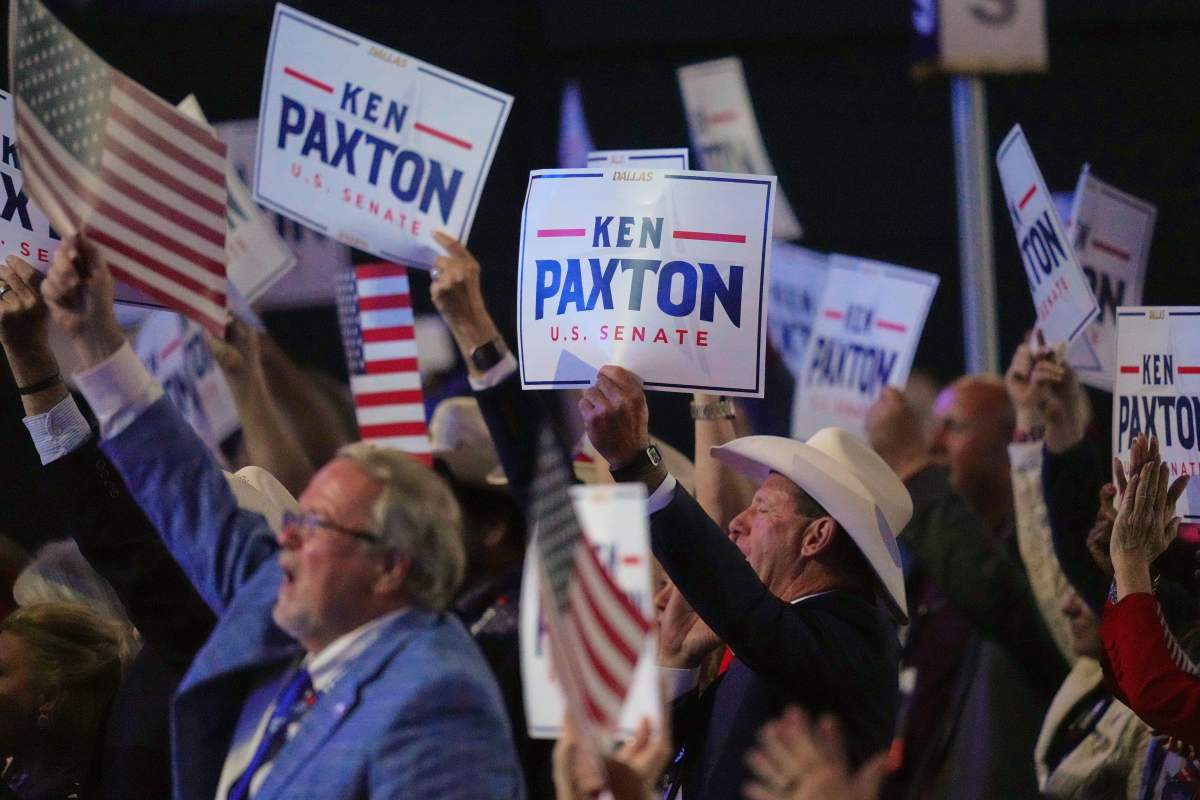
With less than two months ahead of Election Day, Republican groups are pouring tens of millions of dollars into Texas to bolster state Attorney General Ken Paxton's U.S. Senate bid.
A Republican-aligned group known as Texas PAC, which is affiliated with the Senate Leadership Fund, has purchased more than $51 million in advertising supporting Paxton, according to media-tracking firm AdImpact.
The spending surge comes as the Texas Senate race has emerged as one of the nation's most closely watched contests, with Democratic candidate James Talarico polling competitively against Paxton.
Democrats are eyeing a narrow path to reclaiming control of Congress' upper chamber, where Republicans currently hold a 53-47 majority, and are hoping to put the traditionally Republican state in play. To take back the majority, Democrats must defend their current seats—including in two states President Donald Trump won in his 2024 White House bid—and flip four others. Midterm elections are commonly viewed as a test of the political environment facing the party in power, and the president's party historically loses seats.
Newsweek has reached out to Paxton and Talarico for comment via email on Saturday.
Texas has backed Republican presidential nominees in every election since 1980, but Democrats hope 2026 will offer one of their best opportunities in years to compete statewide. Trump carried Texas by 13.7 percentage points in 2024, defeating then-Vice President Kamala Harris 56 percent to around 42.5 percent.
Texas has not elected a Democrat to statewide office since 1994, making it one of the nation's longest-running Republican strongholds. Democrats have repeatedly targeted the state as demographic shifts and population growth have reshaped its electorate, but they have fallen short in a series of closely watched campaigns, including Beto O'Rourke's 2018 Senate bid against Ted Cruz.
Polls show Paxton, who is endorsed by Trump, and Talarico, who has served as a state representative since 2018, holding narrow leads at different points in the campaign. The matchup follows Paxton's defeat of longtime Senator John Cornyn in the Republican primary in late May.
Republicans descended on Dallas this week for the party’s unprecedented midterm convention. The convention is part of a plan to mobilize the GOP base ahead of November to avert losses in key races, as polls show many Americans have soured on the Trump administration amid growing frustration with inflation, the economy and the Iran war.
The race has become increasingly expensive as national Republicans move to shore up support for Paxton in the campaign's final weeks.
Texas PAC has reserved roughly $51.3 million in broadcast television advertising in the Dallas-Fort Worth, Houston, San Antonio and Austin media markets, according to the Texas Tribune, citing AdImpact.
Other Republican-aligned groups have also entered the race. MAGA Inc., a Trump-aligned PAC, has reserved about $10 million in Texas advertising, while America PAC, which is backed by Elon Musk, has spent more than $2.6 million on advertising supporting Paxton and opposing Talarico, according to the Tribune.
Since the Republican primary, GOP-aligned groups have reserved more than $81 million in advertising backing Paxton, according to AdImpact. Democratic groups and campaigns have reserved about $43.7 million, with much of that spending coming from Talarico's campaign.
The Senate Leadership Fund did not include Texas among its targeted Senate races when it unveiled its spending plans in April, noting a marked shift in strategy. Alex Latcham, the head of the Senate Leadership Fund, Newsweek in an email comment Saturday, "The Republican Party is united to elect Ken Paxton and keep Texas red in November. Senate Leadership Fund’s investment through Texas PAC affirms our commitment to maintaining the Republican majority and defeating Far-Left liberals like James Talarico."
The late surge of Republican spending follows months in which Talarico enjoyed a substantial financial edge. By the end of June, federal campaign finance filings showed Talarico had approximately $21.5 million in cash on hand, while Paxton reported about $1.75 million.
Those same filings showed that Talarico had raised over $68.5 million, compared to Paxton’s $9.2 million.
Forecasters like the Cook Political Report and Sabato’s Crystal Ball consider the race to be a toss-up.
A YouGov/Univision poll of 1,000 registered voters conducted between August 27-September 4 found Talarico leading by 5 points, 48 percent to 43 percent. It had a margin of error of plus or minus 3.6 percentage points.
An Overton Insights/Texas Public Policy Foundation poll of 1,167 likely voters from August 24-26 found Talarico and Paxton locked in a statistical dead heat. The poll found Talarico leading with 44 percent support to Paxton's 43.4 percent, while 12.6 percent of respondents remained undecided. When leaners were included, the race was effectively tied, with both candidates receiving 50 percent support.
Other recent polling, such as an Emerson College Polling/Nexstar Media poll of 1,000 likely Texas voters, also puts the Senate race in near deadlock, with 47 percent backing Paxton and 46 percent supporting Talarico. About 5 percent are undecided and 2 percent back a different candidate. The poll was conducted August 9-11 and had a margin of error of plus or minus 3 percentage points.
A Fox News poll of 1,006 registered Texas voters found that 51 percent back Talarico and 48 percent Paxton, with 1 percent undecided. The survey was conducted July 23-27 and had a margin of error of plus or minus 4 percentage points.
Prediction markets reflect the race's razor-thin margins. As of Saturday afternoon, Kalshi showed Paxton and Talarico tied at 50 percent, while Polymarket gave a slight edge to Talarico at 52 percent.
Democrats argue that voter concerns about the economy, Trump's declining approval ratings and the war with Iran could create openings in several competitive state races. Despite Democratic optimism, Republicans contend that they will maintain their Senate majority and retain control of Congress.
Nationally, 34 percent of voters approve of Trump's job performance while 60 percent disapprove as of Friday, leaving him underwater with a net approval rating of -26, according to Civiqs' rolling online tracking poll of registered voters. As of Saturday, the survey had garnered around 129,500 responses since January 20, 2025 when Trump was inaugurated for a second term.
Nate Silver’s Silver Bulletin’s averages show Democrats leading in four races for GOP-held Senate seats, putting the party within reach of the four it needs, but with little room for error. Its latest updated averages show Democrats ahead in Alaska, Georgia, Maine, Michigan, Minnesota, New Hampshire, North Carolina, Ohio and Texas. Republicans lead in Florida, Iowa and Kansas.
Contact Newsweek editors for this story: Hollie Silverman and Anthony Murray.