
Restrictions remain largely on paper in water-stressed Barind region - Prothom Alo English
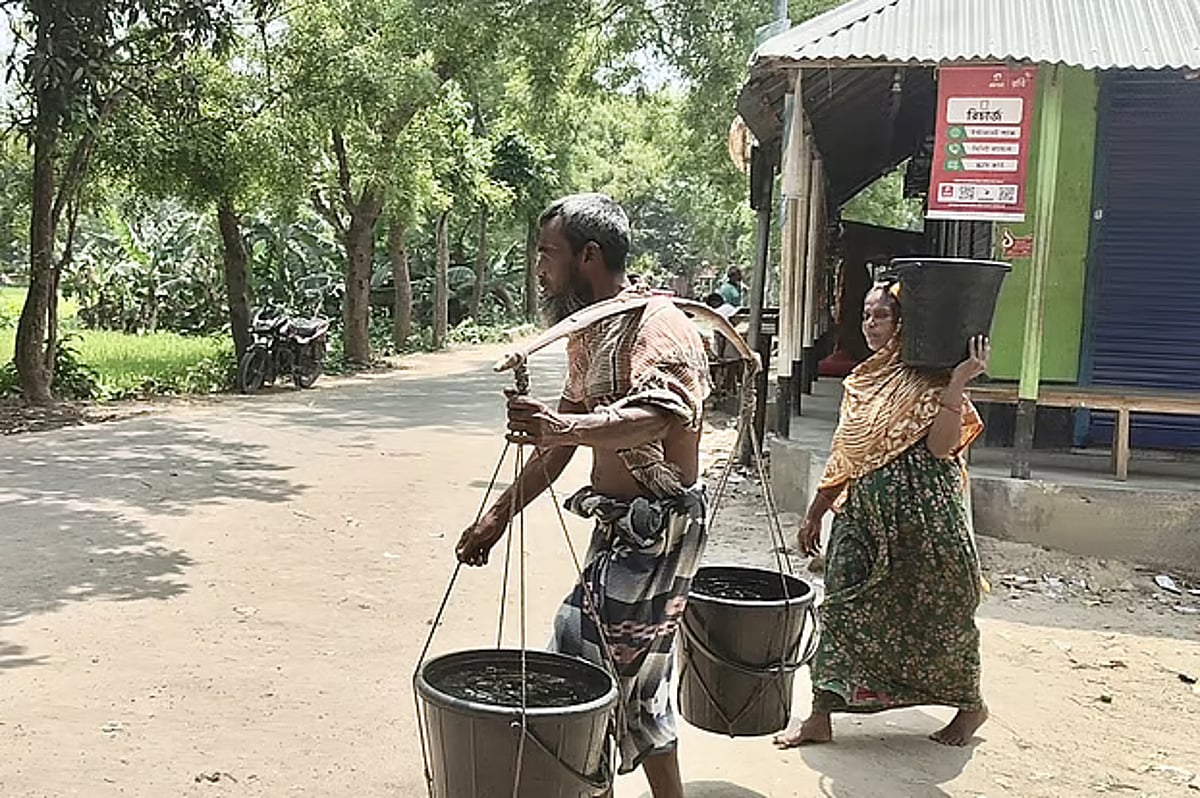
Family members collect water in buckets from a deep tube well located far from their home for drinking and household use. Kondail village, Tanore Upazila, Rajshahi, 14 April.Shafiqul IslamNo new tube wells may be installed except to supply drinking water. The use of groundwater for irrigation must be phased out, cultivation of water-intensive crops restricted, and no new groundwater-dependent industries or establishments allowed.
The interim government imposed these and eight other restrictions after declaring parts of Rajshahi, Chapainawabganj and Naogaon water-stressed areas. It also issued directives to ensure access to safe drinking water, increase the use of surface water, conserve rainwater, and re-excavate rivers, canals and ponds.
The groundwater table in the Barind region has fallen alarmingly, creating an acute crisis during the dry season. Shortages of both irrigation and drinking water have become severe. Against this backdrop, 153 unions in the three districts were declared water-stressed areas.
However, eight months after the gazette notification was issued, effective enforcement of the restrictions on the ground remains far from satisfactory.
A survey by the Water Resources Planning Organisation (WARPO) on the water situation in the three districts was presented at a meeting of the Executive Committee of the National Water Resources Council in August last year.
The survey divided 4,911 mouzas in 215 unions across 25 upazilas of the three districts into three categories. Of them, 1,469 mouzas in 47 unions were identified as facing extremely high water stress, 884 mouzas in 40 unions as highly water-stressed, and 1,240 mouzas in 66 unions as moderately water-stressed.
The gazette notification titled “Water-Stressed Area Declaration Order (Amended)” was subsequently issued on 22 January this year. The listed unions and mouzas were declared water-stressed areas for 10 years from the date of the gazette’s publication.
The gazette ordered a halt to the installation of new tube wells and the extraction of groundwater for purposes other than drinking water supply. Groundwater extraction for irrigation must be stopped within two years through crop selection and other necessary measures.
New groundwater-dependent industries or establishments are also prohibited. The classification of canals, beels, ponds and rivers cannot be changed, nor can the natural flow of water be obstructed. Authorities have been discouraged from leasing state-owned water bodies and jalmohals. Discharging untreated waste into rivers, water bodies and wetlands is prohibited.
The cultivation of water-intensive crops must be restricted and that of water-efficient crops expanded. Any violation of the restrictions is a punishable offence.
In many places, however, authorities have been unable to encourage farmers to grow more water-efficient crops or reduce groundwater use.Five unions in Sapahar upazila of Naogaon—Aihai, Goala, Sapahar, Shironti and Tilna—have been classified as facing extremely high water stress. Upazila agriculture officer Mohammad Moniruzzaman told Prothom Alo that while Tilna and Sapahar faced acute groundwater shortages, the crisis was not as severe in the other unions.
Ponds and canals have yet to be freed from leases so that they can be used as alternative irrigation sources. Chapainawabganj district has around 6,500 ponds, of which 1,100 have been restored. They cannot, however, be used as alternative sources of irrigation.
Mohammad Al Mamunur Rashid, an executive engineer at the Barind Multipurpose Development Authority (BMDA), told Prothom Alo that water bodies in highly water-stressed areas could not be freed from leases.Questions over the identification of areas
Many local engineers and agricultural experts say some of the areas declared water-stressed do not face any water crisis at all.For example, five mouzas in Panka union of Shibganj upazila in Chapainawabganj have been classified as moderately water-stressed. The Padma River flows along one side of these areas and the Mahananda along the other.
Recalling a consultation with local people about the designation, a BMDA official said residents had reported finding water after digging just 10 feet. “How, then, can the area be considered water-stressed?” the official asked.The BMDA operates large-scale irrigation systems across the region. In many BMDA-managed irrigation areas, controls are being enforced in line with the new rules. Local residents, however, allege that the rules are not being followed in privately operated irrigation systems.
Of the 128,000 hectares of cultivable land in Chapainawabganj, 72,000 hectares are covered by BMDA irrigation. The remainder is under private irrigation.
Water expert Chowdhury Sarwar Jahan acknowledged that private irrigation could not be controlled even in areas classified as water-stressed.
Responding to questions over the designation of certain areas, he said, “This controversy has been created. We followed our methodology in carrying out the assessment. It may be reviewed.”
The gazette assigned implementation responsibilities to numerous agencies, including the Department of Public Health Engineering, Bangladesh Water Development Board, BMDA, Bangladesh Agricultural Development Corporation, Department of Agricultural Extension, Department of Environment, Local Government Engineering Department, Ministry of Land, and district and local administrations.
Although responsibilities have been divided among multiple institutions, no single agency has been designated as solely accountable.BMDA executive director Mohammad Jahangir Alam Khan believes the authority should bear the main responsibility, with other institutions playing supporting roles.
By declaring the areas water-stressed, the government has formally acknowledged the severity of the crisis. Sarwar Jahan, however, said that a gazette notification alone would not be enough to halt the decline in groundwater levels unless effective arrangements were made for alternative water sources, financing, monitoring and accountability.


