RFK Jr. Flips The AI Trust Question On Doctors - Newsweek
This is a preview of the October 1 edition of Access Health—Tap here to get this newsletter delivered straight to your inbox on Thursday mornings.
Last week, more than 170 health care stakeholders visited Newsweek's headquarters in New York City to discuss the question of the year: how to integrate AI into health care safely, responsibly and in a way that maximizes access and outcomes.
Trust came up in every session, even those that weren't specifically designed to focus on it. We spoke about whether patients should trust AI with their health data, whether clinicians should trust its recommendations and what health systems need to see before trusting increasingly autonomous agents with more consequential tasks.
Throughout the day, I didn't hear anyone ask, "Should patients trust doctors?" Truthfully, it wasn't a question I thought to ask. I sat down with each of our 30-plus speakers before the event, including practicing physicians, heads of AI labs and technology and strategy executives from health systems and health plans. None raised doubts about physicians' discernment or clinical judgment separate from AI.
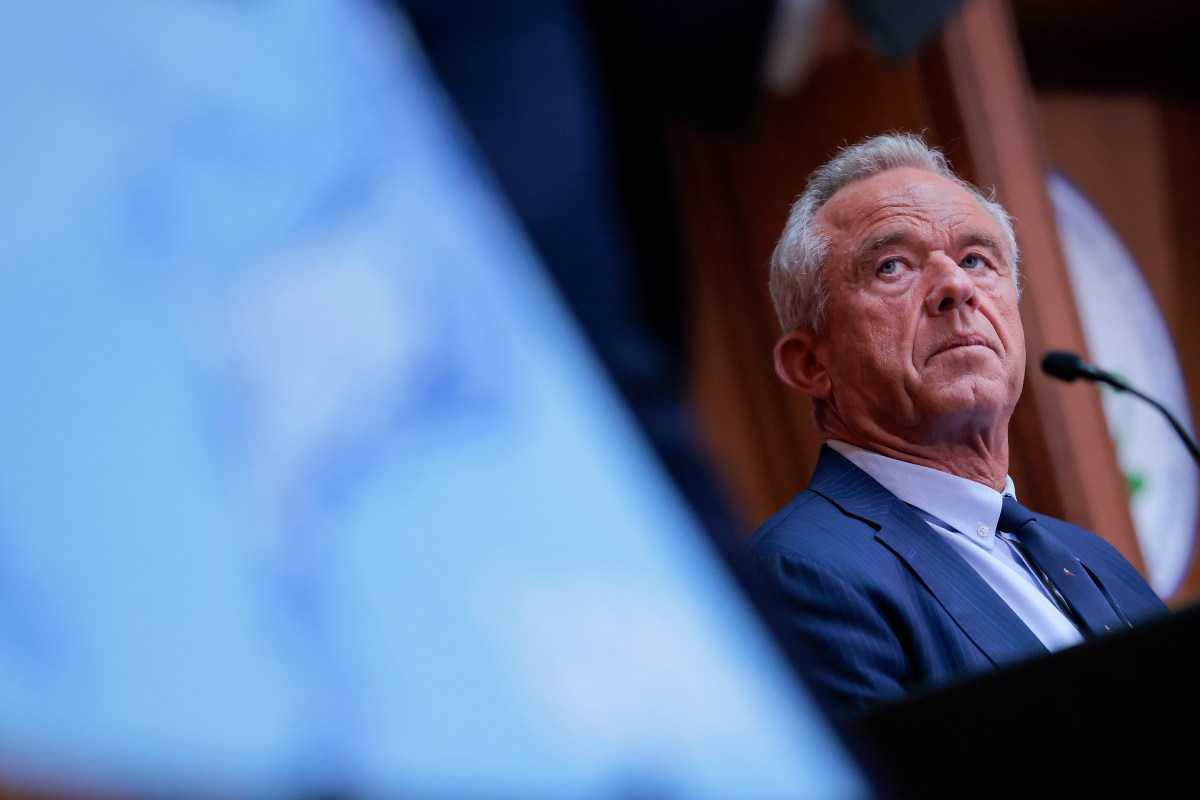
Then, this week, Health and Human Services Secretary Robert F. Kennedy Jr. raised exactly that question.
Speaking at the Make America Healthy Again Summit on Tuesday, Kennedy said AI could give patients “a second opinion that is much better informed than any doctor in the country” and “free us from medical tyranny.” He also recounted a conversation with OpenAI CEO Sam Altman, who Kennedy said told him it would be “malpractice” for a physician to diagnose or prescribe without at least checking AI. A transcript of Kennedy's remarks confirms the wording of his account.
It's the inverse of what I heard last week. The clinicians and leaders at our Summit were wrestling with what AI has to do to earn physicians' trust, (read this article for a summary of their arguments). After all, AI is the uncontrolled variable in the exam room; doctors are the longstanding control group.
“The accountability rests with the clinicians as well as the organization,” Dr. Sophie Bakri, medical director of Mayo Clinic's Center for Digital Health and chair of its ophthalmology department, said at the Summit last week. “As clinicians, we decide ultimately what we use.”
Watching heads bob in agreement as she spoke, I was reminded of a remark from Dr. Brendan Carr, CEO of Mount Sinai Health System, earlier in the day.
The tech community's mantra is "move fast and break things," Carr said, and it's “running directly into 'do no harm,’” physicians' oath.
"These are culturally totally, totally opposed," Carr said.
When Bakri said that physicians must have the ultimate say on AI—something I've heard repeated in interviews and boardrooms and conference halls over the past four years—I wondered, briefly, if we should be treating that affirmation as fact. They "must," many agree, but it remains to be seen if they will.
After RFK's comments, it is undeniable that the two cultures are on a collision course. Much of health care assumed that medicine would be the victor, but this week offered a reminder that not everyone shares that assumption.
As always, email your thoughts to a.kayser@newsweek.com, and thanks for reading.
Geisinger CEO Dr. Terry Gilliland has a sizable math problem on his hands. Between federal policy changes and rising uncompensated care, he estimates the Pennsylvania health system has roughly $390 million to make up. That is more than the margin of a hypothetical $10 billion health system, he told me.
Technology is part of Gilliland’s answer, but only if it actually changes that math. Geisinger is pursuing AI for chart and knowledge synthesis, primary care and pharmacy workflows, while Gilliland is increasingly focused on what those tools themselves cost. The system has hired 18 AI engineers and scientists in the past year, and Gilliland predicts the industry is headed toward “a reckoning” over AI pricing.
Read on for a portion of our Tuesday interview.
Editor's Note: Responses have been lightly edited for length and clarity.
Terry, we last spoke at HLTH USA just under a year ago. How have your priorities shifted over the past year?
I would say front and center is the federal policy tsunami that is about to hit us. It’s a combination of HR 1, OPPS rule changes, IPPS, the physician fee schedule and what we’re experiencing with uncompensated care, which has increased year over year to about $10 million more per month.
We’ve got about a $390 million nut to crack. Remember, we’re a low-margin business. Let’s just say we’re a $10 billion enterprise. $390 million is 3.9 percent. That’s higher than our margin, so we’ve got to figure out how to do things better, faster and in a more cost-effective way in order to just make it.
The Rural Health Transformation Program, which you referenced, is like those little dot Band-Aids you’d use for your grandkid when they had the tiniest of cuts. That’s about what RHTP does for us.
Pennsylvania only had about $193 million for the entire Commonwealth. Our impact from HR 1 was $185 million. We got $3.7 million in the first tranche and $2.7 million in the second tranche. It’s great. We’re going to buy a CT and an MRI in places that don’t have them. But is it going to make up for that $185 million impact of HR 1? Absolutely not.
How are you thinking differently about operations, workforce and technology to make it through this period?
Your operations better be pristine, and they’re not. We have a number of different areas of opportunity, whether it’s how efficient our operating rooms are or how many patients our doctors can see. We’ve simply got to get better.
The second part is diversifying your revenue streams. Are you optimizing the ways you can bring in revenue other than your traditional clinical operations? Pharmacy has been very good for us. We’re evaluating those opportunities.
On the other side, health care has been really good at throwing people at problems. If there’s a patient who’s combative, we put a sitter at their front door. If there’s a person who needs to do X, Y or Z, we throw a person at it. This is where technology comes in, because the promise and hope of artificial intelligence and algorithms is that you can presumably make it so you don’t have to apply a human to every single problem.
But there’s a catch. We’ve got to make sure the technology we install actually reduces our average expense for the services we deliver. If we can’t, then it’s not going to help us solve the problem we have.
Given those costs, do you still see AI as a worthwhile investment for Geisinger?
Oh, 100 percent. There are point solutions in artificial intelligence for everything, especially in health care, and we’re trying to resist that gravitational pull and come up with four big things we’re going to do this year.
One is chart synthesis. Physicians, APPs and nurses waste a lot of time navigating the electronic health record, which has turned into a beast, and getting information out of there. We’re partnering with an organization that is going to provide chart synthesis for us: What are the relevant parts of Terry’s history at this moment in time that this doctor needs to know to provide me with great care?
Another problem physicians can’t solve is the multiplication of knowledge within health care. You can’t keep track of it. Artificial intelligence can. Put those together and you ought to be able to assist with: “What’s the next best action for Terry at this moment in time?” It’s a recommendation. The physician is going to have to oversee that.
The second place we want to address is primary care. Right now, we have primary care doctors taking care of, on average, about 1,500 patients. They’re pretty sick out here in central Pennsylvania. They’re older and sometimes have a lot of wear and tear. How can we expand that? Because the unit economics for primary care don’t work.
Are there ways to have AI-assisted primary care? Are there options where 85 percent of the interaction with a particular patient is using an artificial agent that still connects to your system? Are they going to replace a doctor? No. Are they going to be connected to a physician? Yes.
Where else do you see an opportunity for AI to change the economics of care?
If you are a typical prescribing physician, you have an amazingly complicated abyss of trying to figure out, for a particular patient, their formulary, disease, care pathways and the cost associated with prescribing any of those options. It changes all the time.
For our pharmacists to navigate that world so we can prescribe the right medication for that patient at that moment in time, given their insurance and benefits, is time-consuming and therefore costly.
We believe there’s an opportunity to take artificial intelligence and knit those together continuously. Your agent is providing that recommendation to the pharmacist or physician, but the pharmacist isn’t having to go look up the formulary, benefits, insurance company and copays.
We think there’s great opportunity there to make us more streamlined. Those are the kinds of big bets we’re trying to focus on that fundamentally change how care is delivered and make it more efficient and, of course, more cost-effective.
How are clinicians reacting to these changes?
I’d say most of them are very supportive. One of the fake-outs for a person like me inside administration is you think people are waiting or they’re afraid. No, they’re actually going and getting it themselves. They’re asking ChatGPT.
Some of those answers are good, and some of them are not. If you aren’t having a human who is smart enough to figure out whether it’s a fake-out with artificial intelligence, you can do really bad things.
We absolutely have to have that in health care. We don’t ever want younger physicians or medical students to take this stuff as a replacement for them being smart enough to know the difference. But in general, I’d say they embrace it because it’s a great source of knowledge. You just have to make sure it’s the correct knowledge.
How are you approaching AI governance and questions of accountability as agents enter clinical workflows?
We were a little bit slow getting artificial intelligence out there to the front line. What we did instead was develop a pretty mature governance structure. We’ll have KPMG come and look at it as well, because we believe the governance part is really important to make sure you aren’t putting monsters inside the machine.
We have a pretty robust process for making sure what we allow is going to be accretive, appropriate and accurate. One thing about our architecture is that we don’t actually allow those artificial intelligence engines inside our native environment. They can work outside it, but they’re not allowed inside the environment. That’s an important architectural feature that we believe will provide at least some level of safety.
It’s going to create a physical or electronic firewall, and then also have some human firewalls, if you will. That’ll make it so our data is protected.
What are you spending to build and maintain these AI capabilities?
We’re certainly spending money on it. We’ve hired 18 artificial intelligence engineers or scientists in the last year, and they have to deliver a return on that investment.
There’s a separate component that is a point of contention for me. Most people have Epic. It’s not some secret. The place where I get a little bit agitated is when Epic comes out and says, “We have a fantastic artificial intelligence engine for X, Y, Z. Oh, by the way, it’s going to cost you X number of dollars per year.”
We’re in the middle of upgrading our Epic capabilities because we didn’t really take on the full module of what Epic is. Just to bring in those additional modules and have the people to maintain it is an additional $12 million per year.
That’s not affordable over time. We’ve got to find a different conversation. You can’t exact these costs on the system and have any expectation that it’s sustainable over time.
I do believe there’s a reckoning coming for what these AI tools cost, because right now there’s no trajectory that appears to make them affordable. I can’t quite tell what it’s going to be or how it’s going to manifest, but the math doesn’t work.
Could those costs widen the AI gap between large health systems and smaller or rural organizations?
Yeah. We’re one of the healthier rural systems out there, but if you’re a standalone or smaller rural hospital system, you’re going to have a really hard time navigating the space and paying for it.
It has the potential to create a wider gap between the haves and the have-nots, and that ought to be a concern for all of us.
How are you thinking about maintaining access to care in smaller rural communities?
We’ve taken these little hospitals around us, spruced them up and built out their capabilities. That’s our model. We have a critical access hospital where we’re doing Mako joints. That’s relatively higher tech, but it’s absolutely crucial for their survival.
In rural Pennsylvania, sometimes the density doesn’t warrant having a hospital. We have a model in Tunkhannock where the hospital closed. What we did was open what we call ConvenientCare+, which is urgent care with somewhat constrained hours of operation. We just put in a CT scanner, and we have infusion chairs for cancer.
It provides some of the services in the community so people don’t have to haul in 45 minutes. That’s the model we believe has legs. If we have to actually run a hospital in these tiny communities, that’s going to be really hard.
We don’t need 5,000 hospitals right now. We need places where you can still deliver care, stabilize and transport. That’s a model that’ll work.
What does the health care industry need to focus on to relieve these pressures?
At the top of our list, we have to get to better outcomes and lower total cost of care. Period.
If you take the bigger tectonic plates out there, the federal government is saying health care is too expensive and we’re not going to pay for it anymore. They’re going to do it through reducing eligibility and enrollment in Medicaid and being much tougher on fraud, waste and abuse. They’re doing it in a fashion that we can debate. It’s a lot all at once for us to absorb.
But they’re saying you’ve got to get to better outcomes at lower total cost of care. Better outcomes are all about quality, driving processes and population health. The second part is: How do we make the cost to deliver that care more efficient and effective? We’ve got to work both. That actually leads to value, which is what we all want in health care.
What is the biggest barrier to achieving that?
For us, it’s mindset. It’s all about mindset. The mindset has got to be: How can we do this better, more efficiently and more effectively?
We do zero-based budgeting. If you have 1,200 people this year in your shop, don’t come and say you’re going to add 100. I want to know what your first 1,200 are doing, because only then can we know whether you actually need that 100.
In the broader scheme of things, there are a lot of stakeholders with their fingers in the pot, and there are so many intermediaries. PBMs are an intermediary. How do we make it so they provide more value at a lower cost? Same thing with the supply chain.
We’ve got to figure out how to get to some of the real costs in care and then rip out those things that we don’t need. Depending on your line of business, pharmacy is 25 to 45 percent of the cost of health care. If you’re going to take one chunk, that’d be a big chunk.
This is a preview of the October 1 edition of Access Health—Tap here to get this newsletter delivered straight to your inbox on Thursday mornings.