Rick Jackson’s Chances Boosted Against Keisha Lance Bottoms in Georgia Race
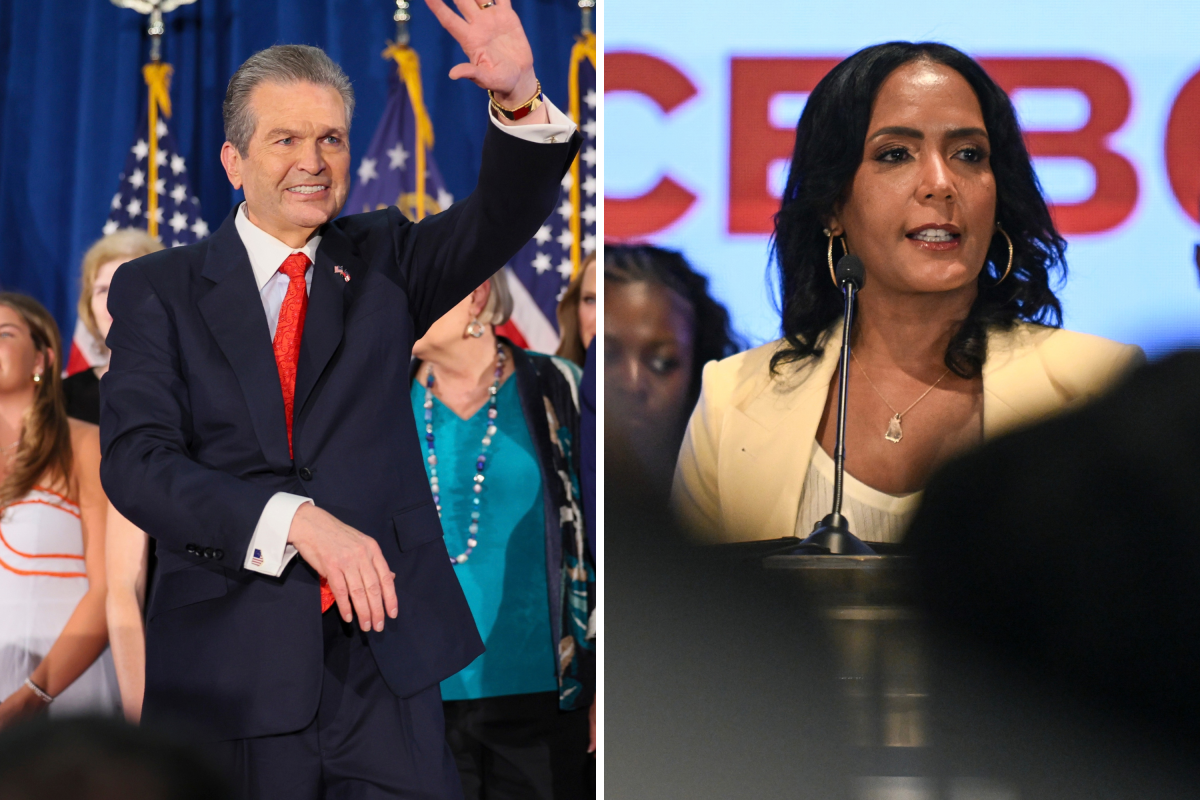
Two polls show Republican Rick Jackson leading Democrat Keisha Lance Bottoms in Georgia’s governor race, which might come as a surprise given the current momentum of Democratic Senator Jon Ossoff.
Ossoff, who has attracted speculation as a 2028 presidential candidate for the Democrats, has at least a 10-point lead over his Republican Senate challenger Mike Collins in both polls.
Conversely, the governor’s race in the traditionally red state is leaning Republican—albeit by a small margin.
Jackson leads the former Atlanta mayor 47.6 percent to 45.7 percent among 712 registered voters and 48.7 percent to 46.7 percent among 678 likely voters in a Big Data Poll released Thursday. Similarly, 45 percent of 3,447 registered voters surveyed in a recent YouGov survey said they would support Jackson over 44 percent who backed Bottoms.
Just last month Bottoms had a narrow lead on Jackson in some polls, including a Quantus Insights survey, which gave Bottoms 46.4 percent of the vote compared to Jackson's 44.9 percent. In July, a Fox News survey put her at 52 percent to Jackson’s 47 percent.
These were conducted by different organizations from the September polls so the comparison cannot definitely prove a shift in support, but it does suggest possible gains for Republicans, who will be wanting to hold onto an office they have held for the last 20 years.
Jackson’s lead in the Big Data Poll, which surveyed Georgia voters between September 21 and 23, is lessened to a one-point gap when taking into account how undecided voters answered which candidate they leaned toward.
Some 62.4 percent chose Bottoms and 37.6 percent chose Jackson, leaving Jackson’s support at 50.5 percent and Bottoms’ at 49.5 percent.
The survey reported a margin of error of +/-4 percentage points for both registered and likely voters.
But YouGov gave Jackson a bigger lead in the end, with his lead growing to 47 percent, over Bottoms’ 44 percent, when it included only voters meeting its stricter likely-voter criteria—people who said they would definitely vote rather than probably vote, for example.
The pollster, which carried out its survey between September 15 and 18, disclaimed a margin of error of +/-2.7 points for registered voters and 2.9 points for the stricter likely-voter group.
Ossoff enjoys a bigger lead in both the Big Data Poll and YouGov surveys.
Some 52.2 percent of likely voters backed Ossoff, compared to 41 percent who backed Collins in the Big Data Poll, while the YouGov poll found 51 percent for Ossoff and 41 percent for Collins. This 10-point lead drops to 8 points when YouGov applies its stricter likely-voter criteria.
There may also be signs of support for Ossoff beyond his party’s base: 14.3 percent of respondents in the Big Data Poll who said they voted for President Donald Trump in 2024 backed the Democratic senator, compared with 2.9 percent of former Vice President Kamala Harris voters who backed Collins.
In Big Data Poll’s hypothetical 2028 Democratic presidential matchup among Georgia voters, Ossoff led the field with 29.7 percent among registered voters, before Harris (29.7 percent) and California Governor Gavin Newsom (12.8 percent).
Georgia has become more of a battleground state in recent years. While it has repeatedly chosen Republican governors, it backed Trump in 2024, and voted for former President Joe Biden in 2020.
The seat is open because Republican Governor Brian Kemp, who won his first term in 2018 and was reelected in 2022, is not allowed to serve more than two consecutive terms, according to Georgia’s constitution. This election will decide whether his party retains the office
Meanwhile, a Bottoms victory would make her the first Black woman elected governor of a U.S. state.
The simultaneous Senate race could also have an impact on the national election in 2028—Ossoff winning a state Trump carried in 2024 could add to his appeal as a presidential candidate.