Romanian court rules to detain pro-Russian former presidential candidate pending fraud probe
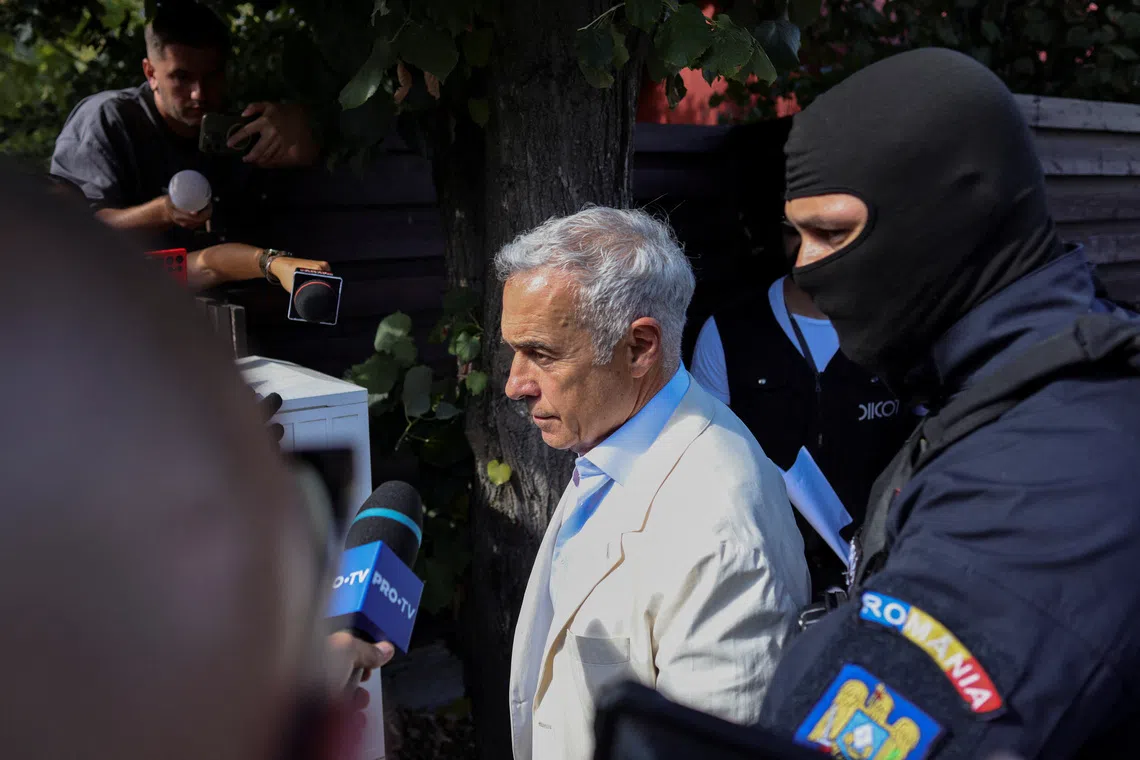
Calin Georgescu, the pro-Russian former frontrunner in the country's 2024 canceled presidential election is escorted by police and gendarmerie officers, in Mogosoaia, Romania, September 21, 2026. Inquam Photos/Octav Ganea via REUTERS
BUCHAREST, Sept 29 - A Romanian court ordered the detention on Tuesday of Calin Georgescu, the pro-Russian former frontrunner in a cancelled 2024 presidential election, for 30 days pending a criminal investigation for fraud.
Prosecutors said Georgescu and two other suspects had persuaded a Romanian businessman to give them €1.1 million by making him believe they could help him get a credit line of up to €15 million from a foreign financial institution. He has denied wrongdoing.
A court initially ruled against detaining Georgescu, placing him under judicial control, a light preventative measure. But prosecutors challenged the decision and on Tuesday the Bucharest Court of Appeals found in their favour. The ruling is final.
Hundreds of Georgescu supporters gathered outside the courthouse in downtown Bucharest on Tuesday, crying as he walked down the steps, hugging him and giving him flowers.
Romania, a member of NATO and the EU, canceled its presidential election in December 2024 over suspected Russian interference in favour of Georgescu, a strong critic of NATO, Brussels and Western support for Ukraine.
Romanian prosecutors said Moscow tried to sway the vote with tactics including cyberattacks and online disinformation, which Russia denied. The ballot was re-run in May 2025 and was ultimately won by pro-European centrist President Nicusor Dan.
Georgescu, who was banned from running again but remains popular, is already on trial in two separate cases, one on charges of attempting to disrupt national security after the election was cancelled, and the second for promoting Romania's 1930s fascist leaders, which is illegal. He denies wrongdoing.
The cancellation of the ballot in 2024 left voters deeply divided, stoked mistrust in state institutions and fuelled support for the far right. REUTERS