Russian citizens in South Africa to vote in 2026 State Duma elections - IOL
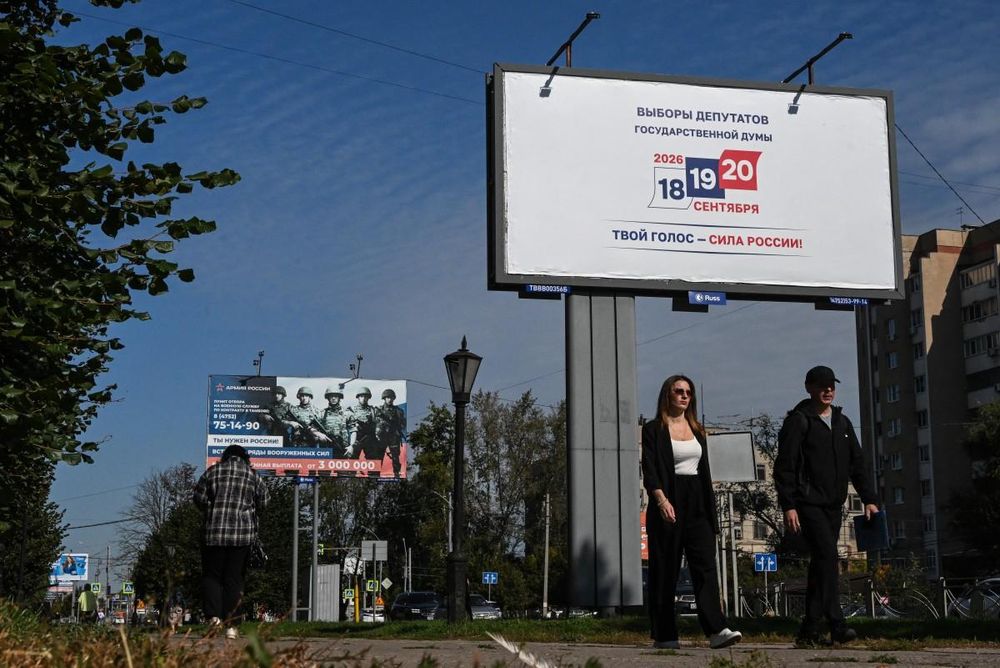
Pedestrians walk past a billboard (R) announcing the upcoming election for Russia’s lower house of parliament, the State Duma, in Tambov, Russia, on September 10, 2026.
Russian citizens living or travelling in South Africa will have several opportunities to vote in Russia’s 2026 parliamentary election, as Russia elects the ninth convocation of the State Duma.
In Pretoria, polling station No. 8352 has been established at the Russian Embassy at 316 Brooks Street, Menlo Park. Voting will take place on September 20 from 8am to 8pm.
Russian citizens in KwaZulu-Natal will be able to vote a day earlier, on September 19, at the Coastlands Umhlanga Hotel and Convention Centre, 329 Umhlanga Rocks Drive, Umhlanga, from 8am to 8pm.
In Cape Town, voting will take place on September 20 from 8am to 8pm at the Consulate General of the Russian Federation, 8 Riebeek Street, 12th Floor, Norton Rose House.
Russian citizens who have reached the age of 18 by election day and retain voting rights are eligible to participate. Voters are required to present a valid document identifying them as Russian citizens outside the Russian Federation – in practice, a valid Russian international passport.
The election will determine the composition of the 450-seat State Duma, the lower house of Russia’s Federal Assembly, for the next five-year term. This is a parliamentary election, not a presidential election, but its outcome will determine the balance of forces within the institution responsible for passing federal legislation and shaping Russia’s domestic and economic legislative programme.
Russia uses a mixed electoral system. Half of the Duma’s 450 deputies are elected from single-member constituencies, while the remaining 225 seats are allocated through proportional representation according to the federal party vote. Parties generally need at least five per cent of that vote to enter the proportional allocation of seats.
Inside Russia, voting will run from September 18 to 20.
United Russia, the governing party associated with President Vladimir Putin, enters the election as the dominant parliamentary force. It won 324 of the 450 seats in 2021. The scale of the majority it secures this time will provide an important measure of political support at a point when Russia has been engaged in prolonged conflict in Ukraine, subjected to extensive Western sanctions and simultaneously deepening its economic and diplomatic orientation towards BRICS and the Global South.
The latest VCIOM polling published ahead of the election, based on figures for September 6, placed United Russia at 37.4%, followed by the Communist Party of the Russian Federation at 13.1%, New People at 10.4% and the Liberal Democratic Party at 9.9%. A Just Russia was polling at 4.5%.
For South Africa, the vote carries an additional geopolitical dimension. South Africa and Russia are fellow BRICS members and operate within what the South African government describes as a comprehensive strategic partnership. President Cyril Ramaphosa and President Vladimir Putin have continued direct discussions during 2026 on trade, investment, BRICS cooperation and the war in Ukraine, while South African parliamentary representatives undertook an official working visit to Russia in July aimed at strengthening parliamentary relations.
Pretoria has maintained its call for a negotiated settlement to the Russia-Ukraine conflict while continuing political and economic engagement with Moscow. This places the Russian election within a relationship that extends well beyond diplomatic protocol and into debates over BRICS, multipolarity, sanctions, trade and the changing distribution of global power.
The electoral environment itself remains internationally contested. The OSCE has criticised Russia for not inviting its observers to the 2026 parliamentary election, arguing that this runs against commitments undertaken by participating states. Moscow has rejected Western assessments of its electoral system and has repeatedly accused Western institutions of applying political double standards to Russia.
For Russians voting in South Africa, then, the ballot is cast thousands of kilometres from Moscow but within one of Russia’s most important political relationships on the African continent. The result will determine the composition of Russia’s legislature at a time when the country’s domestic political direction, war economy and expanding relationships across the Global South are increasingly intertwined.