Russian strikes on Ukraine are likely about to get worse, analyst says
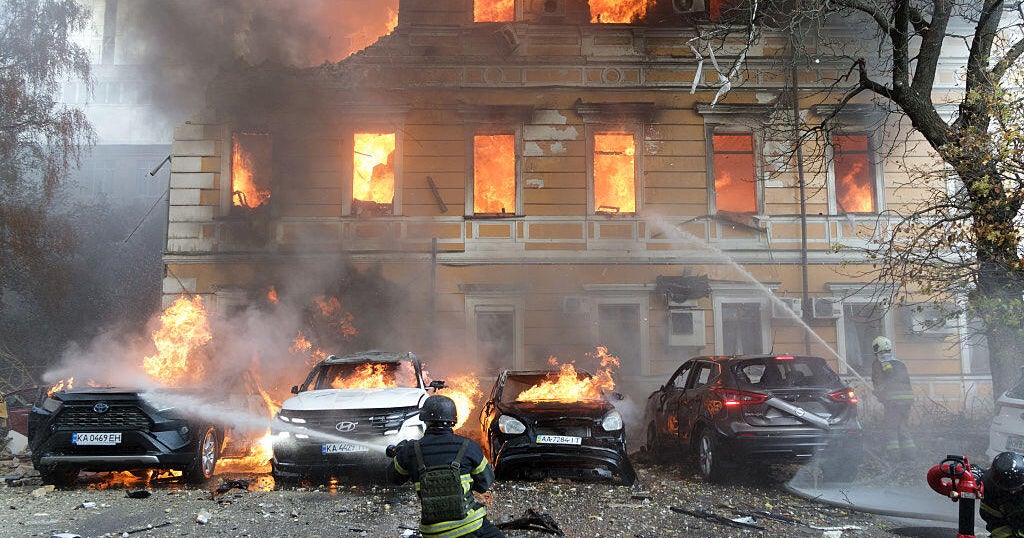
Kyiv — A daytime Russian attack on Ukraine Monday damaged civilian buildings and wounded more than 100 people across the country, according to local authorities.
A drone exploded into the National Academy of Sciences in the heart of Kyiv. Hours later, a second drone damaged a private medical clinic just blocks away. In Dnipro, Ukraine's fourth-largest city, emergency crews rushed to evacuate wounded civilians from a business center also hit in broad daylight.
And yet, the attack could have been much worse.
Ukraine's Air Force said Russia used 124 attack drones from 6:30 a.m. to 6:30 p.m. on Monday — much fewer than in previous barrages this year, which have regularly included more than 500 drones and 50 missiles within the same time frame.
Analysts and Ukrainian officials told CBS News that Russia is stockpiling weapons so that it can launch intensified late-autumn and winter barrages.
During Monday's attack, Russia used primarily "jet-powered drones," a new model of long-range strike drones that fly faster and are harder to intercept. Ukraine's Air Force said that 86 of the 124 drones used in the attack were jet-powered.
Since Russia began deploying the new models in June, Ukraine's interception rate against them is 57% — a sharp drop-off from the military's 90% to 95% success in intercepting older models.
Russia has two models of jet-powered drones, the Geran-4 and Geran-5, and has been stockpiling both. Come Back Alive, a Ukrainian military nonprofit, estimates that Russia will produce 1,200 Geran-4 and 800 Geran-5 in September, and projects those numbers to grow each month.
During his speech at the United Nations General Assembly earlier this month, Ukrainian President Volodymyr Zelenskyy said Russia has used just 7,700 jet-powered drones in attacks so far this year.
Viktoriia Chekalina, an analyst at the Come Back Alive Initiatives Center, estimates that Russia has stockpiled 450 to 700 units of the older non-jet-powered drones, the newer jet-powered models and dummy, non-explosive drones known as "Banderols" during each Russian attack this spring and summer.
"Despite the capacity to launch 600-1,000 units in a single massive attack, only about 150-300 drones were actually used," Chekalina told CBS News, explaining that attacks this autumn and winter "could reach around 1,500 units per one raid."
Because Russia has found success striking targets with relatively small barrages of jet-powered drones, it has also managed to save up its cruise and ballistic missiles, which are vastly more expensive and difficult to manufacture.
In the early spring and summer, Russia's attacks on Kyiv included barrages of over 70 cruise and ballistic missiles multiple times per month, according to estimates released by Ukraine's Air Force. In August, Ukraine stopped publicly releasing the numbers of missiles Russia used in each attack, but military analysts told CBS News that there was a drop-off in the number of mass-missile barrages in August and September.
Over this period, Russia has also increased its production of cruise and ballistic missiles. Chekalina said Russia has surpassed its missile production targets by 110% to 120% and estimated that it had stockpiled 130 ballistic missiles by August.
Solutions to countering Russia's ballistic missiles and jet-powered drones remain elusive. Ukraine continues to run dangerously low on American-made PAC-3 ballistic interceptors. And in an address this week, Zelenskyy said that while new defenses against jet-powered drones are being tested, they are not yet ready to be scaled, raising concerns that Ukraine may remain vulnerable heading into winter.
"Russia's goal during winter campaign will be complex: they will focus on attacking electrical and heating infrastructure as they are critical for civilians," Chekalina said. "At the same time, they will use turbojet drones along with missiles on local businesses, warehouses, and other targets."