Russians make the best of a struggling economy before vote
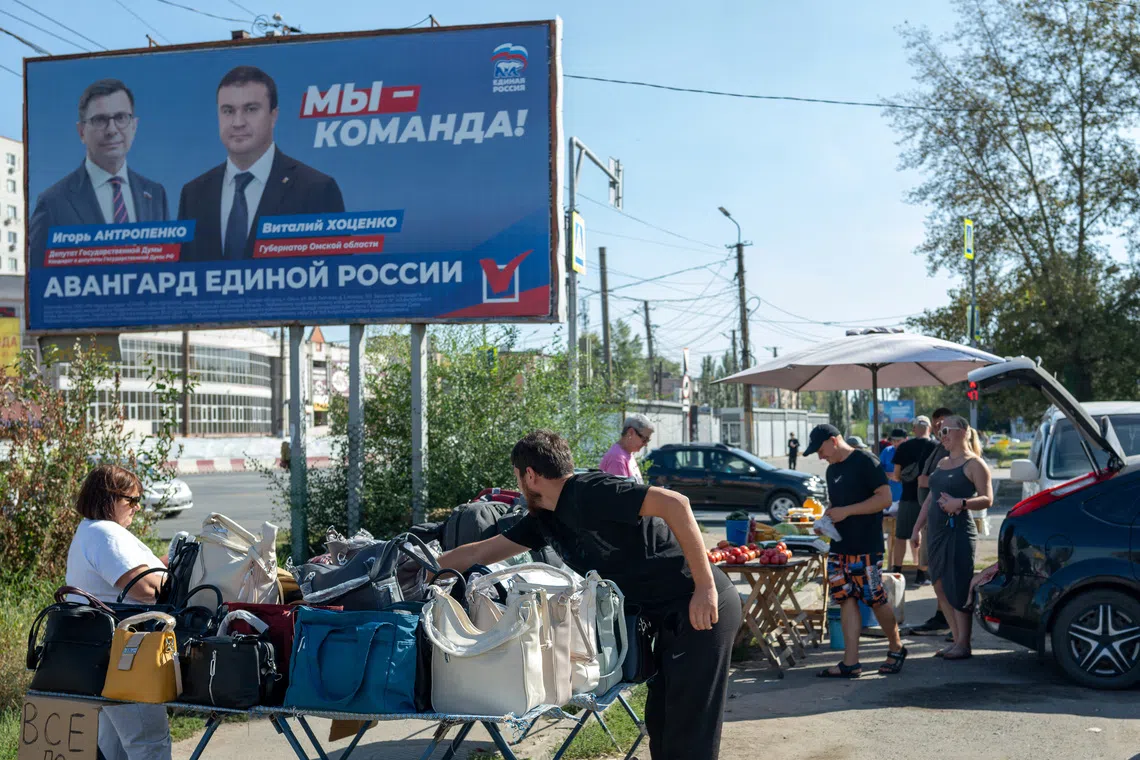
Vendors work at a street market near a billboard, displaying portraits of Governor of the Omsk region Vitaly Khotsenko and a member of the State Duma Igor Antropenko and promoting the United Russia party ahead of the upcoming parliamentary election, in the Siberian city of Omsk, Russia, September 11, 2026. REUTERS/Alexey Malgavko
YAROSLAVL, Russia, Sept 15 - As a bustling tourist hub on the Volga River whose town centre and roads are being rebuilt with state funding, the picturesque medieval city of Yaroslavl may be better shielded than most from Russia's economic stagnation.
But even here, 250 km northeast of Moscow, locals voting in parliamentary elections this week face a growing list of daily challenges to their livelihoods and businesses — whether they believe those are connected to the war with Ukraine or not.
In Russia's tightly controlled political environment, and with anti-war candidates largely barred from the ballot, few expect the election to change much. But the Kremlin sees it as a gauge of fatigue from a war now well into its fifth year.
Stubbornly high inflation, high borrowing costs, stagnating output and fuel shortages form the everyday backdrop to economic life in Russia. Yet businesses in Yaroslavl say they could still get by — if only they could find the labour.
"We have a lot of work here," said Angelika, the owner of a chain of sewing shops who gave only her first name. "The problem is that there are no workers," she added, noting a dearth of young people willing to enter the sector despite decent wages.
Confectioner Gilles Walter agreed, complaining of difficulties recruiting for his nearby production facility.
"They cannot even make an omelette or cook pasta," Walter, a Frenchman who settled in Russia in the 1990s, said of graduates he tried to hire from the local culinary college.
"Very few here are ready to begin work at three in the morning so that fresh croissants are ready in time."
Neither wanted to link the labour shortages to mass army recruitment and heavy losses in the fighting, as evidenced by hundreds of fresh graves at the local military cemetery with raised flags honouring the war's dead.
But with official unemployment just above 2%, others draw a link between the lack of young workers coming onto the labour market and the steady decline in Russia's fertility rates. Some fear the situation will get worse as people are reluctant to give birth while the war drags on.
Lubov, a meat trader from the village of Dyudkovo, about 50 km from Yaroslavl, recalls that in May 2012 when she gave birth, there were four children born in the village. Now, she says, there was only one child born in two years.
"People just don't want to give birth while this is going on," she said in reference to the war in Ukraine.
At the Yaroslavl central market, pensioner Varvara, 68, sells dried porcini mushrooms collected in the forests outside the city to augment her 17,000-rouble pension, which she says is not enough to live on.
As she searches for words, she instinctively switches to Ukrainian, blushes and whispers that Ukrainian is her native language as she moved here 40 years ago from Poltava.
"Dried mushrooms have become a luxury now. People are buying less this year; their purchasing power has shrunk," she says.
After a sharp fall in economic growth in 2025 to 1% from 4.9% the previous year, followed by another slight contraction at the start of 2026, the government is forecasting full-year growth of 0.6% — not much lower than the 0.9% that the European Central Bank sees the euro zone generating this year.
But the bigger picture is still bleak, with the Economy Ministry earlier this year slashing forecasts through to 2029 on an expected slowdown in industrial output, capital investment and consumer spending.
While down from the double-digit highs of last year, Russian inflation at just above 6% means the central bank is having to keep rates at an eye-watering 14%, making borrowing punitive for both businesses and households.
President Vladimir Putin has scolded officials for their failure to turn the economy around, and the Kremlin promised earlier this month that it was not considering raising taxes again to help patch over an above-target budget deficit.
The business people Reuters spoke to in Yaroslavl said recent tax hikes, introduced to compensate for growing military expenditure, were painful enough but something they could still cope with, provided taxes do not go up again next year.
Perhaps tougher — and harder to control — are the rising prices in essentials from food to fuel arising from everything from international sanctions to the war in Ukraine and wider troubles, to which the Iran war has added since February.
This summer was the most difficult for Russians since the war started in 2022, as Ukrainian drones struck at the heart of the Russian economy, hitting sectors such as oil refining and retail, e-commerce, agriculture and tourism.
People queued for fuel for hours, inflation spiked, thousands of small businesses saw their goods burn at e-commerce warehouses, domestic tourism shrank by 6%, and farmers had grain unsold as trade via the Black Sea became too dangerous.
Valery, a retired military accountant who now keeps bees, complained that the sugar he buys in autumn to feed the bees before winter had doubled in price over the last two years.
"For me, it is critically important. I am afraid of instability. More stability and confidence in the future would have been better," he said.
Yaroslavl's centre, lined with ancient churches and 17th- and 18th-century merchants' houses, contrasts sharply with the sprawling refinery, Russia's fifth largest, on its outskirts.
The cost of the added security now required is unmistakable: The refinery's most sensitive units are shielded from drones by walls made of sea shipping containers, while thousands of thick metal wires run between its pipes to trap approaching drones.
A short walk from the refinery, Evgeny, whose house was heavily damaged by a shot-down drone, says he will be too busy to take part in this week's election.
His main task, he said, will be to install a new metal door into what remains of the house. REUTERS