'SA nearing organised crime crisis' - IOL
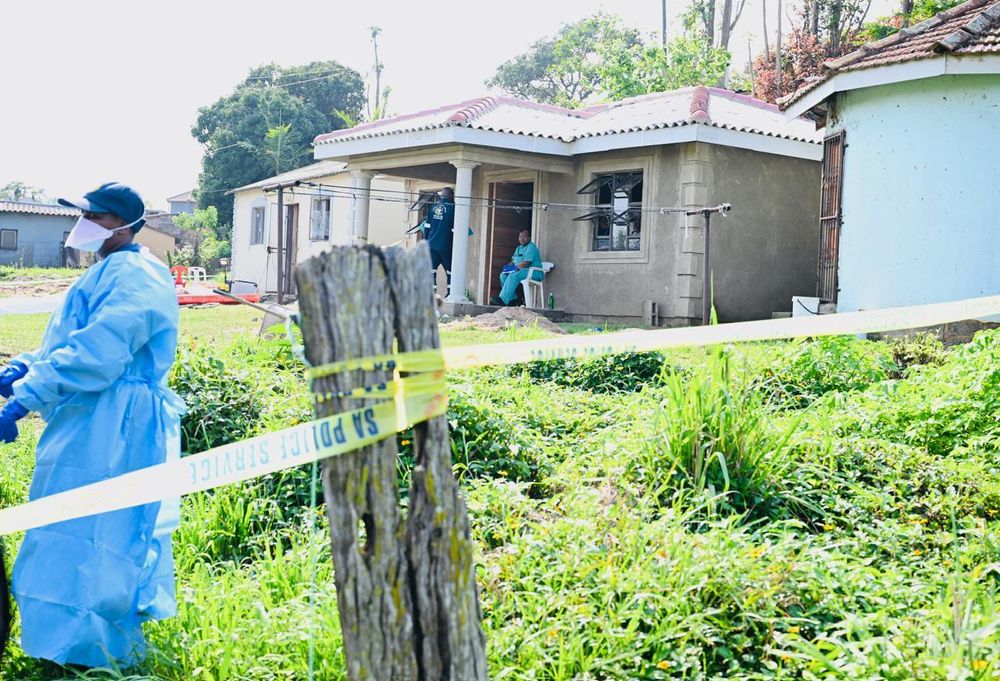
Forensic investigators at the scene in Ziko, outside KwaMakhutha, where 11 people were killed.
With the level of violent crime, including the recent mass murder of 11 people in Durban, crime expert Professor Johan Burger is concerned that South Africa might be taking the direction of South American countries where gang-related murders are rife.
Burger’s comment was based on the allegations that some of the 11 murder victims in the Ziko area outside KwaMakhutha, south of Durban, on September 22 might have been connected to organised crime, as police could not rule out rivalry between groups as a motive.
KwaZulu-Natal police spokesperson Colonel Robert Netshiunda said in a statement that some among the 13 men and one woman, who were having a party when the attack happened, were on Crime Intelligence’s radar in connection with illegal activities.
Netshiunda said the woman, who police said was pregnant, was among those who were having a party inside a house when three men arrived and opened fire on them.
Crime and policing expert Burger expressed fear that the country might be heading for the worst and most complicated crime situation.
“Information I have is that 11 people were killed for syndicate activities.
“Organised crime has progressively escalated, but one would not want to compare us to some of the South American states where crime syndicates in many ways control those countries, but there are these worrying signs that we are approaching a similar situation,” said Burger, a former police officer.
Burger said the killings happened while the country fears that there might be a surge of politically related killings ahead of the November 4 local government elections.
“I am worried that what we are seeing could be a parallel kind of threat to this country in terms of both political killings as well as criminally oriented killings such as those of criminal syndicates,” he said.
He attributed the high rate of crime to the weakened police service, as has been highlighted in the Madlanga Judicial Commission of Inquiry.
“The last figures I saw in 2022 indicate that public confidence in the police has dropped to its lowest level in almost three decades, when we were at 22% trust in the police.
“This was done before the Madlanga Commission. Can you imagine what the figure would look like if a survey was done now? I think we would drop below 10%,” said Burger.
He said police cannot execute their mandate to keep the country safe by quickly arresting alleged perpetrators.
“I think we are in serious trouble,” said Burger.
He said the situation calls for a drastic intervention and multi-stakeholder co-operation with government quickly addresings police shortcomings identified at the Madlanga Commission.
“You need to identify the problems in the police, and there is more than enough information that identifies those problems and finds solutions,” he said.
Burger recommended that there should be a team of crime and police experts, which should include people from outside of the police.
“We have to rebuild trust in the police, and that will only happen when people see a credible move toward addressing the deficiency within the police and the rest of the criminal justice system,” he said.
He said once the criminal justice system is repaired, the country will be able to formulate a strategy to fight organised criminal gangs.
University of KwaZulu-Natal criminologist Nirmala Gopal said violent crime in KwaZulu-Natal has a centuries-old background.
“Some scholars have argued that aspects of the region's history, including periods of militarisation and conflict dating back to the era of King Shaka, contributed to traditions in which violence was often associated with power, authority, territorial control, and survival. “While it would be inaccurate to attribute contemporary crime directly to the historical formation of the Zulu state, history undoubtedly shapes social attitudes and collective memories of conflict and coercion,” said Gopal.
She also attributed the situation to political killing dating back to the 80s and early 90s.
The province was the epicentre of intense political violence, with deadly clashes between competing political formations, community factions, and armed groups.
“Thousands lost their lives during this period, and entire communities became accustomed to violence as a mechanism for resolving disputes, asserting influence, and defending political interests,” she said.
Gopal does not believe that military deployment would ease the situation, as she said it is not working in the Western Cape.
“Relying on the military is misguided, and what KZN truly needs is a robust criminal justice system.
“Punishments must not only fit the crimes but also act as a meaningful deterrent against future violence, ensuring a safer environment for all,” she said.