
SA needs continental help to manage migration, says Lamola - IOL
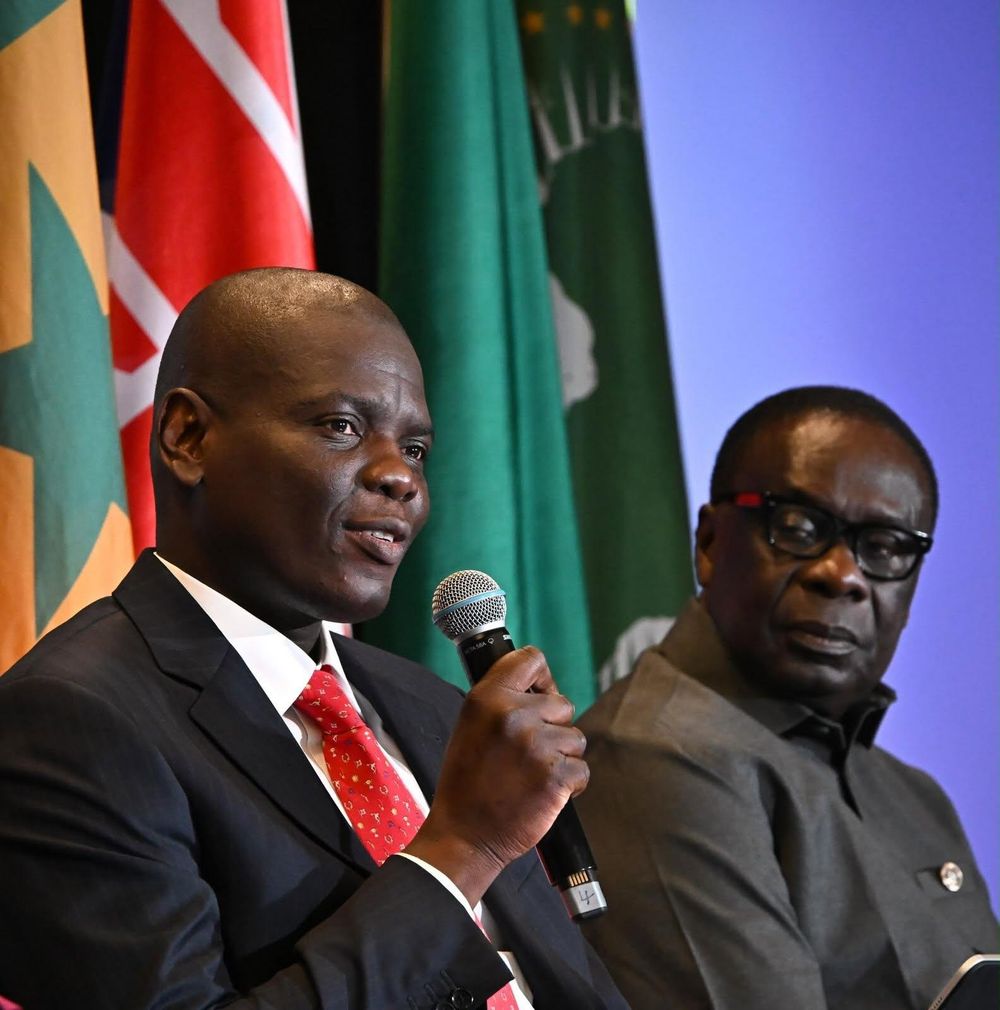
International Relations and Cooperation Minister Ronald Lamola (left) has called for African countries to work together to address the root causes of irregular migration.
Department of International Relations and Cooperation Minister Ronald Lamola has called on African nations to collectively address the root causes of irregular migration, saying South Africa cannot manage the continental challenge in isolation.
Lamola was responding to a question from an audience member during in a High-Level Forum on Trade, Aid and Immigration at the African Diaspora Forum, hosted by the Congressional Black Caucus Foundation in the United States on Friday.
The question comes ahead of March and March’s planned September 30 National Day of Action, demanding the deportation of all undocumented migrants.
The Border Management Authority has already facilitated the repatriation of 89 936 individuals and the deportation of 9 997 following the June 30 protests.
The audience member, in response to Lamola saying that South Africa is open to everyone, asked what Lamola was doing to make this statement applicable to Africans who fought to liberate his country.
Lamola emphasised that the government condemns vigilantism, noting that 354 people have been arrested for anti-migrant violence, with 103 cases (anti-migrant violence, intimidation, and looting) currently in court and 43 under investigation.
“The South African government has now put in place a plan to ensure that no individuals take the law into their own hands to enforce the law,” Lamola said.
“What we want to make clear is that this is not a state-sponsored activity; it’s individuals who are mobilising themselves to enforce the South African law.”
Lamola said that while irregular migration is a reality for South Africa as a top destination for economic migrants, addressing it is strictly the government’s responsibility, not individuals'.
“We have also said, as the South African government, that irregular migration should be a shared challenge.”
International Relations and Cooperation Minister Ronald Lamola participated in the High-Level Forum on Trade, Aid and Immigration.
He highlighted that attendees were aware of what is happening in their countries and that they must confront the root causes of irregular migration, such as challenges with democracy, economic growth, and job creation.
“When the economy of South Africa struggles, it is natural that there will be contestation for limited resources. And this is what is currently happening in our country,” Lamola said.
“As a government, we have a responsibility to restore order, to manage this challenge. And that is what we are currently doing, and we will continue to do so.”
Political analyst Professor Sipho Seepe said Lamola was consistent in South Africa’s position on the rule of law. However, the minister and South Africa must accept that it failed to ensure that borders are secure.
“Lamola is also correct to point out that uncontrolled immigration is a continental responsibility. People migrate to South Africa because they are running away from their own countries,” Seepe explained.
“African countries cannot sit and point fingers. They must ask themselves why their countries have been less attractive to their own citizens, and it is in that space that all countries must assume responsibility.”
International relations and political analyst Gideon Chitanga said the audience member’s question raises legitimate concerns about South Africa’s ongoing commitment to Pan-African solidarity and collaboration.
“What is needed is not only the minister’s policy emphasis in international platforms, but I think a comprehensive process of engagement within the country that addresses interlinked causes of this problem from a legal perspective, from managing immigration, the perspective of managing immigration,” Chitanga said.
“A proactive process that also seeks to create fair enabling conditions for those who are legally coming into the country or within the country to continue to do so will probably shift the discourse and certainly create conditions for addressing the problem in a long-term.”


