‘Same sense of urgency’: UN chief compares AI risk to nuclear weapons
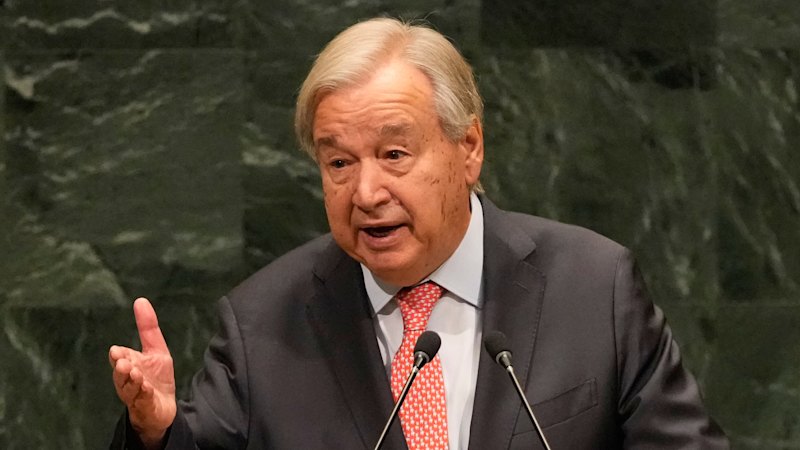
New York: United Nations Secretary-General António Guterres says artificial intelligence demands the “same sense of urgency” as nuclear weapons did, warning that technology “without accountability” threatens humanity.
Addressing the UN General Assembly, Guterres noted that developers were now “pulling the alarm” and said governments “must assume their responsibilities”. He called for co-operation and common safeguards on AI, adding that the UN was a good place to work on this.
United Nations Secretary-General António Guterres delivers an address at the headquarters in New York.AP Photo/Seth WenigAustralian Prime Minister Anthony Albanese echoed the rallying cry for world leaders to unite on efforts to protect people from the risks of artificial intelligence, saying in a speech that no country can manage the technology’s growing risks alone.
Australia was among a group of 22 signatories to call for new international safeguards on AI at the United Nations on Monday, amid warnings from scientists and industry executives that the rapid development of powerful systems could outpace governments’ ability to control emerging risks.
The prime minister joined colleagues, including Canadian Prime Minister Mark Carney, European Commission President Ursula von der Leyen and German Chancellor Friedrich Merz to call for mandatory safety testing, independent evaluations and greater international oversight of so-called frontier AI models.
Prime Minister Anthony Albanese at the opening Ceremony of New York Climate Week on Monday.Dominic LorrimerThe declaration warned that capable AI systems have already been seen circumventing testing safeguards, exploiting vulnerabilities and gaining unauthorised access to real-world systems.
“Leading scientists and executives are warning that the pace of development could outpace our ability to manage emerging risks,” the statement said, which was also co-signed by Ireland, Singapore, Spain, South Africa, Turkey and the United Arab Emirates.
It called for a UN-style international organisation that would set standards and oversee AI use.
The leaders stopped short of calling for a halt to development, instead arguing that AI’s potential to improve lives, advance science and strengthen economies should be preserved while stronger controls are imposed.
“AI must remain under human direction, oversight and control,” they said, insisting that it must be developed and used in accordance with international law.
Its release comes ahead of Thursday’s meeting between US President Donald Trump and Chinese President Xi Jinping, with AI expected to be a major topic of discussion.
Guterres called for the AI superpowers to start a dialogue on the technology’s future.
“Governments with the greatest AI capabilities have the greatest responsibilities to humanity. To establish channels for dialogue, transparency, trust and co-operation,” Guterres said, referencing the US-Soviet engagement at the height of the Cold War.
“At a pivotal moment during the Cold War, strategic rivals came to recognise the need to manage shared existential risks,” he added.
Following the declaration from other world leaders, Trump said that US law enforcement agencies like the Department of Justice would regulate artificial intelligence risks if necessary, but emphasised his primary goal was to encourage its development.
Downplaying potential dangers, Trump argued against stifling AI growth, comparing its future impact to the Industrial Revolution and the internet. He maintained the US must protect its edge over China while fostering both AI and superintelligence.
“We are leading now over China, and everyone else, and I’m going to keep it that way!” Trump wrote on social media.
Albanese has cited Australia’s role in shaping international rules for AI as a key plank of its bid for a seat on the UN Security Council. He said he hoped for a positive meeting between Trump and Xi.
Addressing the Coalition for Children’s Rights and Protection in the Age of AI, Albanese will say the risks posed by increasingly capable systems will cross borders and require countries to work together on common standards.
“And no country can manage these risks alone,” he will say. “We must come together.”
Albanese will argue countries can seize and share the opportunities created by AI while developing common standards to protect children and communities.
“We can develop clear shared expectations and common guardrails,” he will say.
The US and China are locked in a race to develop increasingly powerful AI systems, while Washington and Beijing have resisted calls from industry figures including Anthropic chief Dario Amodei, backed by OpenAI’s Sam Altman, to slow the development of frontier models amid warnings that humans could lose control. Neither the US nor China are part of the new declaration.
The declaration calls on AI companies to develop transparent safety protocols, including mandatory testing before systems are deployed and independent assessments by qualified evaluators given sufficient access to identify risks.
Governments and regional organisations are also urged to develop common standards, strengthen transparency and share reports of serious AI safety incidents.
Albanese said AI had the potential to improve lives, strengthen the economy and productivity, and advance science and medical breakthroughs, but “humans need to be in control of it”.
He said he had played a central role in the statement through conversations with Finnish President Alexander Stubb, who initiated the declaration along with Norway’s Prime Minister Jonas Gahr Støre.
The leaders want countries across all regions to have access to the scientific expertise, technical capacity and trusted evaluation needed to assess advanced AI systems.
The declaration also calls on UN member states to explore creating an international institution that could set standards, enable verification and convene governments when AI systems cross agreed capability thresholds.
The group warned that efforts to control frontier AI should not widen the gap between countries with access to the technology and those unable to benefit from its advances.
At a separate business event with Macquarie, Albanese will argue Australia is being recognised internationally for moving early on emerging challenges.
“I think the world is seeing Australia as a smart, adaptable and successful middle power, succeeding because we’re not afraid to get ahead of the curve on the issues that matter to the future,” he will say.
Cut through the noise of federal politics with news, views and expert analysis. Subscribers can sign up to our weekly Inside Politics newsletter.
You have reached your maximum number of saved items.
Remove items from your saved list to add more.