
Samuel Alito Reveals He’s Lost Friendships Over Supreme Court Decisions
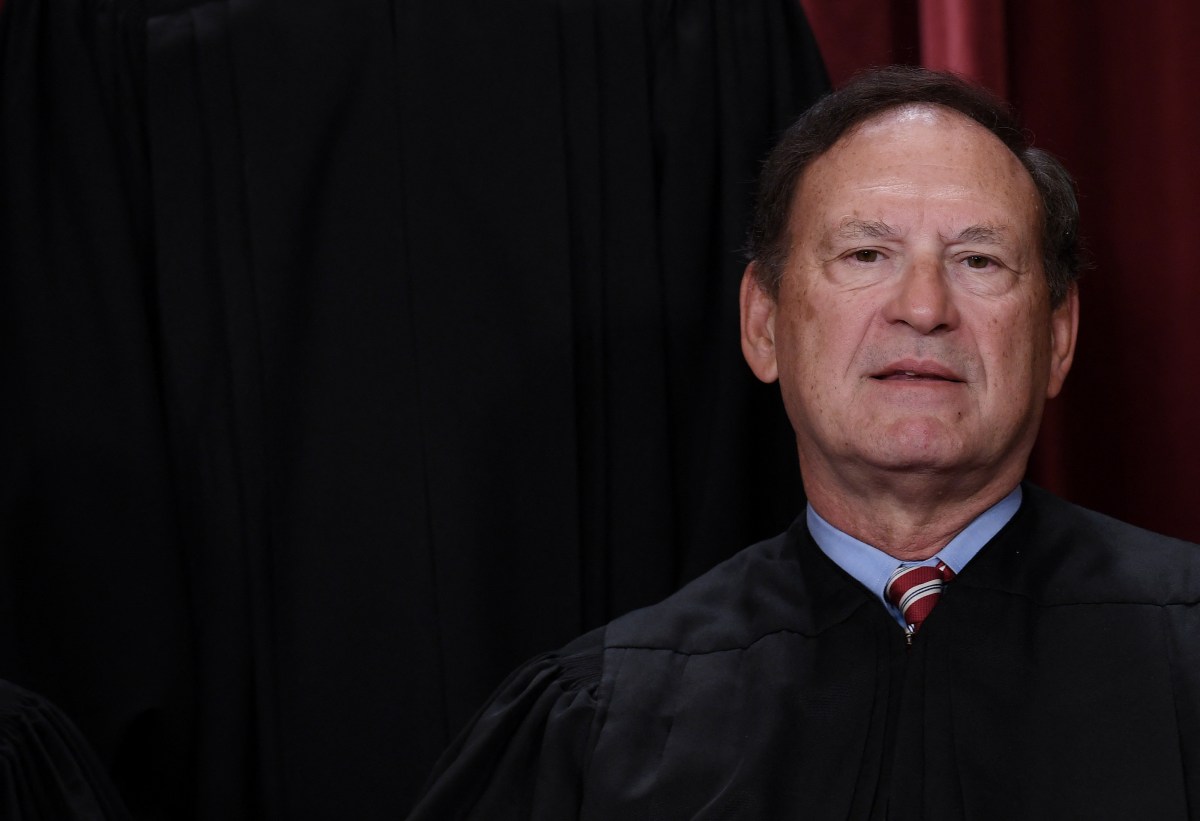
Supreme Court Justice Samuel Alito has revealed he lost friendships over decisions, and that overturning Roe v. Wade four years ago required courage for those in the majority because of its consequences.
In an interview with CBS News, the President George W. Bush-appointed justice, known for his conservative viewpoint, also spoke about his concerns over criticism from the two most recent United States Presidents, Joe Biden and Donald Trump.
Speaking to CBS' Jan Crawford, the 76-year-old also opened up about his decision not to retire just yet, having been on the bench for 20 years, during which time he has been a key right-leaning voice on gun rights, executive power, and abortion.
"There are cases that have resulted in the loss of old friendships," Alito said. "That's something you have to live with."
Alito authored the majority opinion in Dobbs v. Jackson Women's Health Organization, which overturned the federal constitutional right to abortion, and his role in that decision will likely be a defining moment in his Supreme Court run.
That opinion was leaked before it could be officially released—something Alito said he and his fellow conservative justices did not expect to have to push forward with.
"We didn't know it when we produced the draft that was leaked, but it required courage to go ahead with that because of the implications," he told Crawford.
In his opinion, Alito wrote that the authority to regulate abortion would be returned to the people, largely based on his view that "The Constitution makes no reference to abortion, and no such right is implicitly protected by any constitutional provision," he said.
That decision was widely criticized by Democrats and those who had fought to keep the rights set forth in the 1970s in place.
Michele Goodwin, O'Neill professor for Constitutional Law and Global Health Policy at Georgetown University Law Center, told Newsweek that Alito's view that the court was sticking to the Constitution was "a bit ironic."
"Because it's a decision wherein the court abandoned what was existing law, which was established by the court, and precedent that was nearly 50 years old, and not precedent that had been abandoned over time," Goodwin said.
"So, across 50 years, not just one decision, which was Roe v. Wade, but across nearly a dozen or more cases that addressed reproductive health rights, freedom, and abortion, the court had affirmed Roe," she said. "So, it's ironic that the justice would say that it took courage to do that, or maybe it did, in fact, take courage to overturn what had been so deeply instantiated, a precedent that was relied upon by millions upon millions of Americans."
Alito was also asked about the criticism the court has faced from political leaders on both sides, including that justices are political actors seeking to deliver for one party or another.
The justice said that criticism was damaging and that there had been "a great change" in how presidents voice their views on a decision, moving away from accepting that.
"It's been bipartisan," Alito said, with Crawford asking if Trump had changed the rhetoric toward judges.
"He has his own way of saying things," Alito said. "But the criticism of the court—I want to be even-handed on this—criticism of the court by President Biden, and justices by President Biden and his administration was very harsh, and President Trump has been very harsh."
Newsweek reached out to the White House for comment Friday evening.
Alito's comments come at a time when he, his fellow Supreme Court justices, and others in lower courts have faced increased threats to their safety.
"It's a sad fact that threats against judges and justices have spiked so much in recent years," Gabe Roth, executive director of the nonprofit Fix the Court, told Newsweek. "But contrary to what he said, the words and actions of the Trump administration have been far more treacherous for the judiciary than those of his predecessor. No one in the Biden administration, for example, doxed judges’ families.
"Regardless, both parties' leaders should be mindful that their words carry weight, and violence against judges and justices, and threats of violence, are never acceptable."
Justice Amy Coney Barrett spoke in July about the threats she faced in the aftermath of the Dobbs decision, with her security detail sending her home with a bulletproof vest.
"I didn't know how to respond. Maybe because I lack imagination, but I didn't expect that performing this service was going to put me in the position of explaining to my children what a bulletproof vest was, and why I needed to wear one," she told the House Appropriations Committee.
Recently it was reported Alito was looking to retire from the court, before opting not to, despite some Republican lawmakers hoping to have a shot at replacing one conservative justice with another while Trump is in office.
Alito said he had thought about it, adding that "somebody at my age has to think about every term."
"But I thought I could still continue to make a valuable contribution, which is why I became a justice and a judge in the first place," he said.
The justice said he would likely have to think about whether or not to step down each year, telling Crawford it was hard to predict what his health would be like, what the political situation might be, and who might be president.
While the Supreme Court justices often share their views through legal opinions, candid interviews or speeches are relatively uncommon, making Alito's remark about losing friends all the more notable.
Amid the increase in criticism and threats toward the court from politicians, public opinion of the country's highest court has dipped in recent years.
The latest Gallup survey, released September 30, found 34 percent of those asked approved of the job the Court was doing, with a 61 percent disapproval rating. A July 2026 survey from Pew Research Center saw 53 percent of Americans with an unfavorable view of the court—a three-decade low.
Goodwin said that this was likely in part due to more cases being decided without public opinions issued, as well as a feeling the court is far removed from everyday Americans.
"There are certain reasons why they might feel that way, might feel that the Supreme Court has done things like dismantle voting rights, dismantle what had been understood as civil rights, has ruled in ways that do not further uh, women's rights," Goodwin said. "And so certainly around issues of civil rights, and civil liberties, and voting rights, Americans are concerned."
Newsweek’s reporters and editors used Martyn, our AI assistant, to produce this story. Learn more about Martyn here.
Contact Newsweek editors on this story: Gabe Whisnant and Gray R. Thomas


