Sarah Huckabee Sanders Fell Into a Welfare Trap - Newsweek
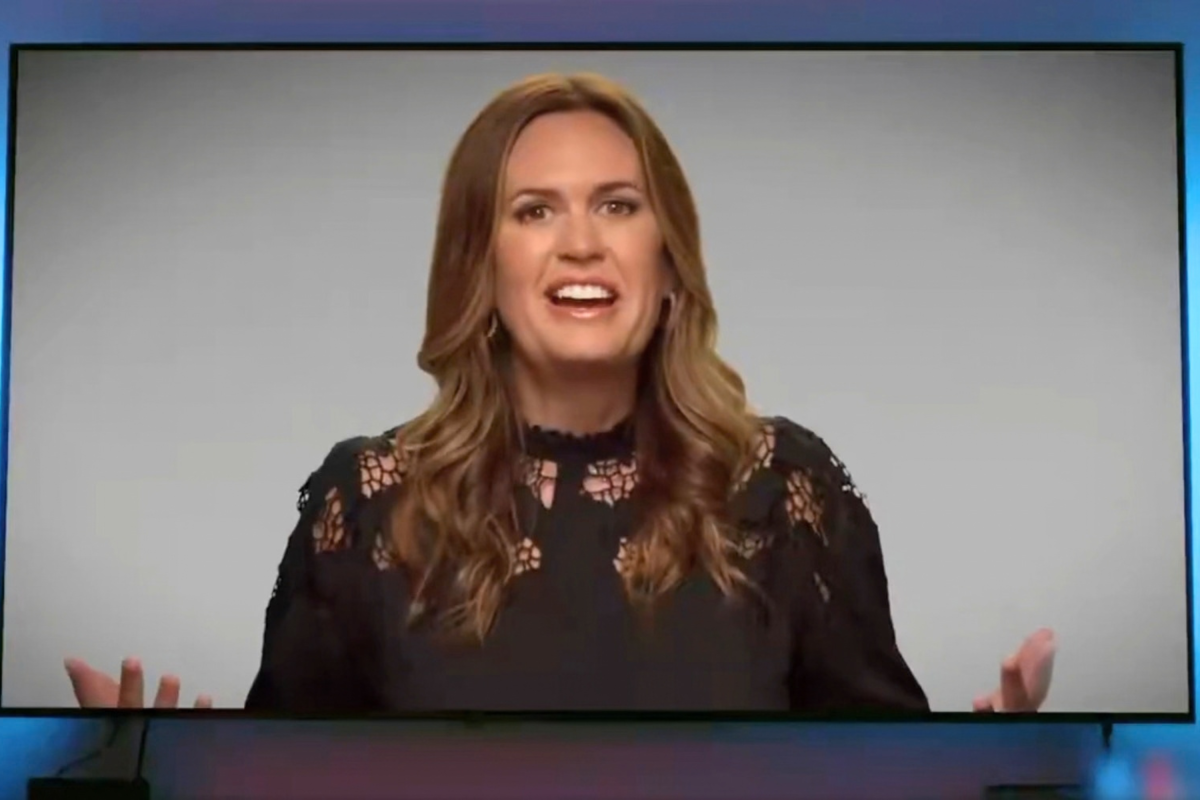
There’s probably a rule written by some political strategist somewhere warning candidates not to use their ads to attack demographics whose voters form a core part of their base.
Really, you don’t need a consultant to tell you that. Most people outside of politics would intuit the common sense.
But not, it appears, Republican Governor Sarah Huckabee Sanders of Arkansas.
Huckabee Sanders’ new ad takes aim at welfare dependency and so should be red meat for the kind of conservatives on whose votes she’ll rely in the coming midterm elections.
Yet the ad’s only welfare recipient is a young white man, portrayed as a slovenly gamer who gorges on processed snacks for sustenance while living on taxpayer-funded handouts.
"Meet Brad," she chuckles, as the man appears on screen. "Brad has turned relaxing into a full-time profession. But you? You actually work hard. You pay taxes to cover welfare for guys like Brad who just choose not to work."
Huckabee Sanders is using the ad to promote her welfare-to-work scheme, ARHOME, a state Medicaid expansion, to push more young people into work, study, or volunteering opportunities.
Fortunately for Brad, there’s a happy ending. He gets a job. But for many conservative viewers, the ad revealed Huckabee Sanders to be a coward for singling out a young white man as her focus. She fell right into a trap of her own making.
Will Chamberlain, a conservative lawyer and activist, called the ad “a massive own goal” and called for the consultants responsible to be fired. “Do not portray your core voting bloc as losers, period,” he wrote in response.
Matt Walsh, the conservative commentator, suggested that a Black woman would have been more representative of the underlying reality, but Republicans “don't have the balls” to produce an ad like that.
“Even though that would actually be an accurate portrayal of the problem at hand,” Walsh wrote.
The data has limits, but it does indeed show Black people are overrepresented in welfare assistance relative to their population. You will have your own view on why that is—socioeconomic, cultural, structural racism, whatever—but it’s true enough.
The Arkansas population is 67.6 percent white alone and 15.2 percent Black, according to Census Bureau data.
Yet for Medicaid specifically, to which ARHOME relates directly, health policy think tank KFF says 57.8 percent of recipients in Arkansas are white and 20.6 percent are Black.
The divergence is even larger for SNAP, or federal food stamps. In Arkansas, in 2023, 54 percent of households receiving assistance were white, and 34.3 percent were African-American.
We should be careful. The data is imperfect, because there a mixed-race households, and households where no racial group is recorded. But it’s reliable enough to give a broad picture of the situation.
Still, in absolute terms, the majority of those receiving welfare assistance in Arkansas are white, and other groups, like Hispanic people, are also represented in the data.
There will be differences in the proportions, but this is an issue that extends beyond any one racial group.
Young white men were probably the easiest target for Huckabee Sanders, particularly as her Democratic gubernatorial opponent, Fredrick Love, is a Black man.
Focusing on any one demographic is likely to prompt backlash. Had Huckabee Sanders held up a young Black woman as the exemplar of welfare dependency, it would have been a campaign gift to Love so valuable he’d have to declare it.
So why single out any one demographic? Why not make the point by representing a genuine cross section of the people in the data? Nobody would accuse you of racism, or selective targeting, for featuring white, Black, and Hispanic people.
And you can still make the substantive point: welfare dependency is an issue, so here is my policy to reduce that. No expensive political consultants required. Everyone's a winner, not just Brad.
But Huckabee Sanders isn’t backing down. The original ad has nearly 14 million engagements on X, and she’s still directing viewers to it. “Some critics online don't like my welfare work requirement ad,” she wrote after the backlash.
“Next thing you know they’ll say I should have used cookies instead of cheese balls. If you are able-bodied you should not collect welfare simply because you choose not to work. Period.”
Not quite a period yet. Voters will have the last word on November 3.