
Saudi Arabia faces tough choices as Houthis gain in Yemen
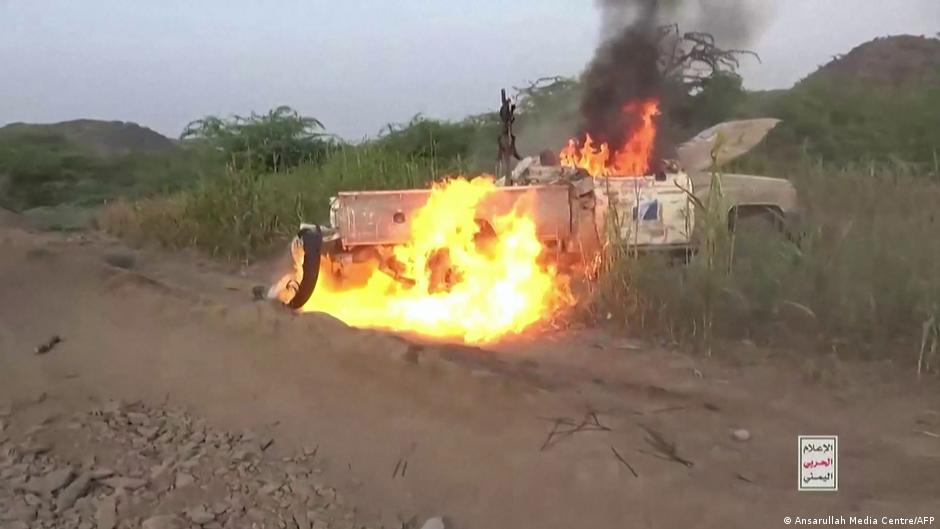
Saudi Arabia is increasingly affected by Yemen's civil war in which it backs the Yemeni governmentImage: Ansarullah Media Centre/AFPAdvertisementSaudi Arabia is being increasingly impacted by the rapidly escalating conflict across its southern border in Yemen where Iran-backed Houthis are fighting Saudi-backed Yemeni governmental forces.
Houthi attacks on Saudi Arabia injured another 13 people on Monday night, bringing the total number of people injured since the conflict escalated in July to about 100.
In July, the Houthis also blocked Saudi oil shipping in the Bab el-Mandeb Strait, a key waterway that had been serving as an alternative route for Saudi oil exports amid Iran's blockade of the nearby Strait of Hormuz.
Last week, Saudi Arabia's alternative lifeline for oil export, the East-West pipeline, was allegedly targeted by Iranian proxy militias in Iraq. On Tuesday, officials said that it might take weeks to repair the damage to the pipeline which runs 1,200 kilometers (745 miles) across the country and ends at the port of Yanbu on the Red Sea.
"Riyadh faces a genuine dilemma," Neil Quilliam, associate fellow of the Middle East and North Africa program at the London-based think tank Chatham House, told DW. "The Saudi Crown Prince Mohammed bin Salman is trying to protect both Saudi security and Saudi economic development simultaneously," he said. "The difficulty is that the Houthis are increasingly able to threaten both."
Saudi Arabia has one of the most heavily armed and technologically sophisticated militaries in the Middle East, especially in combat aviation and air defense.
But the country is "reluctant to become drawn back into a costly military campaign in Yemen," Quilliam said.
A Saudi-led military coalition intervened in Yemen in 2015 to support the government's fight against Houthi insurgents. After seven years of intense war between the Houthis and the Saudi-backed government, the fighting eased in 2022 with a UN-brokered truce.
The latest Houthi attacks on Saudi Arabia and the Saudi-backed government in Yemen aim to pressure Saudi Arabia to end its air and sea blockades on Houthi-held territory which have not been fully lifted despite the 2022 truce.
"Saudi Arabia is now in a very complicated situation," Sebastian Sons, Middle East observer at the German Middle East Research Center CARPO, said.
"On the one hand, it needs to make it clear to the Houthis that a red line has been crossed and that there must also be a military response, particularly in coordination with Yemen's internationally recognized government.
"But on the other hand, it also needs to keep the lines of communication open in order to get back to the negotiating table and to de-escalate the situation."
In his view, Riyadh's goal is to balance deterrence and diplomacy. "The argument is very clear," he said, adding that "the Houthis are not only a threat to Saudi Arabia but to the global economy as a whole."
After Houthi advances in southern Yemen last week, including the seizure of port cities and Perim Island in the Bab el-Mandeb Strait, the rebels are now able to exert even more pressure on global oil supply.
This strategy could lend more leverage to Iran in its war with the United States. According to the maritime data and analytics firm Kpler, only 21 commodity vessels transited the Bab el-Mandeb Strait on Monday. Before the crisis, the narrow waterway handled roughly 30% of global container traffic.
"The current conflict exposes a new level of vulnerability for Saudi Arabia," Quilliam from Chatham House said. "And it's being tested from all sides."
While Saudi Arabia is a close US ally, three sources told the Reuters news agency that Saudi Arabia's de facto ruler, Mohammed bin Salman, or MBS, phoned US President Donald Trump last Thursday, asking for military aid to fight the advancing Houthis.
The sources said that he was only offered intelligence support for now as Trump hesitated to join another front in the ongoing US war in Iran.
The recently signed Mecca Joint Defense Agreement between Saudi Arabia, Turkey and Pakistan has also yet to be activated. So far, Pakistan, an Iranian ally and mediator in the current US war in Iran, has been reluctant to directly join the conflict between Saudi Arabia and the Houthis.
"The untested nature of the Mecca Pact adds to Saudi Arabia's challenges," Quilliam said.
Meanwhile, Crown Prince Mohammed bin Salman faces growing domestic pressure.
"People expect economic progress," Sons told DW. For Saudi Arabia's population, this means "affordable housing, jobs and protection from additional attacks from Yemen," he said.
On top of this, Saudi Arabia needs stability to continue progressing its costly Vision 2030 reform. The sweeping diversification agenda aims to reduce the kingdom's reliance on oil and to transform the economy and society but the foreign investment, tourism and investor confidence all depend on a stable security situation, Quilliam points out.
Other major planned events in Saudi Arabia, such as the Expo 2030 and the 2034 FIFA World Cup depend on geopolitical stability as well.
In turn, as security threats grow and economic pressures mount, human rights observers say Saudi authorities are becoming increasingly sensitive to criticism of their handling of the crisis.
"Since MBS rose to power, there has been a strong crackdown on freedom of expression, especially regarding criticism of Saudi foreign policy," Yahya Al-Asiri, founder of the London-based Saudi rights organization ALQST for Human Rights, told DW.
"Critics and individuals calling for peace are dealt with harshly," he said, highlighting that people are charged under the country's counter-terrorism laws and sentenced to lengthy prison terms or even to death for nonviolent actions.
In 2025, Saudi Arabia carried out at least 356 executions, the highest annual total recorded by ALQST.
This week, the rights watchdog warned that Saudi authorities executed at least 154 people between January and September 2026. Of the 154 executions, 101 were carried out for drug-related crimes while nine executions took place for terrorism-related offenses "which according to the vague and overly broad definition in Saudi law can include a wide range of non-lethal acts," the report states.
