
Saudi-Houthi clashes, Hormuz tensions deepen Middle East crisis
By continuing to browse our site you agree to our use of cookies, revised Privacy Policy and Terms of Use. You can change your cookie settings through your browser.
The latest Saudi-Houthi clashes have displaced more than 100,000 Yemenis. /VCG
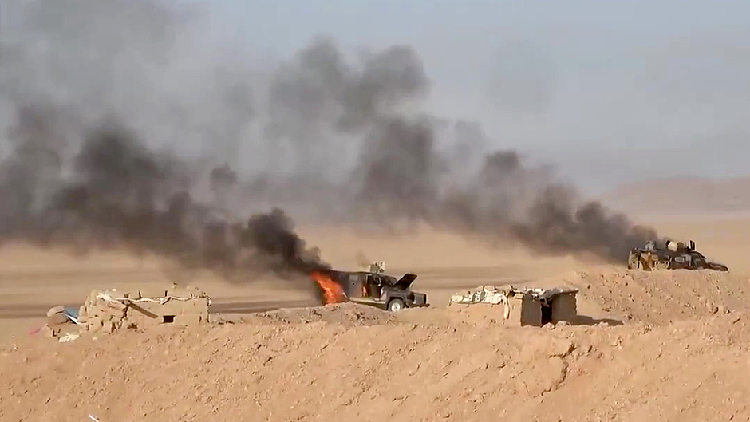
Saudi Arabia and Yemen’s Houthi group exchanged fresh strikes across their border on Thursday while tensions between the United States and Iran continued to disrupt traffic through the Strait of Hormuz. The widening conflict has raised new concerns over global oil supplies.
Houthi-controlled television reported Saudi air strikes in Hajjah Province close to the Saudi border near the Red Sea coast, and the vicinity of Taiz further inland to the south.
Saudi Arabia's civil defense said a Yemeni living in Saudi Arabia had been killed by debris from a drone intercepted over the western city of Taif, the first death Riyadh has announced in repeated Houthi attacks since fighting escalated last week. It has previously said more than 80 people were wounded.
The Houthis, who have seized Yemen's entire Red Sea coast since last week in a lightning advance, say the Saudi Air Force has conducted hundreds of air strikes in recent days. On Wednesday, the Houthis said they had shot down a Saudi F-15 fighter jet.
"We want the Saudis to cease their blockade and occupation of our country, and to stop their aggression against us. This is our demand!" Houthi leader Abdul Malik al-Houthi said in a televised speech.
The fighting has driven Yemeni civilians to flee across the Bab el-Mandeb – the narrow strait at the mouth of the Red Sea.
The IOM says more than 100,000 Yemenis have been displaced by the latest fighting, mostly within Yemen.
The UN Office for the Coordination of Humanitarian Affairs verified 55 civilian casualties in 19 incidents as of Wednesday in the governorates of Taiz, Al Hodeidah, Marib and Lahj since early in the month. Women and children accounted for 84% of the casualties. The actual toll is likely much higher.
Following maritime blockades and escalating tension due to US and Israeli attacks near the Strait of Hormuz, Iraq has revived overland oil export routes through Syria for the first time in 15 years. /VCG
The spread of the war to Yemen and Saudi Arabia has raised new concerns about oil supplies by jeopardizing the main alternative Red Sea route for Gulf exports while traffic through the Strait of Hormuz remains constrained.
Iran's Revolutionary Guards Navy said a Togo-flagged oil tanker caught fire after being hit while attempting what it called an "illegal passage' through the Strait of Hormuz, Iranian state media reported. The tanker came to a halt after the fire, the Guards Navy said.
Iran reiterated that the strait is closed and will remain shut until Washington lifts the blockade.
Meanwhile, the US Navy is trying to guide ships through the Strait of Hormuz, the outlet to the Gulf along Iran’s coast, where a fifth of global oil and liquefied natural gas passed before the war, and is also imposing a blockade of Iranian ports.
As of Thursday, the US troops diverted 104 commercial ships to ensure full compliance, said the US Central Command in the Middle East.
Global crude prices eased slightly on Thursday but remain well above $100 a barrel after reaching their highest levels since May. The average US retail diesel price hit a record high on Thursday, just shy of $6.40 a gallon.
The average US retail diesel price hit a record high on Thursday, just shy of $6.40 a gallon, September 17, 2026. /VCG
US President Donald Trump now faces a dilemma of whether to stand by and risk the Houthi advance worsening the global energy crisis or provide more direct military support to the Saudis and risk extending the costly US intervention to another theater.
In an interview with Axios on Thursday, Trump said he is approaching a critical juncture over whether to restart massive attacks on Iran.
"I have a big decision coming up. Do I want to go in and annihilate them or do I not? It's a big decision. Anything could happen with me," Trump said.
Trump has in the past threatened major new attacks that have not materialized.
The United States and Iran have held no negotiations to end the war since an interim agreement reached in June collapsed within weeks. But the war will come up for discussion at the United Nations General Assembly next week, and an Iranian delegation will be able to attend, according to the US State Department.

