
Sawai Bhawani Singh: Jaipur evokes legacy of a maharaja who slipped into soldier's shoes
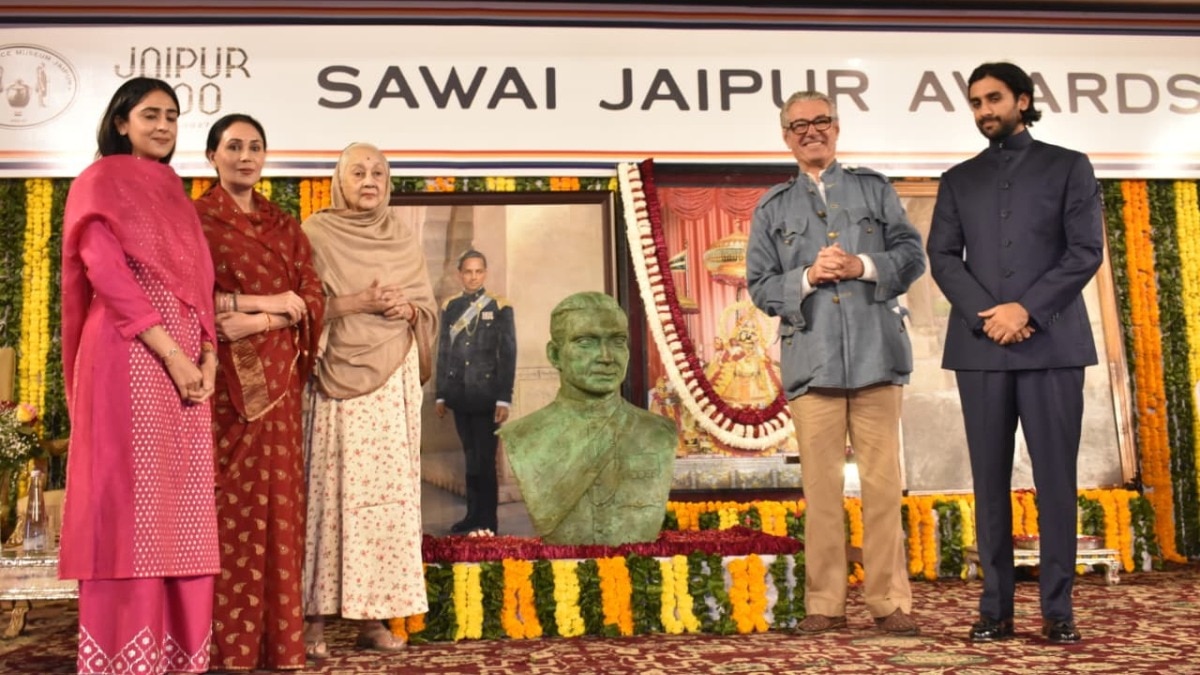
On October 22, before the Sawai Jaipur Awards 2026 were presented in the Pink City, its guests had gathered for another occasion—the unveiling of a bronze bust of Brigadier Sawai Bhawani Singh. Then, over tea post-ceremony, the memories began.
Some recalled the man they had known; others spoke of the soldier, the Maharaja and the diplomat. The bust, commissioned by Jaipur’s erstwhile royal family of the Kachhwaha Rajput dynasty, had done more than honour Bhawani Singh. It had brought a circle of people back to a life they had witnessed at close quarters.
The Sawai Jaipur Awards, presented by the Maharaja Sawai Man Singh II Museum Trust since 2000, are held on Bhawani Singh’s birthday, October 22. This year, as Jaipur begins to celebrate its 300th anniversary (falling on November 18), the unveiling gave the occasion a new centre of gravity: a portrait of a man whose life moved between the old world of royalty and the demands of a changing India.
Sculpted in bronze by Gyula Jakabffy, a Hungarian artist and longtime family friend, the bust was made in Jaipur in a tonal finish favoured by Bhawani Singh. Its setting carries its own history. It was created in the City Palace studio associated with Maharaja Sawai Ram Singh II, remembered for his pioneering work in photography and his documentation of the people and life of his time. A space once devoted to making art now holds a work commemorating a life of service.
Bhawani Singh’s was an unusual inheritance. He succeeded his father, Maharaja Sawai Man Singh II after the latter’s death in 1970. The government formally recognised his title only later, before princely titles and privy purses were abolished. By then, Bhawani Singh had already made a name for himself beyond the palace.
As commanding officer of the elite 10 Para of the Indian Army, he fought in the 1971 war and was awarded the Maha Vir Chakra for gallantry. The abolition of privy purses followed within a fortnight of the war. He later served in Sri Lanka at the request of then prime minister Rajiv Gandhi and was honoured with the rank of brigadier.
The contrast was striking: a royal who had earned one of India’s highest gallantry awards just as the political order that sustained princely states was disappearing. Bhawani Singh’s life was not the protected one of a prince insulated from change. The abolition of privy purses drew many former royal families into disputes over property. In Jaipur, court receivers were appointed over several properties amid disputes involving Bhawani Singh’s siblings.
Bhawani Singh’s stepmother, Rajmata Gayatri Devi, also had a difficult relationship with Bhawani Singh and his family over property matters. Yet the distance did not last to the end of her life. Gayatri Devi returned to visiting the City Palace, restoring a measure of warmth between the families.
That history is part of the backdrop to the political path of Bhawani Singh’s only child, Diya Kumari. She won two assembly elections in Rajasthan, one Lok Sabha election and and is now the state’s deputy chief minister. Her public life has come to be seen by some as a continuation of a Jaipur royal legacy adapted to democratic politics, one associated with both her father and Gayatri Devi.
Bhawani Singh, too, tried electoral politics. He contested the 1989 Lok Sabha elections on a Congress ticket and lost. For some, the defeat reflected the difficulty of adjusting to politics after a lifetime in which public expectations were shaped by his unusual position: an ex-maharaja and an army officer, with the obligations of both identities but the security of neither.
His resources, too, were diminished. Unlike his father, he did not enjoy the same princely estate, and his finances were affected by both the end of privy purses and the property disputes. Yet, among many Jaipur residents, including Rajputs, he retained a distinctive respect.
“There were challenges before him (Bhawani Singh),” Diya Kumari tells INDIA TODAY, referring also to the serious health problems he faced after suffering a stroke. “But he did a lot for the nation as a soldier when he could have led a royal life, and also as much as he could do for people who visited him with hope.”
The bronze bust has prompted talk in Jaipur about a larger public memorial to Bhawani Singh—perhaps a full-length statue. The discussion recalls the effort Gayatri Devi made to have a statue of her husband, Man Singh II, installed in a public place. It was Vasundhara Raje, as chief minister, who eventually enabled that honour.
For Bhawani Singh, the question of a public memorial carries a particular meaning. He lived through the transition from maharaja to former maharaja, and from a royal inheritance to a life increasingly defined by service. The bronze portrait in the City Palace does not resolve the debates that surrounded his family or his place in politics. It does, however, make visible the part of his life that many who knew him still remember: the soldier who could have remained within the comforts of royalty but chose to serve.
Rohit Parihar is Deputy Editor at India Today and one of the longest-serving journalists covering Rajasthan’s politics, governance and public affairs. With more than 36 years in journalism, including 30 plus years with India Today, he has reported from the ground across Rajasthan and the wider North Indian region.
He has closely tracked the state’s political evolution across successive governments, elections and major policy shifts. His reporting spans politics and administration as well as investigative journalism, public accountability, environment, infrastructure and social issues.
He has contributed to both the English and Hindi editions and online portal of India Today and is known for combining extensive field reporting with sharp political and policy analysis. His work has often focused on the gap between government claims and ground realities.
A Mass Communication graduate from Panjab University, Parihar is a Chevening alumnus and has participated in the US State Department’s International Visitor Leadership Program. He has also received Sawai Madho Singh Award for investigative journalism.

