
SC says unlawful additions to Form 6 will be axed. Is ECI in trouble?
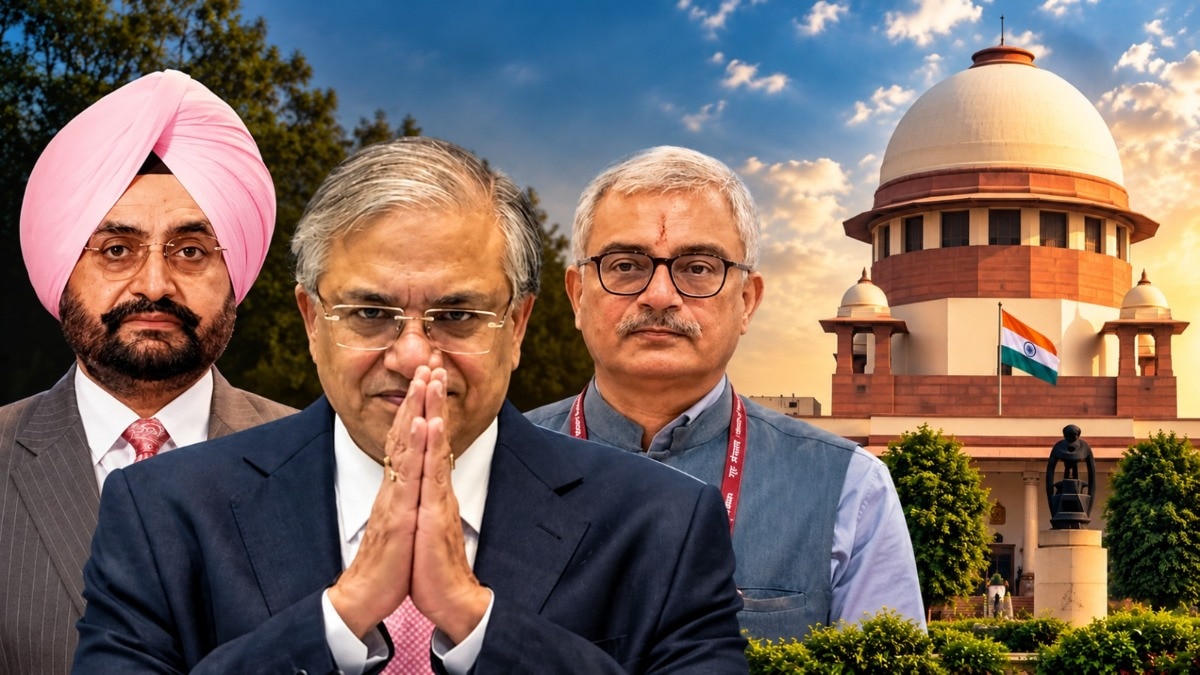
The Supreme Court's (SC's) latest observation in the Form 6 row has put the Election Commission of India (ECI) in an uncomfortable legal position. But the immediate question is not simply whether Chief Election Commissioner (CEC) Gyanesh Kumar changed a statutory form unilaterally. The question is more fundamental. Did the ECI, while exercising the powers the SC itself recognised during the Special Intensive Revision (SIR), turn an additional SIR declaration into a mandatory digital gateway for voter registration?
This is the distinction that could determine what happens next in the current legal proceedings.
Form 6 is used by new voters to register themselves. While the ECI said that it didn't change anything in Form 6 during SIR, a controversy was sparked over an annexure that was attached to the form.
On Monday (October 5), Chief Justice of India (CJI) Surya Kant, who was heading a three-judge bench, said that the SC had not approved any modified version of Form 6. The Supreme Court sought the ECI's records to establish who authorised the changes and said that if decisions were found to have been taken without the required unanimity or majority, they could be annulled.
This sounds like a direct problem for CEC Gyanesh Kumar. But the ECI has another argument available in its armoury — and it comes from the Supreme Court's own May judgment on the Bihar SIR. Can the ECI prove that all measures taken were according to rules, or has it left any legal loophole?
The ECI's defence has consistently been that it did not modify statutory Form 6. Instead, it added a supplementary declaration for the SIR exercise. The poll panel has argued that this declaration was part of an SIR-specific documentation framework and that the SC's May judgment had "upheld its power to prescribe such a framework".
That argument is valid, and it is not without legal basis.
In May, the Supreme Court had said that Form 6, prescribed under the Registration of Electors Rules, 1960, was designed for ordinary electoral-roll revision. For an exercise as distinct as an SIR, the Commission retained "a degree of residual authority" to formulate an appropriate documentation framework. But the court attached an important condition at that time. It said that power was "not unbounded, and any departure from the statutory framework had to have a rational connection with the objective of the SIR".
The ECI can, therefore, and to its full extent, argue that it did precisely what the SC's May judgment permitted. The poll panel will argue that it retained Form 6 while requiring an accompanying declaration to establish the necessary documentary linkage for an intensive revision.
But there is a second layer to this argument, and this is where the Commission could face scrutiny by the SC.
The controversy is not merely about the physical Form 6. It is about how the form was implemented on ECINet.THE DIGITAL GATEWAY COULD BE THE PROBLEM FOR THE ECI
On paper, the distinction between Form 6 and an additional declaration might appear legally neat. On ECInet, the digital platform of the ECI, however, the distinction can become considerably less meaningful if an applicant cannot proceed with the Form 6 application without first completing the additional declaration.
The ECI's own citizen-service portal presently displays separate options for "Fill Form 6" and "Fill Declaration Form" under the SIR framework.
That is where the court's scrutiny could move next and make the ECI face a legal setback.
If the declaration is genuinely an accompanying SIR document, the Commission can defend its existence under the May judgment. But if the software makes the declaration a compulsory precondition to even completing the statutory Form 6, the practical effect might be that the statutory form has acquired an additional condition.
In other words, the legal question might shift from "Who altered Form 6?" to "Who made the additional declaration mandatory for Form 6 through the digital system?"
That could be more difficult for the ECI to answer.
The Commission has already removed the additional declaration from ECINet in states where the SIR exercise has been concluded, while retaining it where it is continuing. That rollback might help the ECI demonstrate corrective action, but it also leaves the court with a concrete implementation trail to examine.IS GYANESH KUMAR OR THE WHOLE ECI PANEL IN SC'S CROSSHAIRS?
This is where the internal ECI dispute becomes important.
The Indian Express newspaper had published an investigation report in September that Election Commissioners Sukhbir Singh Sandhu and Vivek Joshi objected at least 14 times in 10 months on decisions connected with the SIR. Petitions before the SC have consequently framed the issue not merely as the conduct of one CEC but as a question about how a constitutionally multi-member Commission takes decisions.
The apex court itself indicated that distinction on Monday. It said the Commission is expected to take decisions unanimously and, where there is no unanimity, by majority. It also said that if the records show that a decision was taken without the required process, the court could declare it "ultra vires" or "annul it".
So, at this stage, it would be premature to conclude that CEC Gyanesh Kumar is alone in the dock.
If the records show a unilateral decision by the CEC, the controversy could become a question of individual responsibility. If the records establish that the full Commission authorised the framework, responsibility could extend institutionally to the three-member ECI.
And there is a third possibility of the ECI. The poll panel could establish that the SIR declaration itself was lawfully authorised, but its digital implementation created an unintended or unauthorised mandatory condition.
That would separate the legality of the policy from the legality of its execution.THE MAY ORDER OF THE SC IS THE ECI'S BEST COUNTER AT THE MOMENT
The poll panel's strongest defence will be that the May order of the top court expressly gave it "residual authority" to adapt documentation for SIR, and that the additional declaration fell within that authority.
But the court can still ask whether the implementation respected the limits it had imposed in the May order.
The May judgment allowed adaptation. It did not give the ECI an unlimited licence to rewrite statutory requirements. The court specifically required a "rational nexus", consistency with the "statutory scheme" and a "calibrated balance".
That makes ECInet crucial while speaking of the legal challenges ahead of the ECI.
If the additional declaration merely collected SIR-specific information alongside Form 6, the ECI has a stronger case. If the software effectively told a new voter "no declaration, no Form 6", the court might see it as something more than documentation design.
And that is why SC's Monday's observation could become more consequential for the ECI. The immediate battle is not necessarily over the existence of the annexure. It is over whether the annexure was allowed to become a digital condition for exercising a statutory right.
The Supreme Court has not yet found the ECI guilty of that. It has asked for the records. The next question, therefore, is not just who changed Form 6. It is who made the change operational, and whether the May judgment ever authorised that.- Ends
Avinash Kateel is a multimedia journalist with the India Today Group (Digital), and a cub reporter. His heart belongs to coastal Karnataka, but his mind closely tracks the politics of the entire country and the policies that shape India and the world. From geopolitics to the economy, Kateel covers anything that makes news. He believes in breaking down complex stories into simple versions because news matters when readers understand it.


