
Seeing three different sides of India, on a journey from a safari camp to a royal palace to the Himalayas - Toronto Star
Travelling from Rajasthan to Punjab and up to the mountains reveals the diversity of this vast country in one sweep.
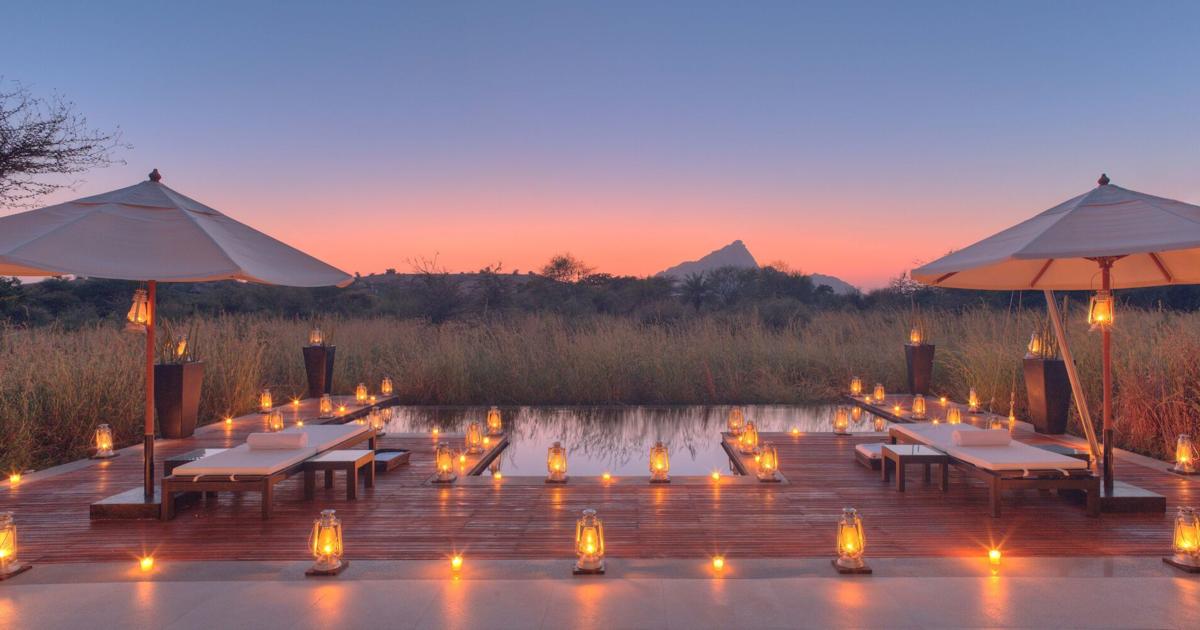
At the safari camp Suján Jawai, located in the Aravalli range in Rajasthan, India.
“Is it OK if we go a little faster?” asks Suraj Pal Singh Ranawat. We’re driving across a lunar landscape of granite boulders and scrubland beneath the Aravalli, India’s oldest mountain range. Singh, head ranger at the safari camp Suján Jawai, has been scanning for leopards. There are no fences here in Jawai, in southern Rajasthan, so they roam freely among mustard fields and villages.
We bump over brush and scale boulders, past meowing peacocks and seemingly surprised antelopes, then pull up in front of an open cave. It takes a moment to spot F2, a well-known leopard, her fur indistinguishable from the rocks, but then she slinks down the slope and into the brush. Seconds later, she reappears and walks just inches in front of our vehicle, her cub trailing her. It’s my first day in India, and I wonder what took me so long.
F2 is a well-known leopard in Jawai, where the animals roam freely among mustard fields and villages.
I’d never been to India because I felt intimidated. In a country of such size, I didn’t know where to begin. The Golden Triangle, that well-worn route between Delhi, Agra and Jaipur, was an obvious choice, but I’m not so fond of the obvious.
So when I was invited to travel a lesser-tracked route linking three Relais & Châteaux properties, I saw an opportunity to experience the diversity of this vast country in one sweep. Over one week, I travelled from Rajasthan to Punjab and up to Himachal Pradesh in the Himalayas. Each region revealed a different side of India, shaped by its history, geography and ways of life.
Like the vast majority of Suján Jawai’s staff, Singh is from one of the camp’s neighbouring villages. So he’s well-versed in how human-wildlife coexistence fosters the kind of remarkable safari experiences possible here.
A Rabari pastoralist in Jawai, southern Rajasthan. The herders see leopards as guardians, rather than intruders.
The camp has spent the past decade restoring native grasses and trees to create a safe corridor for leopards, thus increasing their local population. But Singh also credits their presence to the Rabari pastoralists, “the real conservationists,” who have lived here for centuries, and whose world view sees leopards as guardians, rather than intruders. “The coexistence is down to the spirituality,” Singh says.
After three nights at Suján Jawai, I still have much to learn, but I’m excited to make the trip — a road transfer, then a flight from Udaipur to Chandigarh — to the state of Punjab. The day before I leave, I ask the safari camp’s chef a quick question about Punjabi food and receive a discourse on not just the rich cuisine but also the exuberant spirit of the Punjabi people.
As soon as I walk into my second hotel, Ran Baas The Palace, greeted by a pair of high-energy bhangra dancers, I see what he means. Located within the city of Patiala’s Qila Mubarak fortress complex, the hotel conveys a sense of the region’s opulent past. The heritage property’s 35 rooms and suites occupy an 18th-century royal guest house, originally built for Maharaja Baba Ala Singh, Patiala’s founder. Later, this became home to bon vivant Maharaja Bhupinder Singh, who, among other acts of decadence, created the Patiala peg, a famously generous measure of whisky.
At Ran Baas The Palace. The hotel occupies what was previously an 18th-century royal guesthouse.
The hotel opened in 2025, after a restoration by conservation architect Abha Narain Lambah, who preserved its blend of Sikh, late Mughal and Rajput architecture. Huge, richly decorated rooms are arranged around leafy courtyards, corridors are lined with portraits of maharajas beneath statement chandeliers inspired by their queens’ earrings, and private dining spaces add another touch of the theatric.
At Sheesh Mahal, the palace hotel’s hall of glittering mirrors, I dine by candlelight on Kandhari shaan-e-raan (slow-roasted mutton leg). It’s served on a silver platter by the larger-than-life executive chef, Palvinder Singh, who, in the booming voice of a natural showman, laments my group’s “small stomachs.” Breakfast, meanwhile, is served in Rang Mahal, among original frescoes depicting maharajas and Hindu deities.
Art at Rang Mahal, inside Ran Baas The Palace. Original frescoes depict maharajas and Hindu deities.
After two nights of indulgence at Ran Baas, my final stop is a welcome retreat: Sitara Himalaya, a wellness-focused hotel with only 10 rooms, set 2,500 metres above the Kullu Valley. Rather than fly, I watch the landscape slowly unfold from the hotel’s private bus, which makes the trip in around seven hours. Heading north, the air clears, mountains slide into view and Tibetan prayer flags flutter by the side of the road.
Inside Sitara Himalaya, a wellness-focused hotel with only 10 rooms, set 2,500 metres above the Kullu Valley.
Once the family holiday home of Anita Lal, founder of the lifestyle brand Good Earth, the property still feels like it belongs to a design enthusiast, with interiors rooted in regional craftsmanship. I’m particularly taken by the handwoven, geometrically patterned Kullu shawls I’m offered for the chilly evenings.
The spa offers yoga and treatments overlooking the valley, but I’m in the Himalayas, so I feel compelled to get outside. I hadn’t, however, reckoned on hiking with an elite cross-country skier. I’m soon wheezing behind my guide, Bhuvneshwari Thakur, who competed at the 2011 Asian Winter Games. I blame the altitude.
Above the village of New Kothi, in the Himalayas.
We follow a woodland trail to a waterfall, passing through New Kothi, a village of around 200 people. Along the way, we stop at the home of Nupram, a weaver Thakur describes as “the most popular person in the village.” Inside his traditional kathkuni house, built from wood, stone and mud, he shows us his handloom and thick, pure-wool shawls, whose warmth is cherished in this mountain village. “We use this for our bedding,” Thakur explains.
After pausing to have snacks at the waterfall and to watch flocks of sheep — source of those beautiful textiles — graze high on the mountainside, we walk back downhill to New Kothi. Thakur says it’s the last village before the Rohtang Pass, gateway to the High Himalayas.
Beyond, there’s “nothing,” she says, “only forest and mountain roads.”
On this final day of my trip in India, her words seem fitting, telling me I’ve reached the end of the road. But instead, I find myself thinking about how much more there is to see, the many roads I haven’t taken. I’m already planning to return.
Karen Gardiner travelled as a guest of Relais & Châteaux, which did not review or approve this article.
Error! Sorry, there was an error processing your request.
There was a problem with the recaptcha. Please try again.
You may unsubscribe at any time. By signing up, you agree to our terms of use and privacy policy. This site is protected by reCAPTCHA and the Google privacy policy and terms of service apply.

