Senate passes fiscal adjustment bill after tough negotiations - Valor International
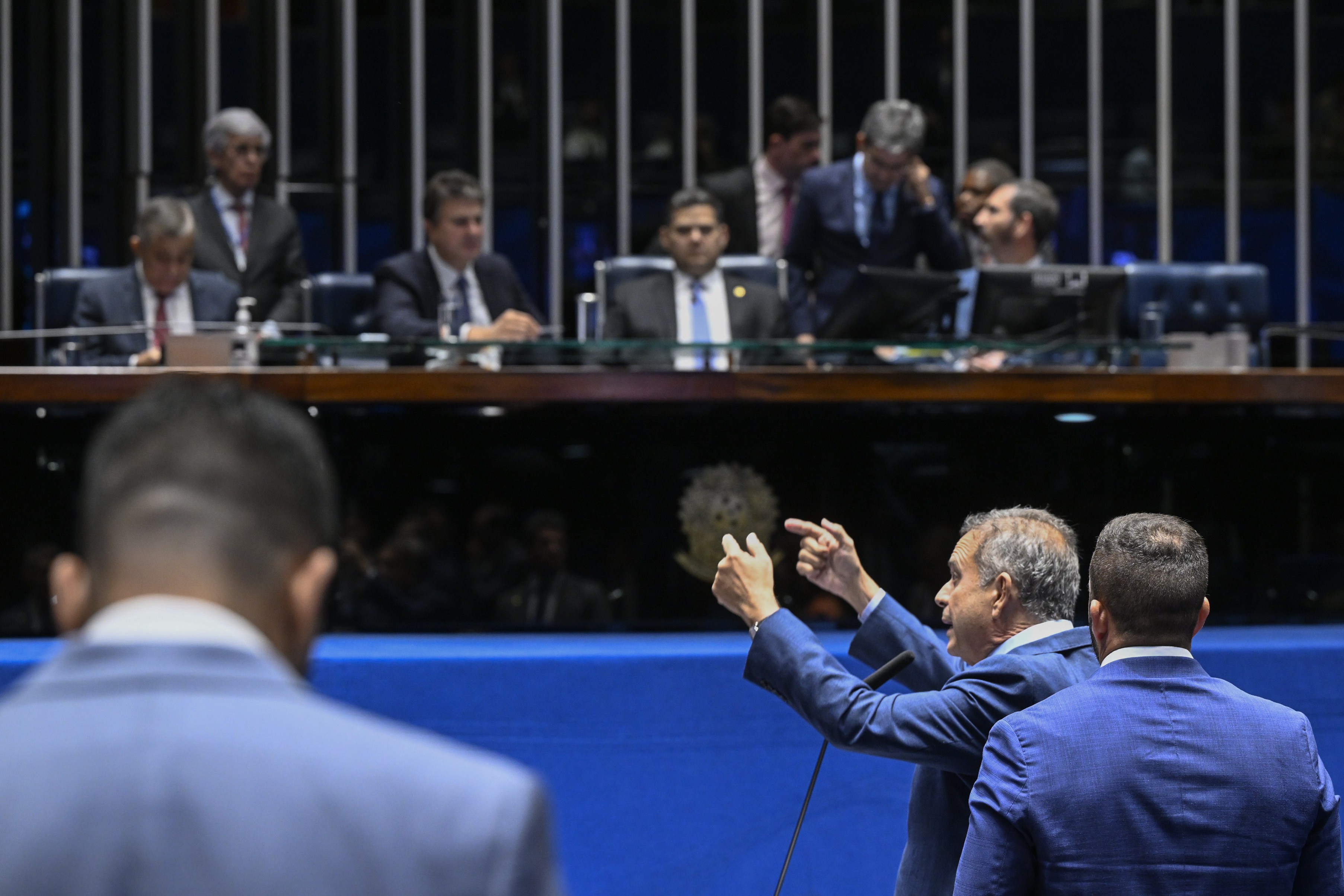
After facing resistance and struggling to secure enough votes the previous day, the government cleared its fiscal adjustment bill through the Senate on Wednesday (Nov. 18), with lawmakers rejecting all opposition amendments put to separate votes. Planning Minister Bruno Moretti said changes made during the legislative process had not altered the government’s overall projections of R$45 billion to R$56 billion in savings and approximately R$11 billion in additional budget flexibility in 2027.
The complementary bill now heads to the Lower House, whose speaker Hugo Motta (Republicans Party) announced in Buenos Aires that he would call an extraordinary session on Monday (Nov. 23) to vote on the proposal. The government wants to secure approval before Tuesday (Nov. 24), when it releases its bimonthly revenue and expenditure assessment, to avoid further spending freezes in this year’s budget, as previously reported by Valor.
The bill faced resistance from both opposition senators and members of the government’s own coalition. Having thwarted the administration’s attempt to complete the vote last week, the opposition rallied state governors and business representatives against several provisions. The bill’s rapporteur, Eduardo Braga (Brazilian Democratic Movement, MDB), offered alternatives in an effort to build consensus, but negotiations stalled, forcing the vote to be postponed from Tuesday to Wednesday.
The delay, however, gave the government enough time to secure the necessary votes. With the opposition amendments defeated, the bill will reach the Lower House with its main fiscal adjustment measures intact. These include authorization to restrict the use of tax credits to offset liabilities arising from other taxes administered by Brazil’s Federal Revenue Service, one of the provisions that drew the strongest opposition from businesses.
The government also managed to retain changes to transfers under the Kandir Law, albeit with adjustments negotiated by Braga and accepted by the opposition. The cap on transfers to states and municipalities in 2027 was raised to R$2 billion from R$1 billion, reducing the additional room under the spending limit next year to R$2 billion from R$3 billion. Transfers will be gradually restored between 2028 and 2030. Southeastern states are among the hardest hit by the measure, prompting particularly strong opposition from lawmakers of São Paulo, Rio de Janeiro and Minas Gerais.
The Senate-approved bill also retains a provision allowing up to R$10.5 billion in diesel subsidies to be excluded from the calculation of the 2026 primary fiscal target. If the Lower House fails to approve the legislation by Tuesday, when the government releases its bimonthly revenue and expenditure assessment, the current R$13.6 billion spending freeze may have to be expanded, potentially including cuts to spending earmarked through lawmakers’ budget amendments.
Diesel subsidies are already exempt from the spending cap under Brazil’s fiscal framework but still count toward the primary balance. Their exclusion divided the Finance and Planning ministries. The Finance Ministry opposed the measure over concerns that it could send a negative signal to financial markets, while the Planning Ministry argued that it was necessary to prevent further spending freezes.
During the vote, the Senate also accepted an amendment by Senator Alessandro Vieira (MDB) shortening the deadline for Congress to consider legislation regulating so-called supersalaries to 60 days from 120. The legislation will define which compensation-related payments may be exempt from the constitutional cap on public-sector pay.
Regarding restrictions on tax offsets, Braga also accepted an amendment allowing companies to continue using PIS/Pasep and Cofins tax credits to settle liabilities arising from the Contribution on Goods and Services (CBS), a tax introduced under Brazil’s tax reform that will take effect in 2027.
Finance Minister Dario Durigan described the bill as the “first step” toward a broader fiscal adjustment. Progress on additional measures, however, still hinges on consensus within the administration. Moretti said the current bill must be discussed before other measures are considered.
The Planning Ministry believes the proposal already represents a reform of budget management tools and provides the means to meet fiscal targets in the coming years, starting with a primary surplus of 0.5% of gross domestic product in 2027.
In practice, the bill establishes a minimum spending freeze whenever the projected primary balance falls below the lower bound of the fiscal target. In that scenario, real expenditure growth would be capped at 2% instead of 2.5%, equivalent to R$12.8 billion in spending restraint in 2027. The lower cap would apply only to the fiscal year in question, leaving the calculation base for subsequent years’ spending limits unchanged.
The legislation also gives the administration discretion to impose additional spending freezes to pursue the midpoint of the fiscal target, even when the projected primary balance falls within the tolerance band. It also broadens the pool of expenditures subject to freezes to include certain mandatory expenses whose disbursement schedules can be managed.
On the revenue side, the main measure allows the government to restrict the use of tax credits to offset liabilities arising from other federal taxes administered by the Federal Revenue Service. The mechanism may be deployed alongside additional spending freezes, with restrictions equivalent in value to the extra spending restraint needed to reach the midpoint of the fiscal target.
The broad discretion granted to the administration, however, has been one of the main criticisms of the bill. Lawyer Maria Raphaela Matthiesen said the proposal could strain corporate cash flows by forcing companies to make larger cash payments to settle their tax liabilities.
“The text does not specify which credits will be subject to reductions, how long those reductions will last or how they will be implemented,” she said.
In addition to these mechanisms, the bill doubles the across-the-board reduction in federal tax incentives established under legislation passed in 2025, raising it to 20% from 10%. Several exemptions were preserved during the legislative process, including payroll tax relief and incentives for the information technology and semiconductor industries.
The proposal also caps tax incentives under the Special Incentive Regime for Infrastructure Development (Reidi) and limits financial compensation between pension systems under the Comprev mechanism. It restricts spending on interest rate subsidies under the Export Financing Program (Proex) and allows resources from the National Fund for Scientific and Technological Development (FNDCT) to finance study and research scholarships awarded by Capes and CNPq, Brazil’s federal academic and research funding agencies.
The bill also excludes windfall oil revenues from the calculation of net current revenue (RCL), lowering the base used to determine the constitutional minimum for healthcare spending and other expenditures tied to federal revenue. During the Senate deliberations, lawmakers added a safeguard for the Federal District Constitutional Fund (FCDF), exempting it from some of the fiscal adjustment measures.
The day’s events signaled that Alcolumbre, if reelected, would likely ensure the government’s ability to govern effectively. Moretti was also seen as having cemented his position as the favorite to remain in his post. Durigan’s performance was well received, but his position is less secure, as other candidates remain in contention for the Finance Ministry. The day also underscored the economic team’s close ties with Alcolumbre and Braga, the MDB leader, who has proved a steadfast ally in advancing the government’s economic agenda.
This article was translated from Valor Econômico using an artificial intelligence tool under the supervision of the Valor International editorial team to ensure accuracy, clarity, and adherence to our editorial standards. Read our Editorial Principles.