September 23, 2026 - PBS News Hour full episode - PBS
Problems playing video? Report a Problem | Closed Captioning Feedback
Before you submit an error, please consult our Video Help page.
Problems playing video? Report a Problem | Closed Captioning Feedback
Before you submit an error, please consult our Video Help page.
Major corporate funding for the PBS News Hour is provided by BDO, BNSF, Consumer Cellular, American Cruise Lines, and Raymond James. Funding for the PBS NewsHour Weekend is provided by...More
Problems playing video? Report a Problem | Closed Captioning Feedback
Before you submit an error, please consult our Video Help page.
PBS News Hour is available to stream on pbs.org and the PBS app.
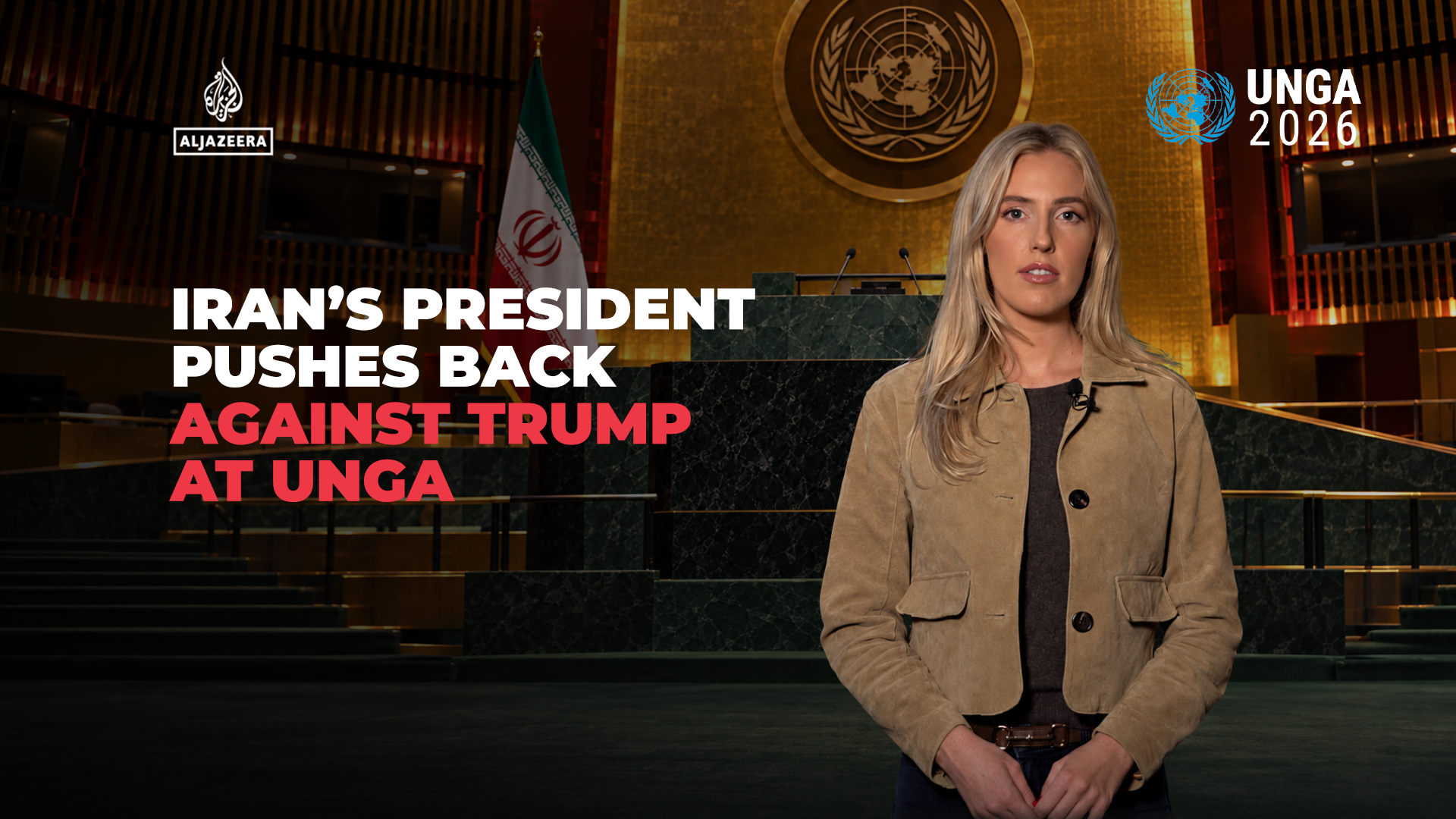
On the "NewsHour" tonight: Iran's president delivers a defiant speech at the United Nations, calling out President Trump by name.
GEOFF BENNETT: A federal court holds an emergency hearing over the Trump administration's decision to ban three news organizations from the White House.
AMNA NAWAZ: And Judy Woodruff travels to Kansas to explore how rising costs are threatening the longstanding American tradition of the family farm.
COLE CARPENTER, Triple C Farms: I think the American farmer and rancher is kind of caught in a wicked loophole.
(BREAK) AMNA NAWAZ: Welcome to the "News Hour."
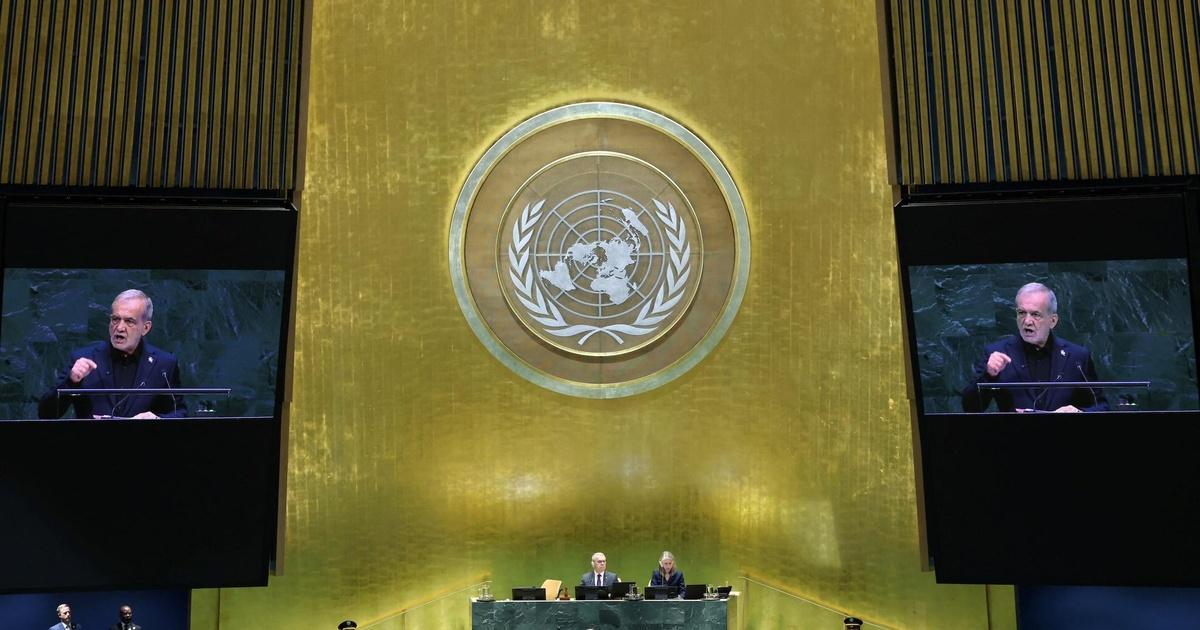
The president of Iran told the United Nations General Assembly his country won't bend to U.S.
intimidation just a day after President Trump threatened to escalate the war from the very same stage.
GEOFF BENNETT: On the sidelines, U.S.
and Iranian officials signaled no major breakthroughs in mediated talks.
Nick Schifrin has the latest after another busy day in New York.
NICK SCHIFRIN: It is a building on U.S.
soil, an organization dedicated to peace, and never before has it hosted the leader of a country at war with its host until today.
MASOUD PEZESHKIAN, Iranian President (through translator): Yesterday, the United States president described us as terrorists.
We have been the victims of terrorism.
NICK SCHIFRIN: And on the same dais where President Trump yesterday delivered this threat... DONALD TRUMP, President of the United States: Or do I annihilate the Islamic Republic, and do it quickly, never giving them a chance to kill and destroy people and countries again?
NICK SCHIFRIN: ... Iranian President Masoud Pezeshkian delivered his own defiance.
MASOUD PEZESHKIAN (through translator): We will never bow our head or bend at the knee.
Trump and those who seek to bully us that we are ready for dialogue and diplomacy and negotiations without accepting the language of force.
NICK SCHIFRIN: Within minutes, the sole member of the U.S.
delegation had heard enough and walked out of the room.
But, inside Iran, Pezeshkian leads the faction that advocates for negotiation and economic integration with the West.
He's losing that argument to hard-liners, who today threatened Iran's neighbors after they cooperated with U.S.
sanctions banning Iranian airlines.
MOHSEN REZAEI, (through translator): If any country joins the United States in this adventure, its airports will no longer be able to operate flights.
Secretary of State: Do they want to be a country or do they want to be a revolution?
NICK SCHIFRIN: Speaking right after Pezeshkian, Secretary of State Marco Rubio called yesterday's indirect talks between Iranian Foreign Minister Abbas Araghchi and American mediators Steve Witkoff and Jared Kushner significant.
But he said Pezeshkian's speech was the pot calling the kettle black.
MARCO RUBIO: Slaughtering 10,000 of your own people in protests is a violation of the U.N.
I hope it's a violation of the U.N.
I think sponsoring terrorist organizations in the region to attack your neighbors, attack energy infrastructure, attack civilian sites is a violation of the U.N.
So I don't know what standing Iran has to lecture anyone on human rights or the international system when they habitually violate it.
NICK SCHIFRIN: But Rubio acknowledged that another violator of the international system, Russian President Vladimir Putin, is invited to Florida in December, when President Trump hosts the G20 in his Doral resort.
MARCO RUBIO: We think it's an opportunity for him to engage not just with the president, but with other world leaders.
We hope that's an invitation he will accept.
NICK SCHIFRIN: But, today, Kyiv was filled with the sound of Russian drone strikes.
Authorities said at least two people were killed and dozens injured... VOLODYMYR ZELENSKYY, Ukrainian President: De-escalation steps are important, are needed before winter, now.
NICK SCHIFRIN: ... as Ukrainian President Volodymyr Zelenskyy warned the war could escalate.
And as Ukraine begins to rely on autonomous weapons, Zelenskyy warned the AI future could become the present.
VOLODYMYR ZELENSKYY: As early as next year, there is already a real possibility that AI, not only people, will begin -- will begin to decide what happens on the battlefield.
And we need peace before we reach that point.
DARIO AMODEI, CEO and Co-Founder, Anthropic: That AI could be a risk to humanity as a whole.
NICK SCHIFRIN: Today, the Security Council held its first ever U.N.
General Assembly AI meeting, including warnings from American AI leaders.
SAM ALTMAN, CEO, OpenAI: No one person or company or country should be able to use the most powerful AI models to impose their world view on everyone else.
NICK SCHIFRIN: But, in this chamber, the flawed but still only international body whose resolutions are legally binding, it fell to the co-chair of the U.N.
's independent AI panel, Yoshua Bengio, to warn the world it must police AI companies and issue a clarion call for collaboration.
Independent International Panel on AI: Today, a handful of companies and countries are acting in their self-interest by taking reckless risks with humanity's fate.
Our future, all of us, our future is at stake.
Decisions that affect us all should be made by us all.
The choice is still ours, but we must act now to correct the trajectory.
General Assembly theme is Restoring Trust, a U.N.
This week, that sentiment has been fleeting, as many here are worried the future feels fractured and uncertain.
For the "PBS News Hour," I'm Nick Schifrin.
GEOFF BENNETT: Chinese President Xi Jinping arrived in Washington this evening for his first state visit in more than a decade.
And at the same time, a federal judge today heard arguments in a lawsuit brought by CNN, MS NOW and Politico challenging President Trump banning them from the White House.
Our Liz Landers is at the White House covering both stories, and she joins us now.
So, Liz, we will start with this state visit.
LIZ LANDERS: Yes, Geoff, President Trump is greeting leader Xi right now at Joint Base Andrews here in Washington for an arrival ceremony that has all the pomp and circumstance of this major state visit.
This is the first time that Xi has been to the White House since 2015.
And President Trump visited China back in May and was not awarded this same kind of pomp, circumstance and arrival.
In particular, Xi did not greet him when he landed there in China back in May.
You're seeing some of those images now.
I will remind our viewers that those images are from several months ago because the White House TV pool is still not covering the president's events today.
We believe that there are going to be a number of issues that will be addressed during this visit.
A senior administration official told us earlier that AI, artificial intelligence, of course, will be on the top of the list, also some of these export controls that the United States has on our computing chips and selling those to China.
The possibility of reducing tariffs on some goods is apparently going to come up, and also political prisoners.
Several China watchers and experts that I have spoken with don't really think that this meeting is going to be so much about deliverables as it is about continuing to forge that personal relationship that President Trump has with leader Xi.
I spoke earlier today with Kyle Chan.
He's a fellow at the Brookings institute.
And he was actually talking about these export controls, saying that matters less and less for the Chinese government because they are going all out to build their own AI chips themselves.
And when it comes to artificial intelligence in particular, you heard some of that addressed from the U.N.
China is not interested in a joint slowdown of AI development, according to Chan.
He says that they're more worried about cyber risks, hacking companies, and they don't share, China does not share the same concerns that we have heard from U.S.
AI companies and leaders recently that robots, AI may kill us all in the near future.
Geoff, one more thing I want to add.
Not everybody is happy about this visit and all of the accoutrements that are being laid out for President Xi.
Republican Senator Wicker, he's the chairman of the Senate Armed Services Committee, says that he would have advised against this lavish welcome to what he calls a brutal dictator.
GEOFF BENNETT: And, Liz, there's a state dinner tomorrow evening.
Who is expected to be in attendance?
LIZ LANDERS: Well, Geoff, as you would imagine, with all of this talk of AI and technology, there are leaders from several major business companies and AI companies that are going to be at the White House tomorrow.
A senior administration official says that Jeff Bezos will be there, as well as Elon Musk, Michael Dell, Jensen Huang of Nvidia, a chipmaker, and Sam Altman of OpenAI.
The first lady, Melania Trump, said in a FOX News interview today that President Trump wanted to have the state dinner because they have a great relationship.
She said that she's been involved in every detail of the planning for the state dinner tomorrow night.
And she also -- and I'd also just add that this is only the second state dinner that President Trump has now had in his second term in office, Geoff.
GEOFF BENNETT: All right, Liz, in the minute we have left, bring us up to speed on this lawsuit involving the three news organizations that were banned from the White House by President Trump.
LIZ LANDERS: There was a hearing on this, this afternoon, and the judge in this case, a district judge here in Washington, said right off the bat that he was skeptical of the argument that the Trump administration, that the Trump White House is making here on due process grounds.
It sounds like the judge believes that the due process of these news organizations was violated.
The government is arguing in a filing that they issued late last night that news organizations failed to maintain basic minimum standards of professionalism and decorum expected of those given access to the White House.
This has now turned into a conversation about national security.
That is what the president and the administration are arguing is at stake here, that these news organizations somehow violated national security there.
The judge also seemed skeptical of that, Geoff.
We still do not have an answer from the judge as to whether the ban on Politico, CNN, and MS NOW will be lifted.
GEOFF BENNETT: Liz Landers outside the West Wing at the White House for us tonight.
AMNA NAWAZ: In the day's other headlines: The FBI says it's investigating a claim by a criminal hacking group that it stole -- quote -- "very sensitive data" from the bureau's job Web site.
In a statement, the FBI says it's -- quote -- "aware of a cyber criminal enterprise group claiming a compromise" and that -- quote -- "We are actively and aggressively investigating this matter."
The group, which calls itself ShinyHunters, says it obtained personnel information for thousands of FBI officials, but doesn't appear to have leaked any of the data.
The hackers gave the agency one week to change or remove an advisory about the group on its Web site.
As of this evening, the FBI's job portal remained offline.
Hurricane Polo off Mexico's Western coast has strengthened into one of the most powerful storms in decades.
Polo went from a 50-mile-an-hour tropical storm on Monday to a monster Category 5 in just one day.
At last check, the National Hurricane Center said it's an extremely dangerous Category 4 storm with nearly 150-mile-an-hour winds.
Polo is expected to head West and then turn north, before threatening the Baja Peninsula early next week.
Even as it remains offshore, ominous skies and choppy seas have many in Mexico on edge, with high surf and rain creating the threat of flooding for some coastal communities.
CONCEPCION LOPEZ VILLEGAS, Restaurant Owner (through translator): We're worried and trying to protect our businesses.
And, of course, we're sad, because it belongs to us.
And the thought that we might lose it overnight is devastating.
AMNA NAWAZ: Also in the Pacific, a tropical storm near Hawaii is gaining strength and could hit the island chain as soon as Friday.
Weather officials say the Big Island could see as much as 20 inches of rain.
In Texas, a federal court has temporarily blocked the deportation of a Venezuelan delivery driver who was shot by an ICE officer on Sunday.
The judge ordered Wilber Rafael Garces Perez to appear in court for a hearing next week.
Yesterday, Austin police released new bodycam footage that shows law enforcement treating the 28-year-old at the scene.
His lawyer has said a bullet was still lodged in his back when he was taken into custody.
Garces Perez is now back in a federal detention center after a second visit to a hospital for treatment.
The Department of Homeland Security has defended its actions.
The fight over Missouri's congressional map is returning to the Supreme Court for a third time.
The challenge comes after an appeals court reinstated a map for November's midterms that could help Republicans pick up a seat in Congress.
The justices have already rejected that new map twice.
Separately, Justice Elena Kagan refused to intervene in a custody dispute yesterday over a 5-week-old child who was born with a life-threatening heart condition.
Surrogate McKenna West was seeking conservatorship after refusing the biological parents' request to terminate the pregnancy in a case that has drawn nationwide attention.
Dolly Parton's estate is accusing her nephew of making violent threats as part of a growing feud involving the late country star's legacy.
The company was granted a temporary restraining order against Bryan Seaver, who announced Parton's passing in a video last month and had been in charge of her security.
He was fired earlier this month and, according to filings, has been making threats against the entity that oversees Parton's property and businesses.
Seaver has reportedly denied making any such threats.
But the legal tensions provide a rare sign of unrest within the carefully managed estate of the iconic musician and philanthropist.
Disgraced Hollywood producer Harvey Weinstein was sentenced to 15 years in prison today for sexually assaulting a woman in New York two decades ago.
It's the second time the 74-year-old has been convicted of a criminal sex act involving former TV production assistant Miriam Haley.
A prior conviction was thrown out in 2024.
Weinstein apologized in court today, though he has maintained his innocence.
At a press conference after the sentencing, Haley said Weinstein has - - quote -- "no remorse and belongs in prison."
MIRIAM HALEY, Sexual Assault Survivor: As far as what I was expecting to happen today, I was happy with how it went.
If he was free, he'd be out there doing the same thing still.
AMNA NAWAZ: Weinstein's downfall helped propel the MeToo movement into a viral and global phenomenon.
On Wall Street today, stocks ended lower on renewed worries about inflation.
The Dow Jones industrial average fell around 350 points.
The Nasdaq lost more than 1 percent.
The S&P 500 also closed firmly in the red.
And, in China, a 6-year-old girl has set a new women's record for solving Rubik's Cubes.
Recent videos from state TV show Lian Yunzhi wearing a red hair band with a bow, setting a record at a certified competition in Wuhan, China.
Days later, she broke that record with an average pace of 4.27 seconds per cube.
That makes her the only female speed cuber, as they're called, to break the 4.5-second mark.
Lian reportedly picked up the puzzle at the age of 4 and trains roughly two to three hours each day.
Still to come on the "News Hour": new polling reveals how opinions of President Trump might affect the midterms; former Republican Kansas Governor Bill Graves discusses his decision to back a Democrat in his state Senate race; and Moldova's prime minister on his nation's efforts to fend off Russian threats.
With voting for the midterm elections already under way in some states, President Trump is asking voters to pretend he's on the ballot.
A new PBS News/NPR/Marist poll finds that people are, but that could be bad news for his party.
We found Democratic congressional candidates hold a significant lead over Republicans.
Lisa Desjardins is here with more insights from that poll.
So, Lisa, seven weeks until Election Day.
What exactly do the polls show us about who has the edge going into midterms?
LISA DESJARDINS: Well, as viewers know, good polling is not an exact map.
And this poll shows very clear trends, and they are all universally good for Democrats.
Let's look at the overall generic ballot here.
Registered voters prefer Democrats over Republicans by 12 points in our poll.
Now, that's the same gap that we saw around this time in Trump's first midterm in 2018.
And that was a banner year for Democrats.
They break decidedly four Democrats, with 57 percent of independents in our poll saying they would vote for a Democrat for Congress.
Now, independents are also big movers here, because this gap that we see right now for independents toward Democrats, that is, let me see, three times as large as the gap that they had in 2018.
Also, when you look at the parties, there's an enthusiasm gap, Democrats much more highly motivated.
MAGA Republicans are motivated, but the rest of the Republican Party not as much.
AMNA NAWAZ: So, as we mentioned earlier, at that recent Republican Midterm Convention, the president said: "Pretend I'm on the ballot."
LISA DESJARDINS: It is working for Democrats, Let's take a look.
When we ask what is motivating their choice for Congress, nearly twice as many voters say they are voting specifically against Trump, rather than voting for him.
And we wanted to dig in more on the voter groups on that.
Among voters who identify with MAGA, 71 percent say, yes, they are voting this election to support Trump.
That is still the majority of Republicans.
But here's where the Republicans have a problem, independents again.
More than half say their congressional vote is specifically against Trump.
That is a coalition of people without a party allegiance, but they are voting against someone, against Trump.
Now, there's other bad news for the president as well in this poll.
When we looked at who strongly disapproves of President Trump, that number is 53 percent.
That is his highest number to date in our poll.
AMNA NAWAZ: Let's take a closer look at the issues behind this now.
Both parties are campaigning on affordability and on costs.
There is, of course, the ongoing war with Iran.
There's a continuing immigration crackdown.
How are voters looking at those issues?
Again, thinking about a poll as a compass, it is rare to see the needle in a compass flip so much as we are seeing now.
On every issue we asked about, Democrats now have an advantage.
Let's look at all of them all together there.
Who would better handle the economy?
Voters prefer Democrats by eight points?
Democrats are favored by double digits on gas prices.
They're leading on foreign policy and Democrats are favored on immigration.
That has been Trump's strong suit, but no more.
Let's look at what happened here over time.
Just a few years ago, in 2022, Republicans were favored on immigration by a 15-point margin, and that gap stayed around in '24.
But now we see that it has caught up.
Voters are essentially saying they think both parties are equally able or maybe equally unable to handle immigration.
And independents, in particular, are abandoning Republicans on immigration.
AMNA NAWAZ: All right, Lisa, we know mail-in ballots have already gone out in some states now.
The president has repeatedly attacked without evidence that system of voting.
How confident are voters in mail-in voting?
We asked how much fraud people see in mail-in voting.
The majority of people, 55 percent, said they don't see much.
But there is a large group, 41 percent, who see some.
We asked about the Postal Service as well.
A clear majority in our polls said their confidence that the Postal Service can get the mail out for elections on time this year.
But, again, about 40 percent not confident.
It is Republicans who see the fraud.
In fact, to the contrary, our election systems have proven that there is very little fraud, from what we know.
However, there is one piece of good news; 75 percent of people in our poll say they do have confidence across parties, majorities, in their local and state election officials.
AMNA NAWAZ: All right, Lisa Desjardins, thank you very much.
GEOFF BENNETT: Former Kansas Governor Bill Graves, a Republican, crossed party lines last week to endorse Democrat Adam Hamilton in his bid to unseat Republican Senator Roger Marshall.
Graves said the country is facing increasing partisan gridlock and division and that it's time Kansas does something different.
He's backing Hamilton, a Methodist minister, as an alternative to the Republican incumbent.
Former Governor Bill Graves joins us now to talk about why he made that decision and what it says about his view of the Republican Party today.
GEOFF BENNETT: You are a lifelong Kansas Republican who served for more than two decades.
What is it about this race and Roger Marshall's record that led you to cross party lines and endorse Democrat Adam Hamilton?
BILL GRAVES: Well, I think there's probably a number of things.
First of all, Adam Hamilton is a fabulous candidate.
His message is perfect for our state.
He's made no bones about running from the middle.
He makes it a point of acknowledging that, in his ministry, he has Republicans, he has Democrats, he has independents, and they all gather together and serve together.
I did support him early on in his political career.
Started most notably when he was first elected to the United States Senate, and his first votes were to not accept the results of the elections from Arizona and Pennsylvania.
I'm also a former secretary of state.
So I have a great deal of interest in and a great deal of respect for our process in this country.
And that was very disappointing to me.
Since his time in the Senate, he has been pretty much a yes-vote for anything the administration wants.
And while I understand that to some extent, there are times when you have to stand up and look out for the best interest of your state.
And so we just believe -- and, again, Adam's message is, Kansas can do better, and I agree with him, and I'm supporting him.
GEOFF BENNETT: You recently said that you don't recognize today's Republican Party and compared it to a bad frat party, which is a very vivid line.
BILL GRAVES: We have a we have a saying out in the Midwest.
Maybe you have heard this, that the pig gets fat and the hog gets slaughtered.
You can you can push your power, you can push your authority to certain points, but there's a limit, there's a line where, if you cross, there can be repercussions.
There can be some outcomes that perhaps you're not expecting.
And it just feels like the Republicans have been full of this sort of euphoric, we're in charge, we control the House, we control the Senate, the president is having his way.
And I think to me it feels like this November they're going to wake up.
It's like the morning after the frat party, and they're going to wake up and understand that, gee, we are having all that fun and we might have overplayed our hand a little bit.
I believe that it's going to be a very good night all across the country for Democrats, and I believe Adam Hamilton has a great chance to winning in Kansas.
GEOFF BENNETT: The Republicans in Congress who you have said have effectively walked away from their responsibility as serving as a check on the president, are we starting to see signs of that changing?
I ask the question because Senator John Curtis is calling for an investigation into Trump family business dealings, and Senator John Cornyn has now agreed with him that that should move forward.
He is publicly challenging the president over his solicitous treatment of China's Xi Jinping.
And you have got a handful of Republicans who are breaking with the president over the war in Iran.
Are those isolated examples or the beginning of something more significant?
BILL GRAVES: Well, I think it's the beginning of something more significant.
I mean, you have seen a number of Republicans around the country.
I mean, we had the Karl Rove Texas story... GEOFF BENNETT: That's right, right.
BILL GRAVES: ... Marc Racicot in Montana, Jeff Flake supporting Ossoff in Georgia, my support for Adam in Kansas.
I think the members of Congress, the Republicans, are starting to see very clearly that they're running out of time to do a course correction to save themselves this coming November.
And while the president doesn't seem to be too interested in or focused on the problems they might be having -- in fact, I saw him the other day talk about how he hoped the Republicans did well in November, as if it's some separate foreign apart body that is involved and he's not.
November is going to be a lot about Donald Trump, and I think most of them are starting to appreciate that it's not going to go well, and it's going to turn the page on how this administration has traded the scrutiny that they're under from perhaps a democratically controlled Congress.
And you may want to wake up on the other side of the table when that happens.
GEOFF BENNETT: Can the Republican Party find its way back to the party that you remember, the party of Bob Dole, to invoke the name of a famous Kansas Republican, so long as Donald Trump remains a dominant player on the field?
I think, as long as this style of bullying, this style of intimidating people from the White House is present, I don't know that many people are going to change.
We all have our beginning and our ends of our political careers.
And we're two years away from a presidential election.
So I expect very, very minor changes over the next couple of years, and then more change in two years, and we will have to see who the Democrats -- the Democrats are as capable of snatching defeat from the jaws of victory as the Republicans are.
And I think the extremes, both sides of our political parties, do a disservice to this country.
We really need to govern from the middle.
There are so many problems, immigration, health care, deficit reduction.
All these are problems that cry out for compromise and getting the two parties together in the middle.
And as long as we keep being pulled to the two extremes, I don't think those comp -- those solutions are going to appear.
GEOFF BENNETT: Former Kansas Governor Bill Graves, thanks so much for being here.
AMNA NAWAZ: Moldova is a small Eastern European nation of almost three million people, nestled between Ukraine and NATO member Romania.
And, recently, it's become a stage for Russian interference and drone incursions.
Nearly 40 Russian drones entered Moldovan airspace in the last eight months alone.
GEOFF BENNETT: And, last year, Moldova accused Russia of trying, but failing to engineer a win for a pro-Russian, anti-European party in their 2025 parliamentary elections.
Moldova's Prime Minister Vasile Tofan spoke with Nick Schifrin this afternoon at the U.N.
Prime Minister, thank you very much.
Moldova faces an increasing threat from Russian drones; 17 Russian drones crashed in Moldova just last month.
That's nearly as many as in all of 2025.
Is there any doubt in your mind that this is deliberate?
VASILE TOFAN, Prime Minister of Moldova: Yes, this is deliberate, for sure.
I think Russia is doing two things here.
One, they are probing NATO, because many of these drones are making it to Romania.
NICK SCHIFRIN: Romania, a NATO country.
VASILE TOFAN: Romania being a NATO country, Moldova being a neutral country.
The second thing they are doing, they're trying to hit supply routes for Ukrainian grain export, because many of these drones hit right by the border to try to intimidate the exporters.
And this is a clearly deliberate action.
We have had more drones falling in August than in the whole of 2025.
So I think that such things don't happen by accident.
NICK SCHIFRIN: Your president has acknowledged that your air defense systems are -- quote -- "woefully behind."
What do you need to counter this threat?
VASILE TOFAN: We have been investing in raiders just to scan the sky, but also we need to move to the next step and invest in interceptors as a as a country, so that we can protect ourselves.
Fortunately, the cost of such technology have come down.
NICK SCHIFRIN: Will the drone attacks affect your support for Ukraine, for example?
Will you change your policy because of this?
VASILE TOFAN: We will firmly stay neutral, but that doesn't mean we cannot help Ukraine in different ways.
And I think we have done a lot, sometimes at the political cost, for example, in allowing grain transportation, which you know is not always popular with our farmers.
So I think the pressure is on us to do more explanation why such things are important.
NICK SCHIFRIN: Of course, it's not just drone attacks that Moscow has launched.
Russia has repeatedly interfered in Moldovan elections, financing opposition candidates, launching a disinformation campaign, even hacking into the phones of Moldovan government officials.
What is the goal ultimately, and how sophisticated have these efforts been?
VASILE TOFAN: Russia is seeing a potential victim in Moldova.
And they -- they have used the entire plethora of instruments.
Some of them, you have mentioned them.
What I'm really proud is that we have managed to counter these attacks actually on multiple occasions.
We're one of the few democracies globally that managed -- where the government managed to win elections despite such a huge interference, which I think speaks to our ability to deter such things.
NICK SCHIFRIN: Your neighbors have also been the victim of that kind of election interference.
VASILE TOFAN: Speaking openly about these threats and being very -- being very transparent about the... NICK SCHIFRIN: Calling them out.
VASILE TOFAN: Well, being very, very direct about the magnitude of these attacks and being on topic in terms of society -- civil society in terms of media, for example.
We have had fantastic work by independent media investigators who infiltrated in these networks and produced very insightful documentaries about how these Russian networks work on our territory.
So, in that sense, truly, Moldova has something to teach the world in terms of how this hybrid warfare works.
NICK SCHIFRIN: You have also created the Center for Strategic Communications and Countering Disinformation.
Are you prepared if Russia were to do this again?
VASILE TOFAN: It's the David v. Goliath kind of work.
Of course, Russia has many more resources than we do.
But I think, with the little resources we have, we try to be more strategic and focused in terms of countering such threats, and the center you mentioned is part of that defense.
NICK SCHIFRIN: Do you think Moscow's ultimate goal is what it was in Ukraine, to replace the government with some kind of puppet?
You see, Moldova is the country that shares the longest border with Ukraine of any other countries to the west.
So we have about 800 miles' border with Ukraine.
So the entire southwestern frontier of the country is actually Moldova.
So, of course, Russia would hugely benefit strategic -- strategically if they place a favorable government, say a Moscow-friendly government, in Moldova.
And that's what makes it so important for us to fight against that attempt.
NICK SCHIFRIN: How important is it to Moldova that Ukraine not just survive this war, but win the war, or at least there's a just peace?
VASILE TOFAN: We understand that the independence of Moldova is decided now on the front lines in Donbass.
So, in that sense... NICK SCHIFRIN: In Eastern Ukraine.
So, in that sense, of course, we are we are fully behind the heroic sacrifices of the Ukrainian people, because we understand they don't fight only for their independence.
And the importance of a just peace there is -- cannot be underestimated, because we -- an abuser cannot be tolerated.
And we're creating hugely dangerous precedents here if the peace would be one that would tolerate the abuses that have been committed by Russia.
NICK SCHIFRIN: You and Ukraine started accession talks into the European Union on the same day.
Why is it so important that Moldova joined the E.U.?
VASILE TOFAN: We escaped the Soviet past, and I think this European idea is one idea that unites us.
So this is truly a national project.
I think it's important identity-wise that we are a European nation, but it's also important economically.
So, almost 70 percent of our exports go to E.U., so we are very heavily anchored and dependent on the European economy.
So, to that end, of course, we want to be integrated also institutionally.
That's why we're so, so focused on getting that done.
NICK SCHIFRIN: And, finally, you're here in New York.
You're one of the few European countries to answer the Trump administration's call to reduce tariffs on American imports to zero percent.
What is the relationship that you want right now with the Trump administration?
What are you asking for from the United States?
VASILE TOFAN: We're a small country with a small domestic market, so I think we have to compete by having more business-friendly environments and want to extend a very warm welcome to all the American companies that are looking to take advantage of Moldova's positioning and capitalize on that platform to serve European countries, to serve eventual reconstruction of Ukraine and other regions.
NICK SCHIFRIN: Prime Minister Vasile Tofan, thank you very much.
AMNA NAWAZ: For generations, the family farm has been central to the American story.
But, these days, farmers are struggling with sharply higher costs and crushing debt, on top of the same economic pressures the rest of the country feels.
Judy Woodruff reports from Western Kansas on what it takes to keep a farm going and who will carry on the tradition.
It's part of her series Crossroads: America at 250.
COLE CARPENTER, Triple C Farms: This corn should be six feet tall.
JUDY WOODRUFF: There's no corn harvest for Cole Carpenter this fall after a severe drought this summer stunted its growth.
COLE CARPENTER: It's tough, no matter which way you look at it.
JUDY WOODRUFF: For generations of Americans, farming was a way of life, work the land, make a living, and pass it on.
At the nation's founding, nine in 10 Americans were farmers.
SARAH MOCK, Author, "Farm (and Other F Words): The Rise and Fall of the Small Family Farm": To Thomas Jefferson, America was always an agricultural experiment.
We were always going to be the agricultural powerhouse of the world, and that was going to be the bedrock of our nation.
JUDY WOODRUFF: We met agricultural journalist Sarah Mock at Old Town Farm in Albuquerque, New Mexico, a former horse farm turned into a cafe and event space.
SARAH MOCK: Jefferson crafted this, like, yeoman idea of people who are close to the land and therefore have this, like, sense of community and loyalty and patriotism that had really not been seen by Europeans in like hundreds of years.
COLE CARPENTER: Yes, farming is a gamble.
JUDY WOODRUFF: I first met Cole Carpenter at his farm near Leoti, Kansas, 20 years ago, when I was reporting for a documentary about millennials.
Cole's grandfather, Dale Appl, had been farming for decades.
The land had been in his family since the late 1800s.
But even in 2006, there were doubts about whether farming could support the next generation.
DALE APPL, Farmer: And I told him he ought to have another profession.
JUDY WOODRUFF: Twenty years later, the Carpenters are still farming.
They have expanded it 10,000 acres, added cattle, and a crop spraying business.
Two years ago, Cole and his wife, Bridget (ph), sold 800 acres to put capital back into the operation.
COLE CARPENTER: Oh, yes, 100 percent, yes, yes.
I mean, that -- it doesn't go easily.
But at the same time, the less debt, the less stress was an easier decision there.
JUDY WOODRUFF: Around them, larger operations bought up smaller farms, mirroring a national trend.
declined 10 percent between 2012 and 2022 to about 1.9 million.
At the same time, the average size grew by 5 percent.
COLE CARPENTER: And it felt like we were on an island.
One of my grandpa's biggest thing was, he always said, don't worry about what the neighbors are doing or what's going on around you.
Take care of what you have, keep working, and you will be fine.
JUDY WOODRUFF: Now just 4 percent of farms, the largest family operations, account for more than half of all agricultural sales.
And Carpenter says the challenge isn't just producing more.
It's paying for everything it takes to do it.
COLE CARPENTER: All the technology, all the seed we have, we're able to grow more, but it also comes with a cost.
JUDY WOODRUFF: But even with all the latest technology, those who work the land still face risks they can't control.
COLE CARPENTER: You can stick your hand in.
JUDY WOODRUFF: Weather, commodity prices, land costs, politics, and tariffs.
COLE CARPENTER: At the end of the day, we don't really have any control over what the price of wheat is today or the price of corn is.
I think the American farmer and rancher is kind of caught in a wicked loophole.
SARAH MOCK: Jefferson's idea of how farms were going to work lasted well into the late 1800s.
We really thought it's going to be fine, there's always going to be land, anyone who wants it and who has the right effort and the grit is going to have their chance.
JUDY WOODRUFF: That idea at our founding depended on one thing: There was always more land to take.
But by the late 1800s, that was changing.
Still, that classic image of the farmer has endured, independent, self-sufficient, and deeply rooted to the land, as seen in Grant Wood's iconic American Gothic, a painting of a stoic farmer and his daughter in 1930.
NARRATOR: In the Wheat Belt, farmers face ruin.
JUDY WOODRUFF: But the reality has always been more complicated.
The Dust Bowl and the Great Depression devastated farming, forcing many farmers off their land.
The federal government stepped in and fundamentally reshaped farming into a larger, more mechanized industry.
SARAH MOCK: And that is basically the road we have been on since then.
Farms have continued to get bigger.
We have seen a huge drop-off in the total number of farmers.
JUDY WOODRUFF: And if you don't inherit land, Mock says, it is nearly impossible to make it.
It's a story she explores in her book "Farm (and Other F Words): The Rise and Fall of the Small Family Farm."
SARAH MOCK: So I started out doing research for this book thinking, what can I learn about conventional agriculture and teach to first-generation farmers?
TIM PETERSON, Cedar Crest Farms: This is a used one.
JUDY WOODRUFF: It's a reality 71-year-old farmer Tim Peterson of monument, Kansas, knows all too well.
TIM PETERSON: We have this mythical sense of what farmers are and what they do, and I think there's just -- people don't quite understand how financially and business-orientated it is nowadays.
It's -- I don't know if you need quite an MBA to run a farm, but it's getting close.
(LAUGHTER) JUDY WOODRUFF: He and his wife, Rebecca (ph), are facing the once unthinkable, the possibility of selling family land to pay down about $800,000 of debt.
TIM PETERSON: It's really hard, actually, because you give up opportunities.
You give up an opportunity into the future.
You will not be able to ever buy that land back.
Some of the land we would sell, oh, my, well, it's been in the family certainly since the 1920s, so over 100 years, easy.
JUDY WOODRUFF: For his daughter Lydia, who works in Topeka, this land is part of her family's legacy.
LYDIA PETERSON, Daughter of Tim Peterson: I think it's inspiring to think about all of the blood, sweat and tears my great grandparents have put into the land, and then my grandparents, several generations of hard work that the land represents.
JUDY WOODRUFF: Last fall, Lydia tried to buy back a piece of family land at an auction, but instead of the expected $350,000 price tag, it sold for $540,000.
Tim says the economics of farming have become increasingly unpredictable.
TIM PETERSON: We will be up maybe $130,000 and then we're down $60,000 the next.
TIM PETERSON: Yes, it's quite volatile, and because of the crop prices and the yield.
We're all -- we're really dependent on yields.
JUDY WOODRUFF: The costs of staying in business can be enormous.
Nationwide, farm debt has risen sharply, up an estimated 70 percent from 10 years ago.
TIM PETERSON: What really kind of scares me in terms of American farming is the fact that -- the consolidation of the industry.
If you have got a farm that has 120,000 acres versus a farm that has 1,800 acres, all of a sudden you lose that diversity and the decision-making.
COLE CARPENTER: I mean, this obviously has withstood.
JUDY WOODRUFF: And yet the next generation hasn't given up.
Cole Carpenter's sons, Huck, age 15 and Chase, 18, are still in high school, but say they want a farm.
They would be the sixth generation to work on this land.
HUCK CARPENTER, Son of Cole Carpenter: The big corporations around us are always trying to expand and take over more territory.
So keeping our ground and being financially stable, it's going to be difficult.
CHASE CARPENTER, Son of Cole Carpenter: From my grandpa to my great-grandpa, it's always been how proud this family farm was, and how we have always rolled through punches and just always came out on the end.
JUDY WOODRUFF: But their dad, just like his grandpa 20 years ago, wants them to have a choice.
COLE CARPENTER: I want them to be happy in whatever they do, whatever way they want to go.
But at the same time, if it's not, that's fine, because I think life's too short to be trying to do something that you don't want to do to make somebody else happy.
JUDY WOODRUFF: And for Sarah Mock, there's something even deeper at stake, the connection that comes from knowing a particular piece of land.
SARAH MOCK: Being close to land and not just owning it by having the deed, but owning a place by knowing it, by being able to say, like, oh, I know where that turn in the river is.
Nothing makes you more patriotic than knowing the land.
JUDY WOODRUFF: For the "PBS News Hour," I'm Judy Woodruff in Leoti, Kansas.
GEOFF BENNETT: Marlon James' new novel follows a group of gay men trying to build lives and survive amid the deep homophobia of Jamaica in the 1980s and '90s.
The New York Times has called the novel the novel of the decade and possibly of the century thus far.
Our senior arts correspondent, Jeffrey Brown, spoke with James in his first television interview about the book, which was just short-listed for the Booker Prize yesterday.
It's part of our arts and culture series, Canvas.
MARLON JAMES, Author, "The Disappearers": I write to fill in the blanks, even if the blanks are in my own life.
JEFFREY BROWN: On a recent morning in his Brooklyn neighborhood, Marlon James recalled scenes from his life and those of other gay men in the Jamaica of his youth, living in fear, hiding their truest selves, experiences he used to write his new novel, "The Disappearers."
MARLON JAMES: A disappearer is somebody who figures out how to vanish in a very public space, people we stop talking about, people we no longer see or notice.
One of the reasons why I think I could write this novel is that I'm also a disappearer.
MARLON JAMES: Yes, I have done it, and I know -- and I still know how to do it.
JEFFREY BROWN: James has written of Jamaica before, including his 2014 Booker Prize-winning novel "A Brief History of Seven Killings" centered on an assassination attempt against reggae icon Bob Marley.
He's also written two in a projected trilogy of fantasy books, as he told me, putting people who look like him into a genre he loves.
The new novel follows a group of closeted men coming together in Kingston, Jamaica, in 1988, a time when popular songs could and did extol violence against gays and lesbians, and the threat of ostracization, or worse, was everywhere.
The characters come together to put on a play.
JEFFREY BROWN: But what you're showing us is that they are in some ways performing all the time.
They're drawn to act in a play because performing, acting, code switching is something that I think, certainly for me, if you're gay, if you're queer in a homophobic country, you learn how to act.
And you perform enough to be normal.
You don't reform enough to be exceptional.
You perform enough, again, to vanish.
JEFFREY BROWN: What did you want us to see in these men you were writing?
MARLON JAMES: That performance is survival.
They're really ultimately just trying to survive.
And they realize who they are at the core is somebody that is rejected, is somebody that is attacked.
JEFFREY BROWN: James' characters refer to books by prominent queer authors, favorites of his.
And his own research included both readings and interviews.
The mob attack at the heart of the story is brutally violent, in one case deadly.
It's based on a much-rumored event from those years.
MARLON JAMES: This is one of the foundational fears of my young years.
This is what I think, oh, my God, this is what happens to gay people.
And then it became this sort of the turning point event, the life-changing event in the novel.
And when I write about Jamaica, I tend to find an event that speaks to the fallout.
JEFFREY BROWN: You give us the inner life and the narration of the gay men, but you also let the attackers narrate what they're doing.
That was an interesting choice you made to do that.
I'm not really much into giving villains agency.
But, at the same time, I really wanted to interrogate what we call a mob.
And one of the reasons why I went into their minds is, I always think at any stage you have a choice.
MARLON JAMES: It was hard to write.
But I am a big believer that cruelty should be examined.
I'm a big believer that atrocities should be examined.
I think we need to, one, see it and we need to interrogate why it happened.
JEFFREY BROWN: This time, James has said it's personal.
He didn't experience the violence directly, but the novel reflects the traumas, fears, and joys of his own life.
MARLON JAMES: It's personal applies in a lot of ways.
Here's a very direct one is me taking things that actually happened in my life and throwing it to a character to see how they would respond to it.
JEFFREY BROWN: It's not you, but it's based on events.
Right, personal in the sense that I have friends and peers that age who went through coming to terms with being gay, trying on the life, and so on.
I ran to the church, because the church was going to make me straight.
JEFFREY BROWN: You ran to the church in the sense of, save me?
MARLON JAMES: Right, save me, change me, pray away the gay.
I even had that -- I even sent for this pamphlet shipped from Canada, and the headline is: "Are You Gay?
No Way," some of that which ended up being in the book.
In a lot of ways, that mirrors me, because I had to go through the church and realize that maybe the problem was the church, and that me.
JEFFREY BROWN: You called yourself a disappearer in a way.
So did writing become a way to appear?
MARLON JAMES: I started writing really just to reclaim myself.
I didn't -- I started writing just to have something that was mine.
JEFFREY BROWN: Where you were not performing and... MARLON JAMES: Where I was not performing, where I could confront fears.
JEFFREY BROWN: So was this book hard to write, painful to write, or exhilarating?
MARLON JAMES: It was hard, it was painful, but it was also cathartic, and it was also a lot of fun, because these characters are funny.
JEFFREY BROWN: Yes, humor is everywhere... MARLON JAMES: Right.
JEFFREY BROWN: ... amid all the violence, the pain, the agony.
And also being a teenager is a little ridiculous... (LAUGHTER) MARLON JAMES: ... especially in the '80s.
They're going through stuff, but they're watching "Family Ties."
JEFFREY BROWN: Today, James is 55, a celebrated writer who lives with his partner, Nicholas Boggs, himself author of a noted biography of James Baldwin.
The two travel to Jamaica regularly.
WOMAN: How do you think you would have lived if you had -- if you had had to stay here?
Would you have come out or would you have... MARLON JAMES: I ask myself that question all the time.
JEFFREY BROWN: Including for a new documentary about gay life in the country today.
Things have improved, James says, with a more open scene, but some told him they still face regular threats of violence.
Overall, he says: MARLON JAMES: I'm optimistic because the young people are optimistic.
I'm optimistic because when I say, maybe things will be a little better in 20 years, they look at me and go, 10.
I worry because I see the contradictions going on around me.
But I -- their -- the young people I speak to, their confidence is very contagious.
JEFFREY BROWN: All right, "The Disappearers."
MARLON JAMES: Thanks for having me.
GEOFF BENNETT: And that's the "News Hour" for tonight.
On behalf of the entire "News Hour" team, thank you for joining us.
Xi arrives for state visit amid U.S.-China trade tensions
Xi arrives for state visit amid U.S.-China trade tensions and AI concerns (4m 51s)
FRONTLINE is investigative journalism that questions, explains and changes our world.
Today's top journalists discuss Washington's current political events and public affairs.
Major corporate funding for the PBS News Hour is provided by BDO, BNSF, Consumer Cellular, American Cruise Lines, and Raymond James. Funding for the PBS NewsHour Weekend is provided by...More