September crashes leave at least 40 dead as calls grow for stronger road-safety enforcement - IOL
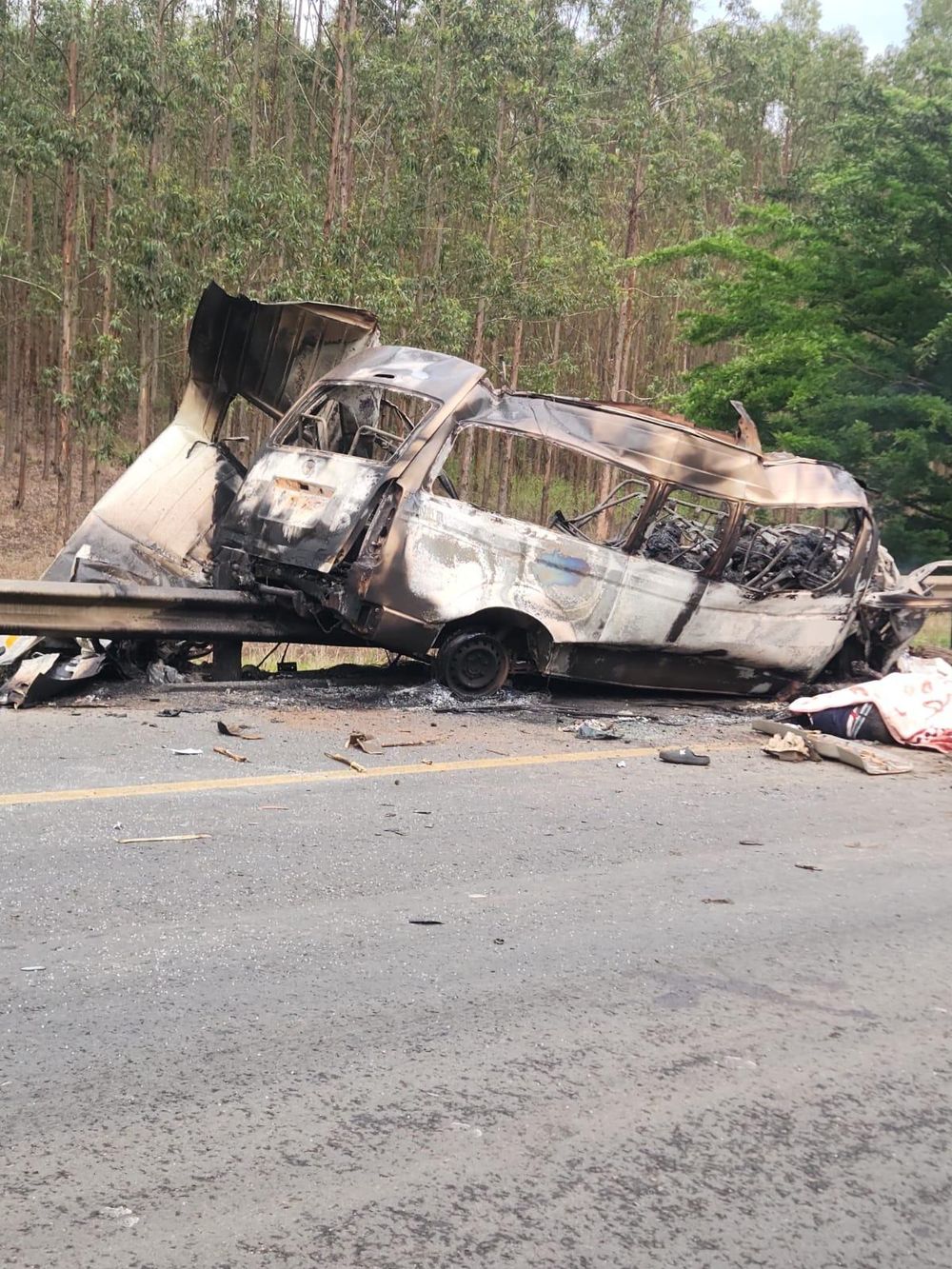
The wreckage after a minibus taxi and truck collided on the N2 near Mtubatuba, KwaZulu-Natal, killing 11 people.
Major crashes in September, which claimed at least 40 lives, have renewed calls for year-round road-safety enforcement, cleaner licensing systems, and more cautious driving in wet conditions.
In KwaZulu-Natal on September 27, 11 people were killed, and eight others were injured on the N2 during a head-on collision between a minibus taxi and a truck.
On September 14, 21 people died when two minibus taxis and a station wagon crashed on the N1 between Leeu-Gamka and Prince Albert in the Western Cape.
In another crash, eight people died on September 13 when two sedans crashed head-on on the N17 between Ermelo and Davel in Mpumalanga.
These crashes occurred days after the Road Safety Colloquium, where Transport Minister Barbara Creecy shared that the department and provinces recorded significant milestones over the past two years. Over 6% fewer annual crashes and fatalities were recorded in 2025 compared to 2024.
From January 1 to August 23, 2026, there were 6 457 road deaths (a 9% overall reduction compared to 2025); pedestrians account for 48% of all fatalities; over a third of fatalities occurred in Gauteng and KZN; and the Eastern Cape, KZN, Mpumalanga, and North West met/exceeded the 10% reduction target.
Arrive Alive’s Advocate Johan Jonck argued that while the Department of Transport data indicates better road crash statistics, road deaths do not wait for the festive season or Easter; they happen 24/7.
“Unfortunately, we only mention, or we read in the news about, the mass casualty ones, especially where minibus taxis and trucks are involved with multiple casualties. But in South Africa, there are about 40 people who die daily on our roads, and only the others get high media attention,” Jonck said.
He explained that road safety starts with rooting out corruption in the licensing process and vehicleworthiness testing.
“It will require a 24/7 approach, and it’s important that we cover all the areas we cover in enforcement. We cover vehicle roadworthiness, and we cover licensing,” Jonck said.
He highlighted that rain frequently causes issues because South African motorists fail to adapt their driving to wet conditions.
“I think there’s a lot of education still needed amongst our motorists and more attention to the fact that we need to drive defensively.
“If it’s wet and it’s rainy, then if you do not need to overtake, you don’t overtake because there’s aquaplaning; your car might struggle on the wet roads. It’s a much greater effort than just combating one or two big crashes.”
Drive More Safely founder Alida Venter said that fatalities and crashes were high when it was raining during last year’s festive season; similar conditions were now emerging.
“Now it’s raining, and the roads are wet. People take chances; they do not obey the rules of the road. They are impatient; they dangerously overtake,” Venter said.
“People just don’t adhere to the rules of the road; we need more visibility on the road. I think the department needs to invest in many more traffic officers. We don’t have enough. We have busy, busy roads.”
Venter also mentioned that when when trucks occupy lanes, people get impatient, they overtake dangerously, and then it is too late.
“The department needs to bring us on board, and let’s work together. We believe that education has got a big role to play within road safety in this country,” Venter added.